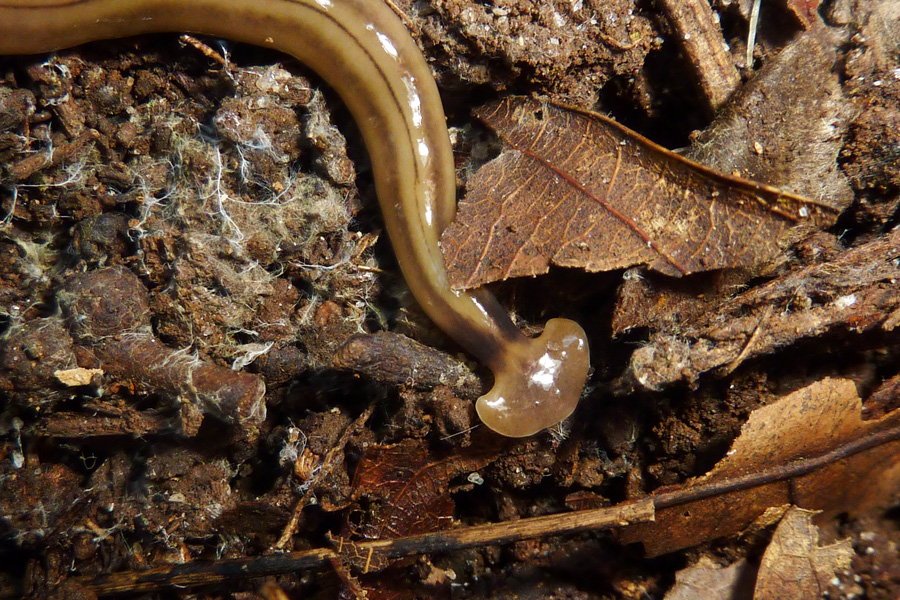


Insects and other arthropods are found in nearly every terrestrial and freshwater habitat on the planet. Insect abundance dwarfs all forms of visible life and makes up more than 75% of all known and named animal species. Worldwide, nearly 1 million insect species have been named, yet entomologists estimate the total number at 2.5–5 million. That means as many as 80% of the world’s insect species are undiscovered and yet to be named!
Because of their diversity, insects display many different lifestyles. Certain insects spend their early life inside the body of another insect, some grow up attached to a river rock, while others spend their entire life in the grass of a front yard. This diversity also means that some insects are known to consume or damage a wide variety of items that are important to people. It is not surprising that a few of those 1 million species can—and will—eat our food, clothing or the wood in our homes. Other insect species may be dangerous, especially those that bite, sting, transmit disease, or cause allergies. Many more insects are a nuisance simply because they appear in our living space. Insects then are considered pests for a variety of reasons, and placing them into that subjective category also may justify our attempts at their elimination.
Proactive Pest Management
The origin and extent of a pest infestation is often associated with one or more conditions that promote the survival and reproduction of that particular pest. Those conditions are often referred to as life support requirements, and include:
➤ Favorable temperatures, ➤ Abundant food and water, and ➤ Available shelter/harborage
When pest problems occur there is usually one or more of these requirements readily accessible to the pest population. Often the presence of one life support requirement will lead to an abundance of one or more of the other requirements.
The preferred living environment for most humans also provides the necessities many pests need to satisfy their life support requirements. Therefore, it is important that homeowners limit pest access to potential sources of food, water, and shelter in and around the home in an effort to keep our personal living space inhospitable to unwanted house pests. Proactive pest management is a process that begins with identifying the pest and using information on the biology of the offending creature to decide upon a plan of action. The action plan should involve interventions aimed at reducing pest population numbers or the chance for future encounters with that pest. Proactive pest management interventions will vary from one household or business to the next but there are a few overarching themes worthy of comment.
Food
General rules of cleanliness during food preparation, storage, and disposal is the logical starting point for helping to resolve and prevent certain pest problems. Denying pests access to food is an important component of making our living environment less hospitable to pests. Important practices (habits to establish) that may limit insect access to food include, but are not limited to:
- Keep food in tightly sealed containers;
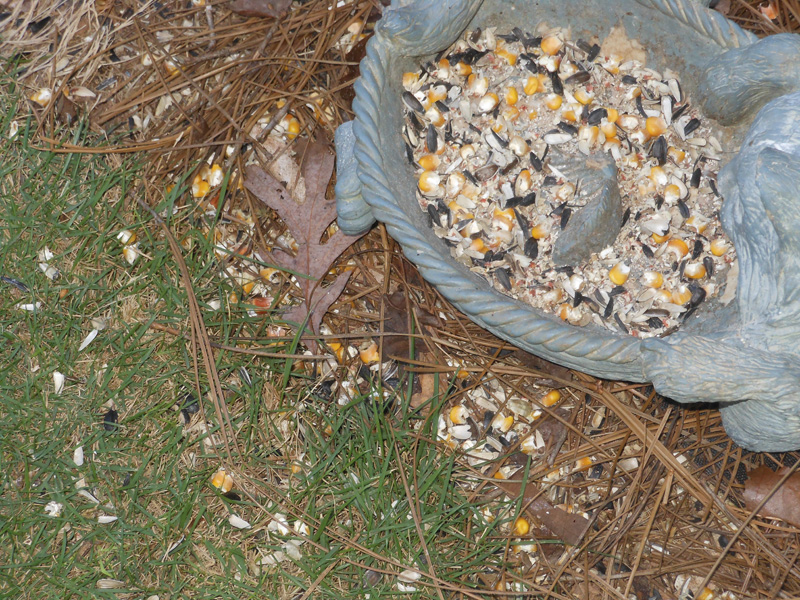
- Keep bird food in feeders, as rodents may use spilled food as a food source (Figure 1);
- Store birdseed in a tightly sealed container, preferably outside and away from doors; Rotate (use) boxed or packaged foods every 1–2 months;
- Clean up spills that occur during food preparation or handling;
- Do not keep soiled dishes in the sink or dishwasher overnight;
- Empty indoor garbage receptacles twice per week, at a minimum;
- Clean garbage disposals at least once a week;
- Keep outdoor garbage in a tightly sealed container and away from any dwelling entrance;
- Rinse recyclable containers prior to recycling;
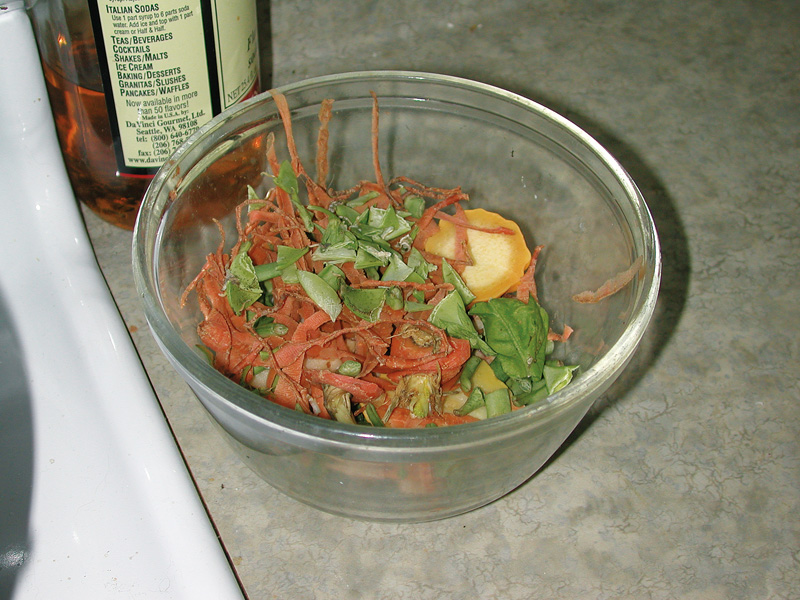
- Ensure that discarded plant waste is removed twice per week, at a minimum, especially during the summer (Figure 2).
Shelter
Shelter, also referred to as harborage, is simply a place where insects reside, rest, or hide. Specific locations become harborage because that site provides features that promote pest survival. Preferred pest harborage sites are usually protected from air movement (and its desiccating effects) and predators. They also include areas where food and water is abundant or easily accessible, and where temperatures are stable (no wide fluctuations) and optimum. When possible, pest-friendly harborages should be eliminated or pest access denied. It is unfortunate that our homes and landscaped yards provide many cracks and crevices that can be used by insect pests as harborage.
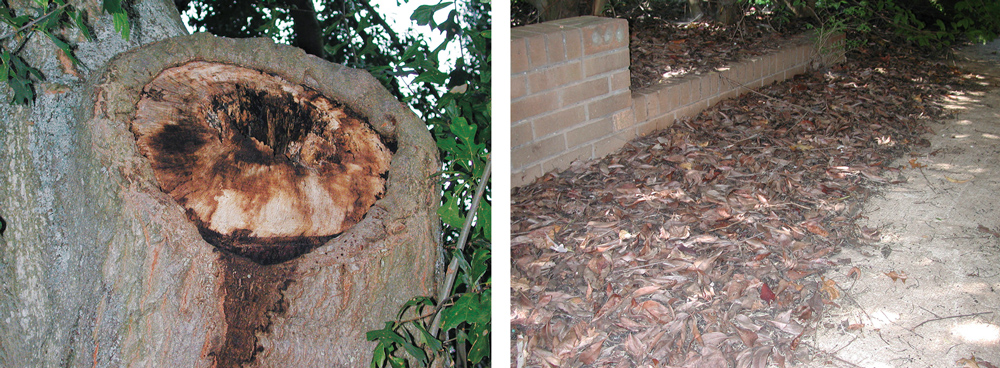
Outdoor harborages include treeholes, areas in and under fallen trees and limbs, leaf litter accumulations, and mulch and associated yard debris (Figure 3). In treeholes, cockroaches, ants, mosquitoes, and a number of other pests find a harborage characterized by moist air, darkness, and protection from the desiccating effects of wind and extreme fluctuations in temperature.
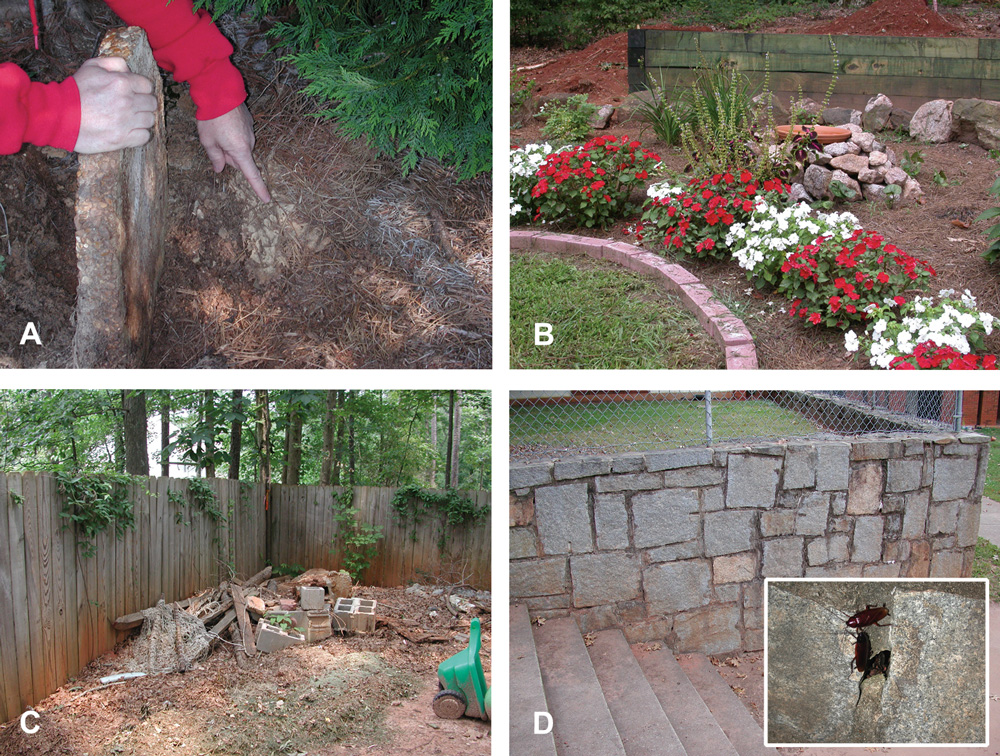
Man-made harborages include, for example, the areas underneath boards, patio stones, potted plants, garden statues, decorative rock piles, garden barriers, and other flat items lying on the ground. Keeping such garden decorations away from the foundation and exterior doors will reduce the potential for pests to harbor near the home and thus their chance of entering. Man-made harborages also include trash and garbage piles, firewood, the interior of hollow retaining walls, and the areas in and between crosstie or landscape timbers used around flower beds (Figure 4).
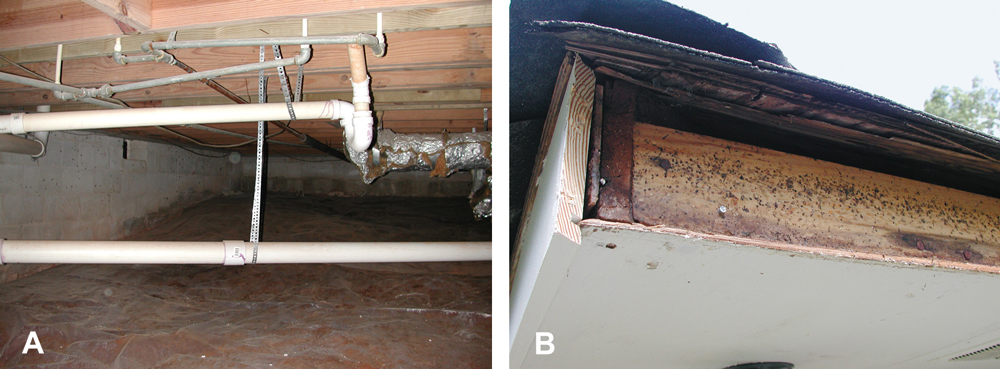
The structure itself can be viewed as a nearly endless series of man-made voids, behind cracks and crevices, that can serve as harborage for pests. Any crack or crevice in a structure that leads to a void will invite certain insect pests to harbor in that space, especially if food and water are available or the space enhances survival and growth. Common harborage sites within a structure include large areas such as crawlspaces (especially those without a vapor barrier and/or proper ventilation), attics (especially those with leaky roofs), and a wide variety of wall voids (the space defined by the interior and exterior siding on wall studs; Figure 5).
There also are numerous small voids, such as the space between the dishwasher and kitchen cabinets, the space behind baseboards, the area between built-in cabinets and the wall, inside appliances and furniture, or gaps on the exterior cladding (boards, siding, brick veneer weep holes).
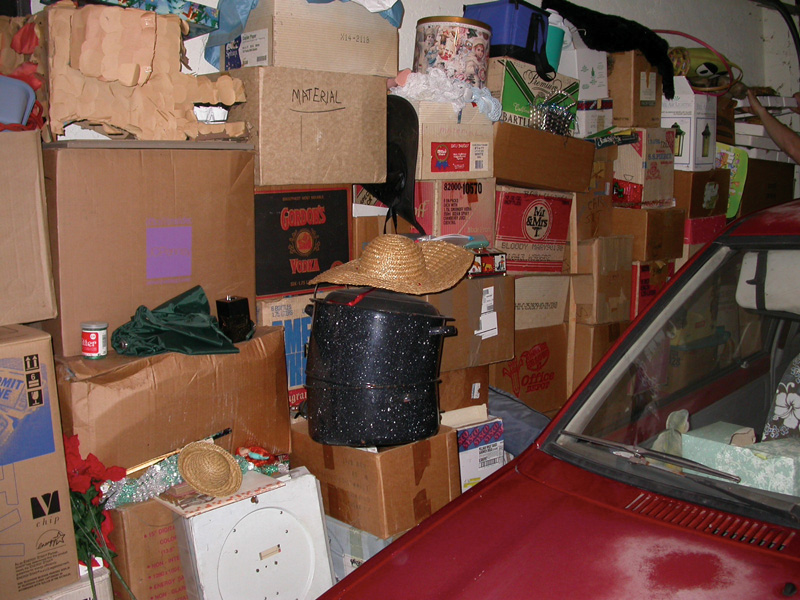
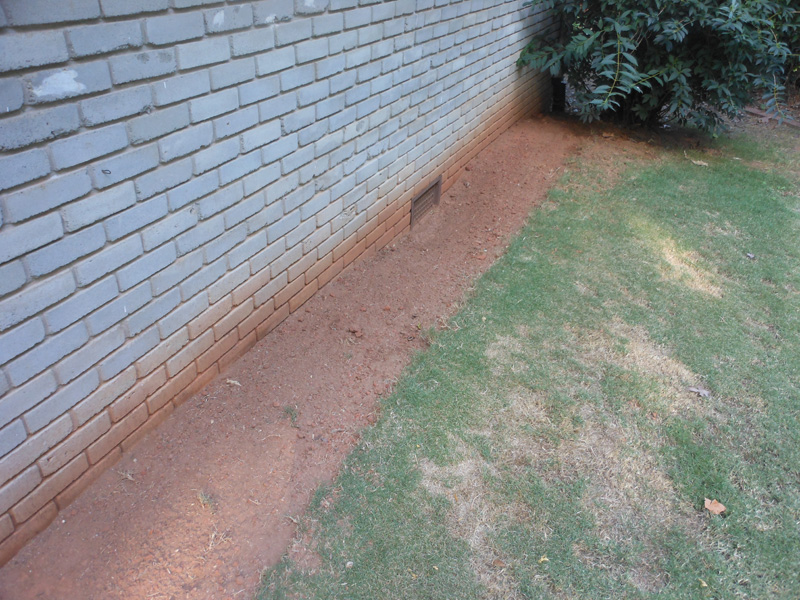
Structural harborages can be made unusable by sealing cracks, crevices, and other entryways. Inside homes clutter also provides harborage, and sometimes food, for pests. Clutter can be defined as persistent piles of clothing, books, paper bags, boxes, papers and newspapers, recyclables, etc. (Figure 6).
Exterior vegetation, combined with elements related to their maintenance (mulch and irrigation), can provide pests with harborage and should be kept away from the foundation and exterior doors. It is important to maintain an exterior landscape that has a minimum of potential pest harborage sites, especially those close to the structure (Figure 7).
Property owners should limit the use of groundcovers, shrubs, vines, and deep mulch beds near the foundation of their home. These landscape features retain moisture in the soil, and thereby expand potential pest harborage areas. Mulch creates conditions that certain pests need to thrive by providing food, water, and shelter. Excessive mulch provides decaying organic matter, fungi, and molds that are the food source for many small insects which then attract predatory pests such as ground beetles, spiders, and scorpions. Mulch near the home should be limited to a depth that maintains soil moisture required by the landscape plants. Groundcovers should be kept at least 1.5 ft from foundation walls. Abundant vegetation can also allow pests direct, protected access to a home, making it more likely for them to enter (because there will be more insects compared to homes without excessive vegetation, thereby increasing the chance for invasion).
Water
Excessive, persistent moisture is the most important condition allowing many types of pest infestations to establish and persist. Not only is water critical to the health and normal metabolism of all forms of life, but also its abundance leads to the growth of various molds, fungi, and other microorganisms which are the primary food source for numerous insect species.
Homeowners should limit the occurrence of persistent moisture in and around their home. Moisture problems can only be remedied by correcting the underlying cause(s). Some common sources of excessive, or persistent, moisture that may lead to a pest problem include but are not limited to:
- Leaking faucets or water lines;
- Condensation, for example on pipes, in walls, and under insulation;
- Improper ventilation of walls, attics, crawlspaces, or basements;
- Roof leaks, especially those that are the result of improperly installed flashing around pipe penetrations, sky lights, and chimneys (Figure 8A);
- Improper landscape grade resulting in poor surface water drainage patterns;
- Misdirected sprinkler heads;
- Gaps around windows (especially bay windows) and doors that allow water behind the structure’s exterior sheathing (Figure 8B);
- Clogged gutters and downspouts (Figure 8C);
- Downspout and air conditioner drain lines that deposit water within 5 ft of the structure (Figure 8D).
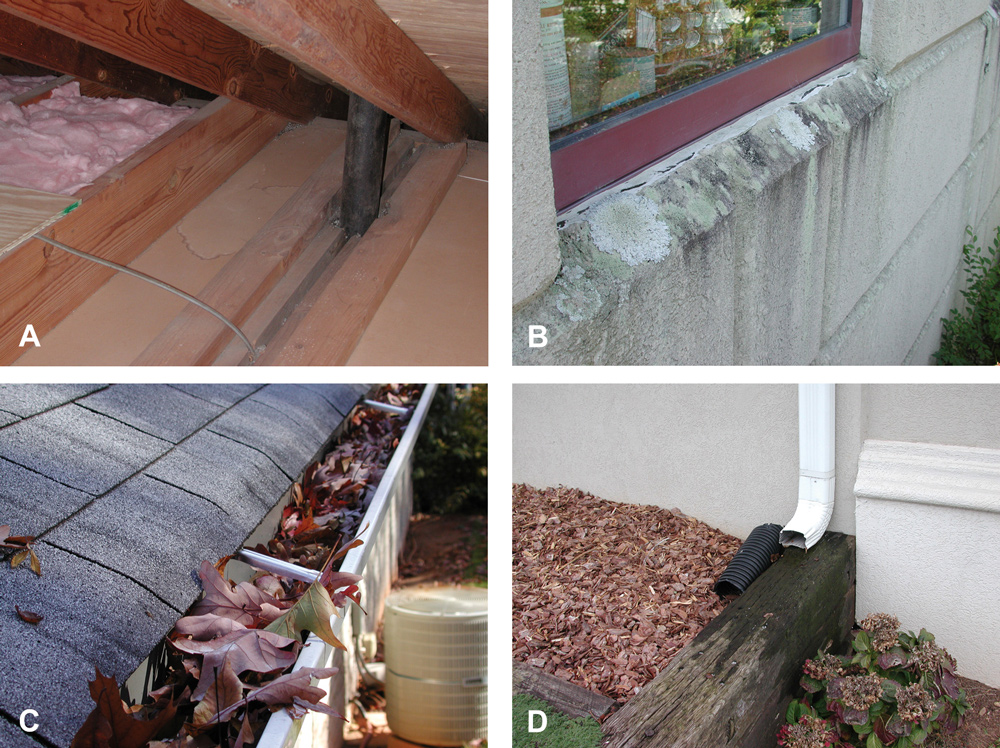
Property owners should ensure that rainwater flows away from their home by examining the grade or slope of the landscape to make certain it is appropriate; that gutters, downspouts, roof, and air conditioner condensate drainage patterns are operating properly and depositing water away from the foundation; that attics, crawlspaces, and basements are properly ventilated; that a vapor barrier is in place in the crawlspace; that sprinklers are positioned properly; and there is no standing water or persistent wet spots next to the foundation or in the crawlspace.
Other Practices
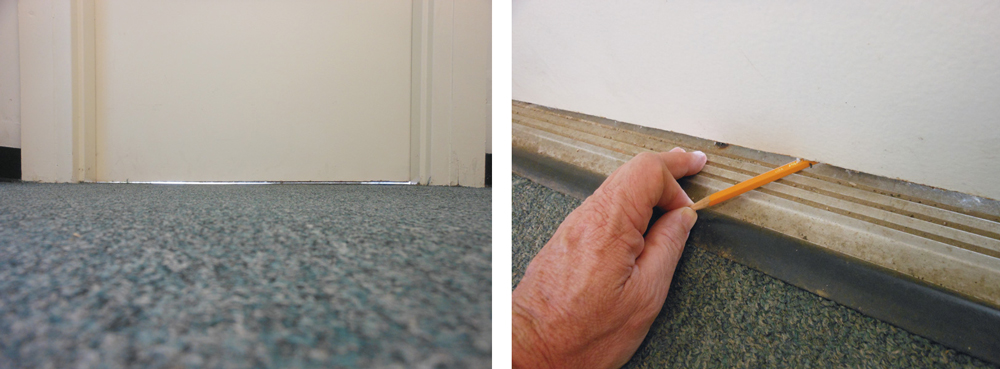
Homeowners can do other things to keep pests from entering the home, such as installing doorsweeps on all exterior doors, screens on all windows, ensuring that doors and windows are well-sealed when closed, and that all foundation and attic vents are adequately screened, sealed, and operating properly (Figure 9).
The type, position, and timing of lights on the outside of buildings can make a structure less attractive to insects. Altering exterior lighting patterns has the side benefit of reducing predatory invertebrates, such as spiders and ground beetles, that feed on light-attracted insects. Yellow, red, or sodium vapor lights are less attractive to insects but can provide sufficient illumination for people. Simply changing the light bulbs used for nighttime exterior illumination or reducing the time that lights remain on can be an effective alternative in managing certain insect pests. Positioning lights away from the structure but pointing towards it results in bathing the structure in light. This lighting arrangement serves to keep insects away from the immediate perimeter of the structure, including doors and windows, yet provides sufficient illumination.
Reactive Pest Management
Pest management action plans may involve an intervention calling for the judicious use of a pesticide. The use of pesticides requires the reading and following of label directions not only to ensure the safe and effective use of the product, but also the proper storage and disposal of such products. The pesticide label is a legally binding document that describes how to handle all aspects of product usage. For example, proper personal protective measures and appropriate equipment must be used during any application of a pesticide.
Application of pesticides should be customized to the target pest. Customized applications include selecting the most appropriate formulation and applying it to areas where the target pest is most likely to encounter it. The following sections are provided for those persons interested in understanding more about the selection and use of pesticide products to manage pests in and around the home.
Product Formulations
When pesticide use is included as part of a pest management action plan it is important to select the most appropriate formulation for the desired outcome. When considering chemical options for managing pests, selection of the appropriate formulation is as important as selection of the proper active ingredient. The following formulation types are commonly used by and accessible to homeowners in the over-the-counter market.
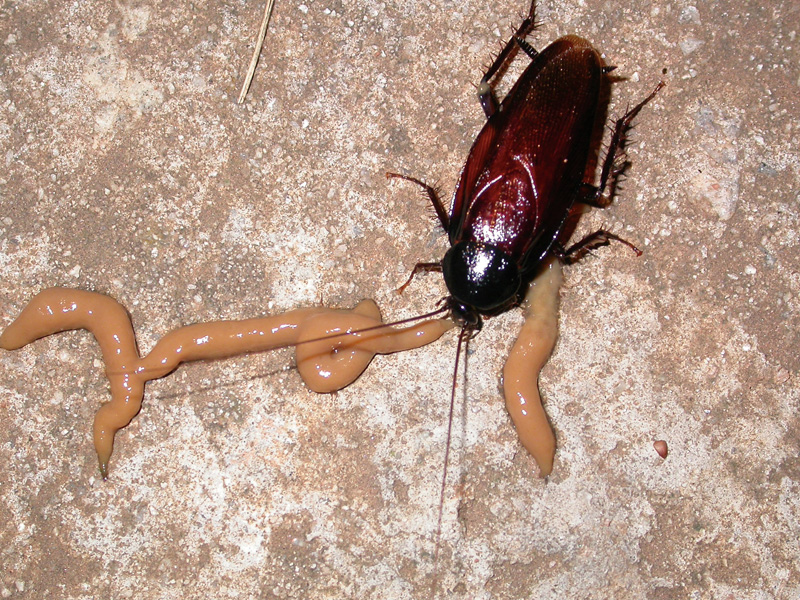
Baits are pesticide products that are effective only after being eaten by the pest (Figure 10). They are formulated with the active ingredient incorporated into a food source that is palatable and preferred by the target pest species. Baits are generally designed to be specific to only one or a few types of pests, are often sold in ready-to-use containers, and are to be placed, according to the label, in specific areas. Bait formulations are therefore considered more environmentally sensitive than other pesticide formulations. Over-the-counter bait products are generally limited to ant, cockroach, rat, and mouse control, and can typically be used both inside and outside the home. In the over-the-counter market baits may be available in the form of gels, pastes, liquids, pellets, granules, or blocks and are ready-to-use, according to label instructions, when purchased.
Granular formulations are comprised of small granules (irregular sized and up to 1/8 in. diameter) of inert material impregnated or coated with an active ingredient. Granular products are labeled only for application outdoors, and are used to control a wide variety of crawling pests by application to places where the pests live or travel—e.g., mulch, leaf litter, lawns, etc.
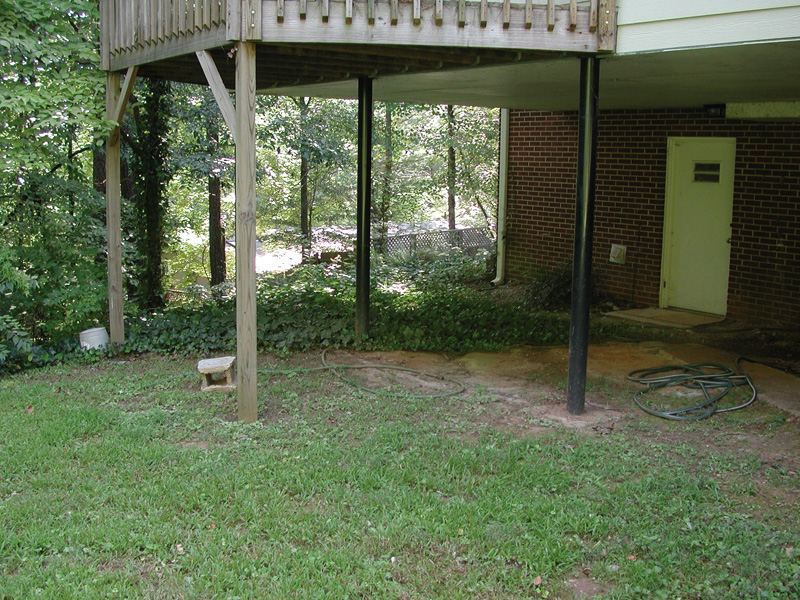
Granular products are most often packaged in large bags or small jugs with shaker-type tops. They are ready-to-use when purchased. It is important to note that pests do not eat products formulated as granulars. Granular formulations must be “activated” (i.e., the active ingredient released from the granule) before this type of contact insecticide can be effective. The active ingredient is typically activated by a follow-up application of water in the form of irrigation or rain. Because of this, granular formulations may be less effective when applied during periods of drought. Granular products exhibit one distinct advantage over other formulation types—their weight. The weight of the granule allows the chemical to reach deep into the substrate being treated. Granular insecticide formulations are usually applied to areas like turf, mulch, ground covers, high grass, thatch, etc. (Figure 11).
Aerosols, commonly known as bug spray, are a ready-to-use formulation packaged in a pressurized metal can. Aerosol formulations are comprised of an active ingredient(s) in a liquid solvent combined with a compressed gas propellant. The contents of aerosol cans are held under pressure. Some aerosol cans shoot their contents in a directed stream and are a good choice when there is a need to treat pests from a distance (e.g., paper wasps). Total-release aerosols, or bug bombs, involve an insecticide-solvent mixture that, under pressure, passes through a valve and is broken into very small droplets. The solvent evaporates quickly, leaving the lightweight droplets suspended and floating in the air. Caution should be observed when using aerosols to avoid breathing the insecticide. Although aerosols may be effective for short-term relief from pests by killing a few exposed insects, they should not be relied upon as the sole means of pest management in and around the home. Under field conditions total release aerosols have been shown to be ineffective at controlling both bed bugs and German cockroaches while leaving substantial pesticide residue on exposed surfaces.
Liquid sprays are available as both concentrates (products which must be mixed with water before use) and as ready-to-use products (products which are usable without further dilution and are often sold in 1 gallon jugs). Liquid formulations are comprised of an active ingredient that is suspended in water, and therefore applied using a handheld pump sprayer. Liquid formulations of insecticides are intended to act as contact insecticides so they should be applied directly to the pest or to areas where pests might congregate (harborage sites) or travel. Unfortunately, research has shown that liquid formulations applied outdoors provide, under most circumstances, only temporary relief (< 30 days) from invading pests.
The main human safety hazard with liquid spray insecticides is that they may be absorbed into the body through accidental contact with the eyes or skin. The personal protection equipment section of the pesticide label on any liquid formulation should be read and followed to reduce the risk of unnecessary exposure during mixing and/or application.
Liquid spray applications are rarely needed indoors, and are therefore discouraged, because a majority of the insect pests in the urban habitat live and breed outdoors. Liquid insecticide sprays perform best when applied to localized areas of the exterior landscape and exterior of homes. Localized treatments are chemical interventions using a liquid formulation applied, according to label instructions, to small areas where pests are found or suspected to be harboring, breeding, or entering a building. When conducting localized treatments, it is important to apply the liquid around and to those areas where pests might enter the structure. Examples would include areas around doors (especially the threshold) and windows, inside weep holes, around crawlspace vents, and around wall penetrations where gas, plumbing, and any wire or pipe enters the building.
More on Insecticides.
All insecticides must be properly stored and disposal of empty containers conducted according to instructions on the label. Additional information about insecticides, including definitions, formulations, information about how to interpret product labels and safety data sheets (including principles of toxicity), safety, and insecticide mode of action (i.e., how insecticides work) can be found in University of Georgia Extension Bulletin 1352, Insecticide Basics for the Pest Management Professional, and Circular 998, Pesticide Safety for the Homeowner, at https://extension.uga.edu/publications.html. Pesticide applicators must act responsibly to protect pollinators and aquatic environments from the deleterious impacts of insecticides.
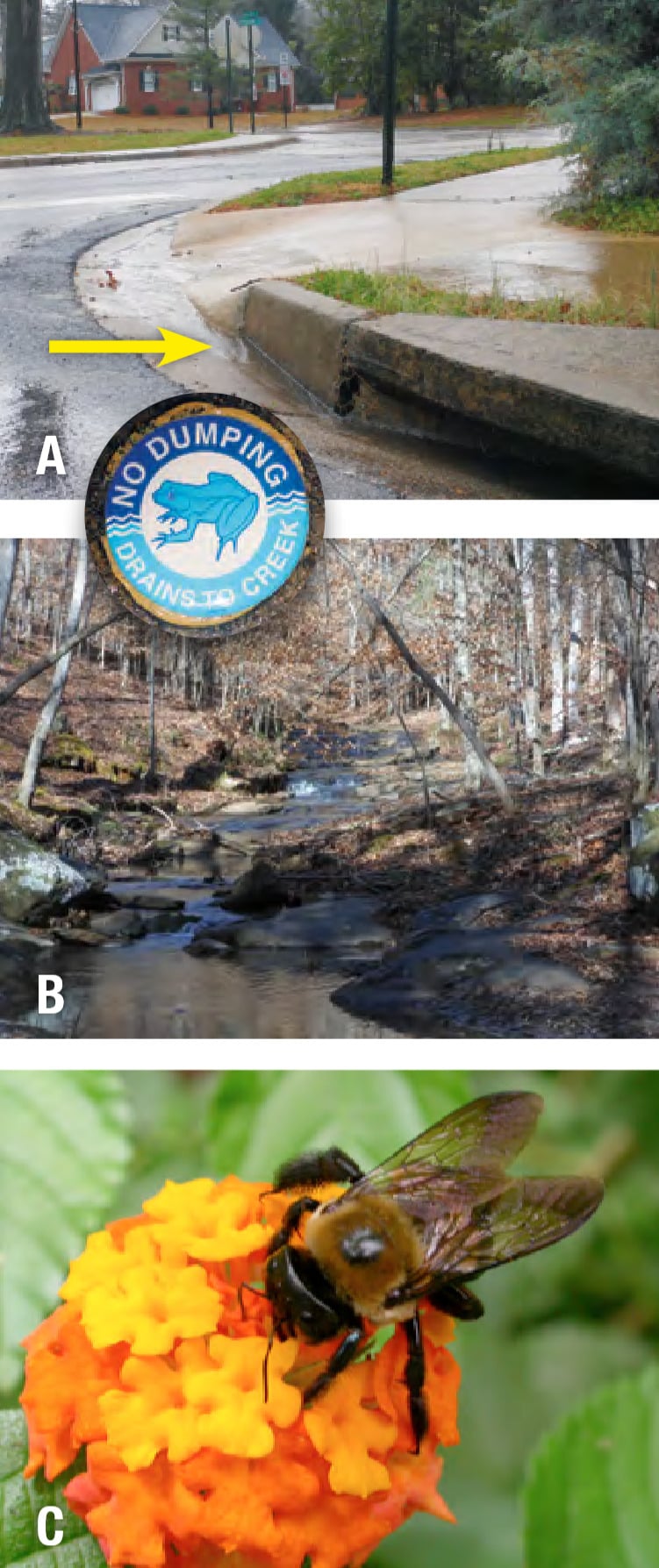
Insecticides purchased by homeowners in the over-the-counter market can be harmful to the environment and non-target organisms if overused or used in a manner not dictated by the product’s label. For instance, many insecticides are extremely toxic to fish, aquatic life, and pollinators. Insecticides are mostly broad-spectrum, so it is therefore imperative that homeowners be familiar with a product’s label—not only to assure that the product is being used in the most efficacious manner possible, but to assure that its use is safe, legal, and environmentally responsible. Most pesticide products used by homeowners must be registered with and granted a label by the United States Environmental Protection Agency. A product label is a legally binding document, as described by federal law (the Federal Insecticide, Fungicide, and Rodenticide Act – FIFRA), on how to safely use (or not use) that pesticide product.
Any person using a pesticide must comply with the directions for use on the product’s label. Never apply more product than allowed by the label instructions. Over-application or application in a manner not consistent with the manufacturer’s directions for use on the label can harm non-target organisms, the environment, or the person applying the product. Misuse, including overuse, is a violation of the product’s label, and thus the law.
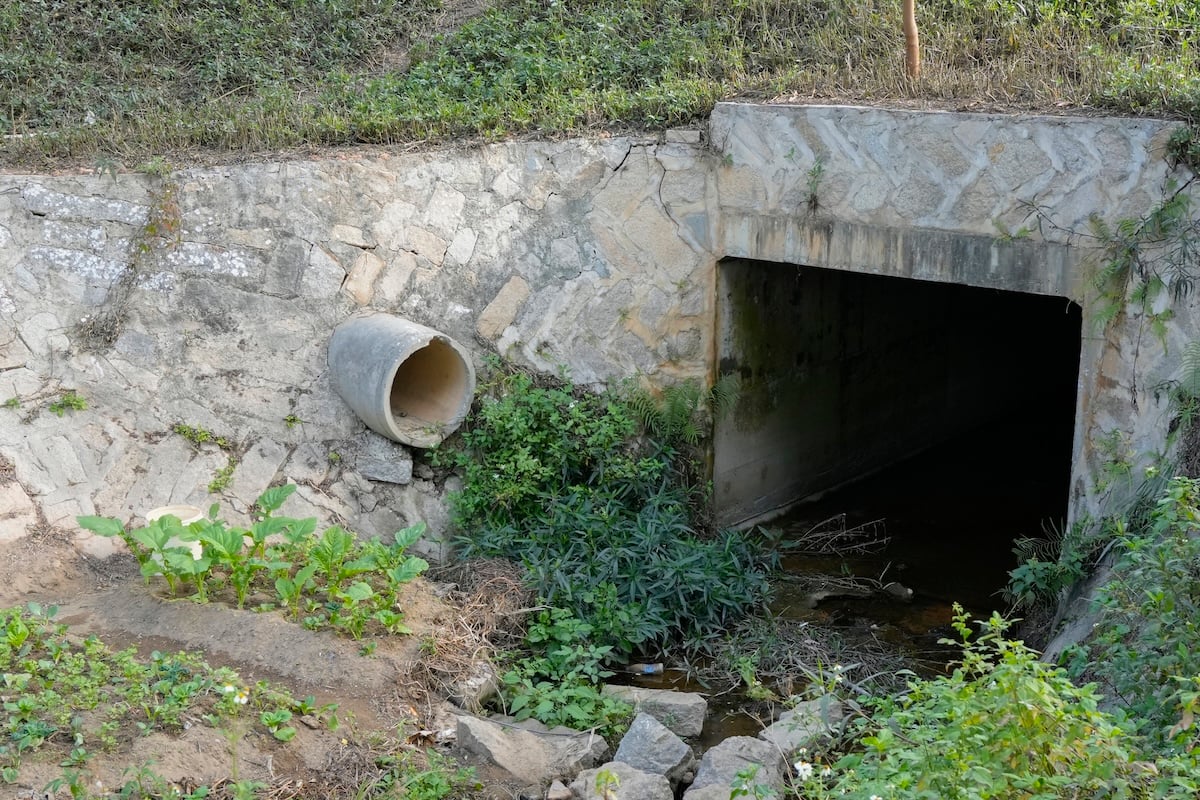
When conducting pesticide interventions outdoors, never apply a product, especially liquid spray and granular formulations, where water runoff might carry the pesticide into a body of water—creeks, streams, lakes, ponds, and rivers—and never spray flowers or flowering plants (Figure 12). Moreover, never apply a pesticide during rain or when rain is imminent. When applying granular formulations, always sweep granules from hard surfaces (e.g., patios, walkways, and driveways) onto grassy areas so they cannot be washed into waterways. Likewise, liquid spray formulations should not be applied to hard surfaces or areas where rain might wash the pesticide into storm drains.
Ultrasonic Pest Management Devices (UPMD).
All studies of UPMDs published in peer-reviewed scientific journals have demonstrated that these devices do not kill or repel insect pests. Studies with cockroaches, fleas, ticks, ants, and mosquitoes conducted by independent laboratories at major research universities have never provided evidence that product claims are accurate. No UPMD has ever worked when tested by rigorous, scientific evaluation.
Services for Termites & Bed Bugs.
Homeowners should not attempt to treat their home or premises for an existing termite or bed bug infestation. The tools and training needed to conduct a proper inspection, as well as access to the products and equipment required to rid a home of termites or bed bugs, are uniquely available to certified, registered pest management professionals. The most important challenge when attempting to rid a premise of termites or bed bugs is locating and properly intervening, with pesticidal and non-pesticidal interventions as appropriate, the area(s) where these insects are found and in following up after the intervention(s). These goals can best be accomplished by a professional. To learn more about subterranean termites see University of Georgia Extension Bulletin 1241, Termite Control Services: Information for the Georgia Property Owner and Bulletin 1209, Biology of Subterranean Termites in the Eastern United States, at https://extension.uga.edu/publications.html. For additional information on bed bugs, visit epa.gov/bedbugs.
Hiring a Professional Pest Management Company
Although some pest problems can be remedied by the homeowner, it is advisable to hire a pest management professional when structural pests or other persistent pest problems arise. Homeowners can be assured that pest management professionals are skilled in the art of solving pest problems, and that they are licensed by their state regulatory agency for the safe use, storage, and disposal of pesticides.
When a professional is needed, it is important to select a company committed to customer service, especially if the homeowner is considering entering a long-term service agreement. Some tips on hiring a pest management company include:
- Ask friends, neighbors, and coworkers about their experiences and interactions with pest management professionals. Selecting a professional pest management company is not unlike selecting other service providers, such as electricians and plumbers. Consistently good recommendations are still one of the most reliable means of selecting a quality service provider.
- Avoid going to the Internet and selecting a company based solely on an advertisement or website. Furthermore, do not hire a company based on treatment price alone. A variety of factors should be considered when making a decision on which company to hire.
- Contact the appropriate regulatory agency to ensure that prospective companies are licensed. In Georgia, the Department of Agriculture (agr.georgia.gov) is the agency that regulates the pest control industry.
- Ask prospective companies to describe their commitment to the continuing education of their employees. Although all technicians in Georgia are required to attend state-approved continuing education seminars, some companies provide in-house training or send their employees to university- or state-sponsored training programs and workshops that are above and beyond that required by the state.
- Ask prospective companies whether they are a member of their state and/or national pest control organization(s). Membership in these organizations suggests that the firm is well-established and that the owners are active in their profession. Membership also suggests that owners and managers attend national and state conferences where insight into key issues facing the pest control industry are highlighted and discussed, and the most recent findings on pest control research and application technology are presented.
- Ask prospective companies whether they have on-staff technical personnel, such as an entomologist, who can assist with pest identification, pest control recommendations, client education, and evaluation of the quality and effectiveness of delivered services.
Identification, Habits, and Recommendations for Interventions for Specific Pests in the Urban & Suburban Environment
The following section includes images and notes pertaining to the identification and management of many of the most common insect pests likely to be encountered by homeowners in the urban and suburban residential environment. This section is intended to be used in conjunction with University of Georgia Extension Special Bulletin #48, Georgia Pest Management Handbook: Homeowner Edition, Household Pests Chapter, which can be found at https://extension.uga.edu/publications.html. In combination with the proactive pest management strategies discussed previously, the Handbook is a list of specific over-the-counter products recommended for control of the various pests found in the following pages.
For additional help, contact a local county Cooperative Extension agent by calling 1-800-ASK-UGA1 or visit the University of Georgia’s Cooperative Extension website at extension.uga.edu.
The pests listed below are found in the urban and suburban residential environment and are arranged according to the type of insect they represent; as an example, all beetles, or the order Coleoptera, are treated together; all ants, bees, and wasps, or the order Hymenoptera, are grouped together, etc. Ordinal, family, and species-level names are provided for the majority of these common home pests. All family-level names end with -idae. Scientific names (genus and species) of individual pests are italicized.
Crickets (Order Orthoptera)
Field crickets (Gryllidae: Gryllus spp.):
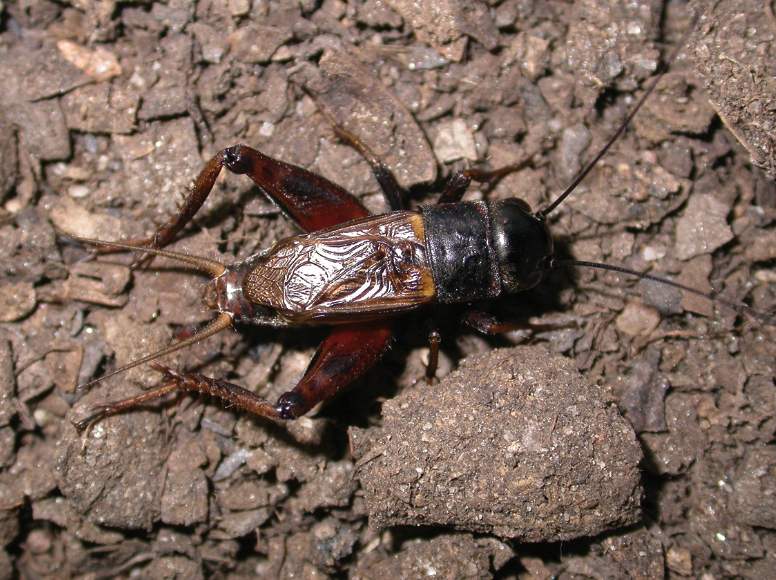
Body is dark brown with enlarged hind legs for jumping; about 3/4 in. long.
Habits: Found outdoors in wood piles and under flat items, such as boards, lying on the ground. Adult populations peak in late summer.
Interventions: Follow suggestions under section titled Proactive Pest Management. It is especially important to eliminate harborage and install doorsweeps. Spread granular bait in areas where crickets are found. If desired, apply an appropriately labeled residual spray directly to crickets (spray only outdoors).
Might be confused with: various cockroach species, camel crickets.
Camel crickets (Rhaphidophoridae):
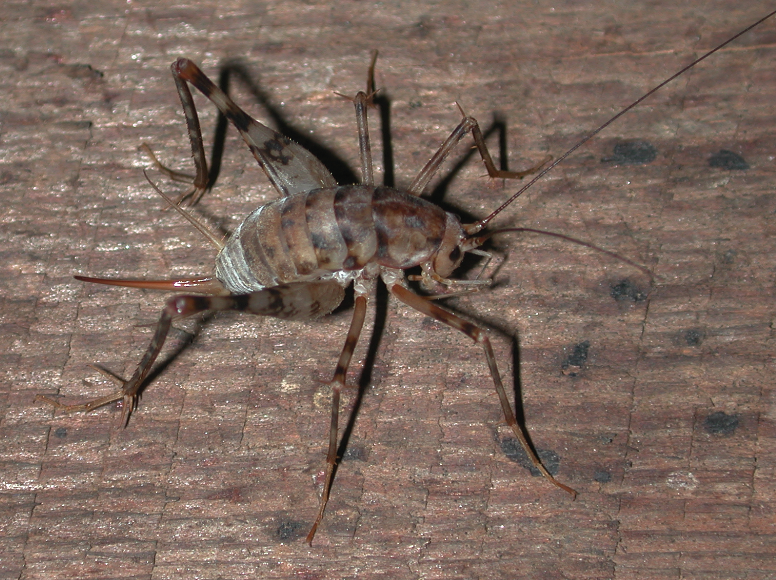
Up to 1.5 in., mottled gray/brown, hump-backed crickets with large hind legs that enable them to jump high and far. Camel crickets have long, slender antennae.
Habits: Camel crickets are common inhabitants of crawlspaces, wall voids, basements, sheds, and other areas where humidity is high. They are commonly found living in the same areas as smokybrown cockroaches and cellar spiders.
Interventions: Properly ventilate, dehumidify, or otherwise dry those areas where camel crickets are found. Spread granular bait or apply gel bait in areas where camel crickets are found. If desired, apply a localized treatment with an appropriately labeled residual spray to those areas where camel crickets are found.
Might be confused with: various cockroach species, field crickets.
Cockroaches and Termites (Order Blattodea)
The order Blattodea contains the cockroaches and termites. Formerly classified in a separate order (Isoptera), the termites are now shown to share a close relationship with cockroaches, based on genetic and molecular evidence.
Cockroaches
Cockroaches are large, night-active, fast-moving insects with a broad, flattened body, long antennae, and a relatively small head. The front pair of wings (called tegmina) are tough, protective, and lay on top of the membranous hind wings. Most cockroaches are poor fliers. Excluding the wood cockroaches, none of the cockroach species listed below is indigenous to the United States, but all are well established.
American cockroach (Blattidae: Periplaneta americana):
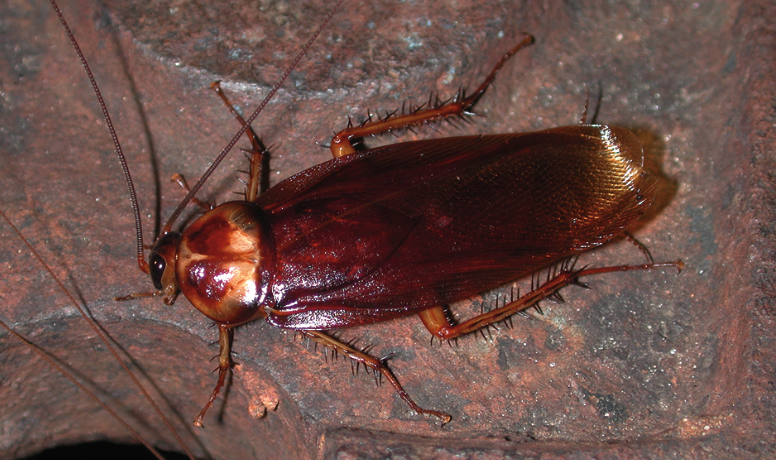
Adults are large (2 in.) with pale outer margins on the pronotum (upper thorax). Chestnut to light brown-colored insects that run quickly. Males and females are visually indistinguishable, although females are a little wider posteriorly than males.
Habits: Mainly found in sewers and other dark, damp hideaways such as basements. Rarely, if ever, found in attics. Night active. Sometimes found cohabiting outdoor harborage sites with smokybrown and/or Oriental cockroaches.
Interventions: Apply gel baits (multiple small dabs no larger than a pea) or broadcast granular baits in areas where cockroaches are found. Bait stations can be used to control small nymphs, but adults and large nymphs may be too big to fit into the small openings in most bait stations.
Might be confused with: smokybrown cockroaches, Oriental cockroaches.
Smokybrown cockroach (Blattidae: Periplaneta fuliginosa):
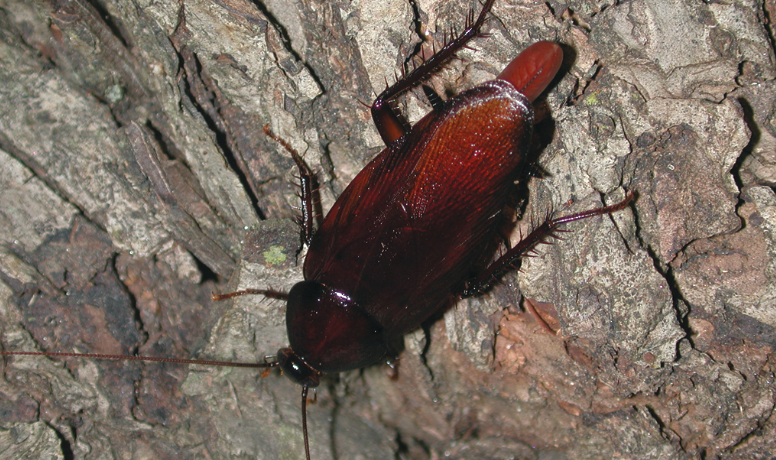
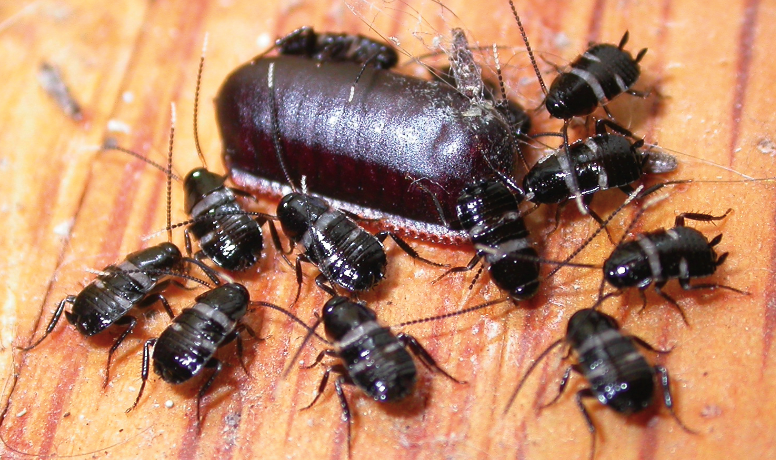
Adults are large (1.5 in.) and uniformly dark cherry to dark red colored. Males and females are visually indistinguishable, although females are a little wider posteriorly than males. First instar nymphs are approximately 1/8 to 3/16 in., and identified by the white band across their backs, just behind the thorax, and a white band on the tips of the antennae.
Habits: Most common cockroach in suburban, Southern neighborhoods with mature hardwood trees present, where they commonly live in treeholes, attics, crawlspaces, sheds, and similar harborages with high humidity where they are protected from the desiccating effects of air currents. Night active. Sometimes found cohabiting outdoor harborage sites with American and/or Oriental cockroaches. Rarely, if ever, found in sewers. First instars are not very mobile; their presence suggests nearby egg case hatch.
Interventions: Apply gel baits (multiple small dabs no larger than a pea) or broadcast granular baits in areas where cockroaches are found. Bait stations can be used to control small nymphs, but adults and large nymphs may be too big to fit into the small openings in most bait stations.
Might be confused with: American cockroach, Oriental cockroach.
Oriental cockroach (Blattidae: Blatta orientalis):

Adults are large (1 to 1.25 in.) and cherry to black colored. Males have short wings that do not completely cover the abdomen; females are wingless (wingpads only).
Habits: Sometimes found cohabiting outdoor harborage sites with smokybrown and/or American cockroaches. Night active. Rarely found around homes in suburban environments. Biology and habits are more similar to the American cockroach than the smokybrown cockroach.
Interventions: Apply gel baits (multiple small dabs no larger than a pea) or broadcast granular baits in areas where cockroaches are found. Bait stations can be used to control small nymphs, but adults and large nymphs may be too big to fit into the small openings in most bait stations.
Might be confused with: smokybrown cockroaches, American cockroaches.
Wood cockroaches (Ectobiidae: Parcoblatta spp.):
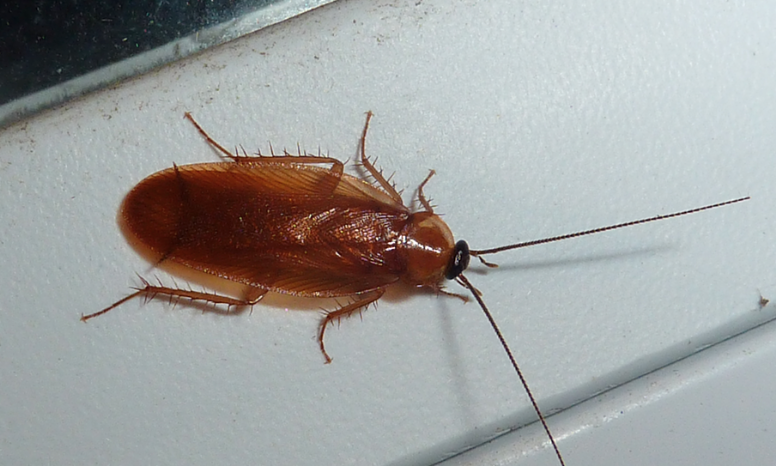
There are eight species of wood cockroaches in the Southeastern United States, including Georgia. All are native species. One of the more common species is the Pennsylvania wood cockroach, Parcoblatta pennsylvanica. Pennsylvania wood cockroach males and females look nothing alike. Males have wings that cover their abdomen, they fly well, are light brown to tan colored, and are ⅞ to 1⅛ in. long; females are chestnut brown, have wings that cover only about ⅔ of their abdomen, cannot fly, and are ½ to ¾ in. long.
Habits: Wood cockroaches are native to forest environments in the Eastern United States, where they live mainly under the bark of fallen, dead trees and in wood piles. They are not indoor pests. During the summer males may be attracted to outdoor lights, and sometimes accidentally come indoors where their presence causes concern. In the winter, both sexes and immatures can be brought inside on firewood.
Interventions: None needed, as these cockroaches will not establish infestations indoors.
Might be confused with: smokybrown cockroach, American cockroach, palebordered field cockroach, Asian cockroach.
Palebordered Field cockroach (Ectobiidae: Pseudomops septentrionalis):
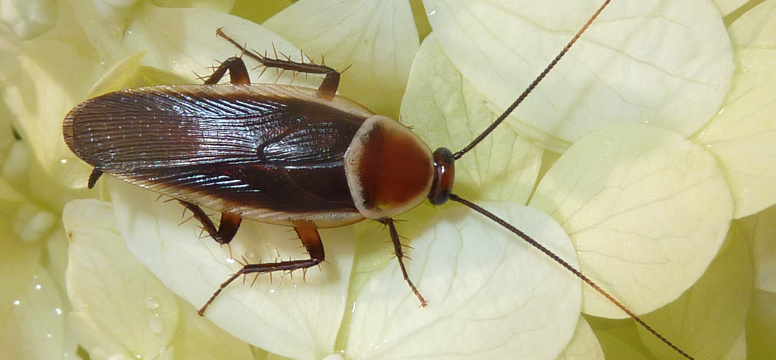
The palebordered field cockroach is ½ to ⅝ in. and strikingly attractive. Their wings are blackish blue and outlined with a thin, white border that disappears posteriorly along the wing’s borders. The head and pronotum are bright red/orange, and the pronotum is outlined by a thin, white border. Legs are black, and the long, fibrous antennae are black and white.
Habits: The palebordered field cockroach is native to Central America and Mexico. It has been found in Texas for decades and has slowly spread throughout the Southeastern United States, including Georgia. This cockroach is found outdoors in gardens, lawns, parks, and home landscapes where they, like all cockroaches, are general scavengers and feed on a wide variety food.
Interventions: None needed. This cockroach lives only outdoors and is not capable of living indoors or establishing infestations indoors like other cockroach species. If found indoors, it came in by mistake or was brought inside inadvertently.
Might be confused with: Asian cockroaches, Parcoblatta species woods cockroaches.
Asian cockroach (Ectobiidae: Blattella asahinai):

Adults of both sexes are about ½ to ⅝ in., tan colored with dual, parallel stripes on back of pronotum (upper thorax). Males and females are visually indistinguishable.
Habits: First found in Tampa, Fl in 1987; native to Southeast Asia. Attracted to light, readily flies (rare for a cockroach), and found in shaded areas outdoors with leaf litter, mulch and/or high grass present. Rarely found indoors, unless attracted there by light. Flies during the day in response to disturbance (e.g., walking through their habitat).
Interventions: Alter lighting to make structure less attractive at night (see section on Proactive Pest Management). Broadcast granular bait in areas where cockroaches are found. If desired, apply an appropriately labeled residual spray to those areas where cockroaches are found. Might be confused with: German cockroaches, wood cockroach.
Might be confused with: German cockroaches, wood cockroach.
German cockroach (Ectobiidae: Blattella germanica):
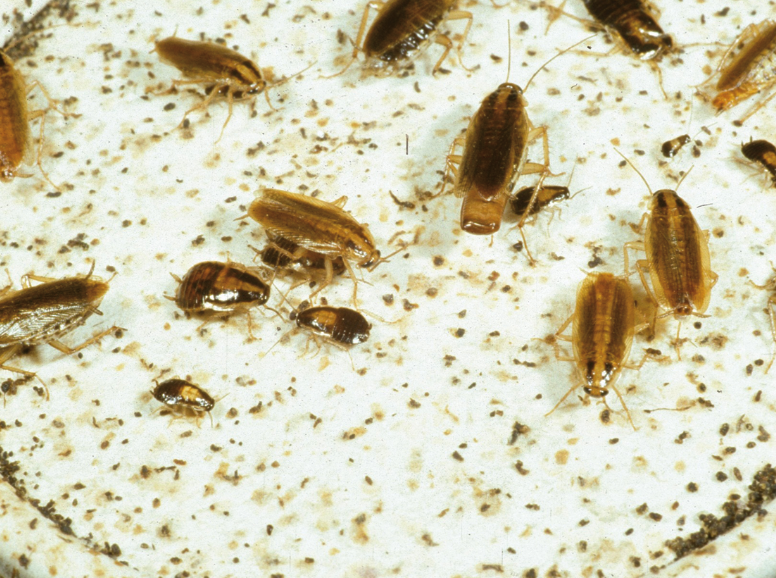
Adults of both sexes are about 1/2 to 5/8 in., tan colored with dual, parallel stripes on back of pronotum (upper thorax). Males and females are visually indistinguishable.
Habits: Obligate indoor pest, rarely found outdoors except in cases of extreme indoor infestations. Found mainly in kitchens near and in warm appliances and sources of water. Night active. Under extreme levels of infestation this cockroach may be responsible for allergies, especially in children.
Interventions: Use pheremone-based sticky traps to highlight areas of activity. Use gel baits and bait stations in areas (mainly in kitchen under the sink, next to the garbage, under/next to the refrigerator and stove, and in infested drawers) where German cockroaches are found. In moderate to heavy infestations, as many as 12–15 bait stations may be needed in a standard-sized home. Place bait stations on flat surfaces in corners and along edges of walls. When using gel baits, the application of many small bait ‘spots’ is preferred to the application of a few large bait spots (it does not take much bait to affect a large number of German cockroaches). If desired, in cases of extreme infestation apply a localized treatment with an appropriately labeled residual spray inside cracks and crevices where cockroaches are found. Total release aerosols (bug bombs) are ineffective at controlling German cockroaches, and should not be used indoors.
Might be confused with: Asian cockroaches.
Termites
Termites are widely recognized as highly modified, social cockroaches and are currently classified as part of the Blattodea. They live in colonies that, at maturity, number from several hundred to several million individuals. A colony contains nymphs, workers, soldiers, and reproductive individuals of both sexes. The commonly encountered species are economically significant pests that can cause serious structural damage to buildings.
Subterranean termites (Rhinotermitidae: Reticulitermes spp.):
Winged reproductives, called swarmers, are most often seen in spring, but can be observed at any time of year. All four wings are the same size. Swarmer body color is black to caramel colored and 1/8 to 3/16 in..

Photo by B. Forschler,
UGA Entomology
Habits: Subterranean termites live in the soil, and forage into structures to gain access to wood. They excavate galleries in wood as they consume it, sometimes leaving only a thin wooden exterior. Termite workers, but not swarmers, eat wood. Swarmers are the most common sign of termite infestation when they swarm from any part of a structure or home. Outdoor swarms from fence posts, stumps, etc. are signs of an active colony in the area or yard but not necessarily a sign of structural infestation.
Interventions: A good preventative strategy is to have the home inspected annually for termites. If an infestation is present, seek help from a professional termite control company. Homeowners should not attempt to treat a structure for termites. The products and equipment used by professionals are not available to the novice. For more information see University of Georgia Extension Bulletins 1241, Termite Control Services: Information for the Georgia Property Owner, and 1209, Biology of Subterranean Termites in the Eastern United States, at https://extension.uga.edu/publications.html.
Might be confused with: drywood termites, earwigs.
Formosan Subterranean termite (Rhinotermitidae: Coptotermes formosanus):

Formosan termites are invasive in the United States. They are native to China. Swarmers are large (about ½ in., wings included), with a caramel-colored body, and wings with very small hairs visible only under magnification. No other termite in Georgia has these hairs. Swarmers of Georgia’s most common subterranean termite, the eastern subterranean termite, Reticulitermes flavipes, are black and about ⅔ the size of Formosan termite swarmers. Formosan termite soldiers have a tear-drop shaped, almost round, head capsule, while the head capsule of the eastern subterranean termite is box-like and with straight, parallel sides. When challenged, Formosan termite soldiers produce a white, glue-like defensive substance from a gland in their head. Eastern subterranean termites lack this ability. Soldiers comprise about 15% of the total termite population in a Formosan termite colony, while in the eastern subterranean termite the number of soldiers is less than 5% of total colony size.
Habits: Formosan termites swarm in mid-May to early June, at dusk (8:00 to 9:00 PM), and are attracted to lights. Native subterranean termite species have a longer swarm season but typically begin swarming in January and are mostly finished by early June; most notably, they swarm in the morning or early afternoon and are not attracted to lights.
Interventions: First obtain a positive identification by a qualified individual. See also Circular #868, Identifying the Formosan Suberranean Termite at https://extension.uga.edu/publications.html. Control of Formosan termites should be conducted by a professional. Because Formosan termites are subterranean the principles of their control are the same as other subterranean termites in Georgia – i.e., annual inspections by a professional; water management to maintain a dry environment; elimination of wood-to-ground contacts; use of liquid termiticides (especially those containing fipronil); and installation of a bait treatment containing a chitin synthesis inhibitor.
Might be confused with: other termites, winged ants.
Drywood termites (Kalotermitidae: Incisitermes spp., Cryptotermes brevis):

Adult termites are rarely seen. Other than a swarm, the most common outward sign of infestation is the continued appearance of uniform sized fecal pellets (frass) which are usually found on a flat surface directly underneath infested wood. All pellets same size (grain of sand) and color of infested wood. When cleaned up, pellets return because termites continue to discharge them from infested wood.
Habits: Unlike subterranean termites, drywood termites do not need contact with soil or any form of liquid moisture as they get all their moisture from wood and metabolic water. Colonies of drywood termites are small in number. In Georgia, they are most commonly found in furniture, picture frames, etc. in the central and northern parts of the state, but native species can be structural pests in south and southeast Georgia. They can also be found in wood items that had originated in Gulf Coast states or California—all states where drywood termites are native and common.

Interventions: Homeowners should not attempt to treat for drywood termites for the same reasons mentioned under subterranean termite interventions. There are several options to discuss with a professional. For example, if the structure is infested, structural fumigation should be considered. An alternative would be localized treatment of active galleries, preferably with a dust or foam formulation. A structural infestation might also be remedied by wood removal and replacement, if possible, following thorough inspection. Infested furniture can be removed from the home, fumigated, and returned.
Might be confused with: subterranean termites.
True Bugs (Order Hemiptera)
A group of insects known as the true bugs, the Hemiptera (suborder Heteroptera), include such common insects as bed bugs, stink bugs, and those discussed below. They all possess piercing-sucking mouthparts, and most species have forewings with both membranous and hardened portions (called hemelytra). True bugs include plant feeders, predators, and blood feeders.
Wheel bugs (Reduviidae: Arilus cristatus):
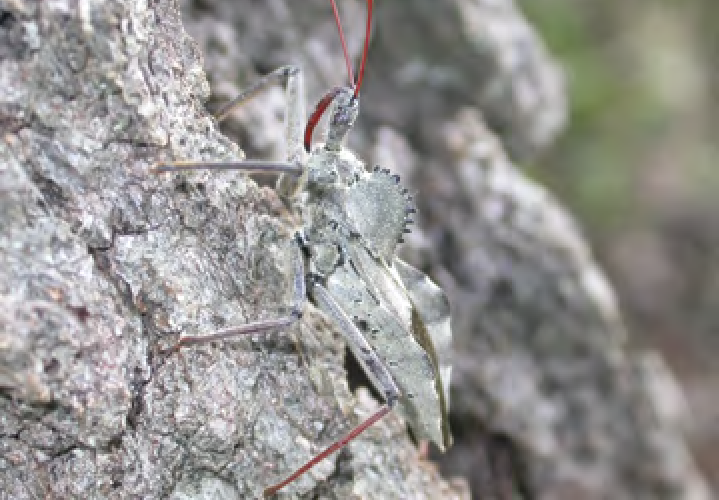
Large, 1 to 1.25 in. silver insects with a distinct wheel-shaped pronotum (upper thorax).
Habits: Wheel bugs are predatory and eat other insects. They have piercing-sucking mouthparts, and may bite if handled.
Interventions: Usually, wheel bugs are not so plentiful that they require insecticide treatment. If present, and control is warranted, try crushing or directly spraying individual bugs with an aerosol insecticide labeled for general insect pests. Widespread insecticide treatments are not needed. For more information see University of Georgia Extension Circular 782, Stinging and Biting Pests, at https://extension.uga.edu/publications.html.
Might Be Confused With: beetles, stink bugs, kissing bugs.
Boxelder bugs (Rhopalidae: Boisea trivittata):
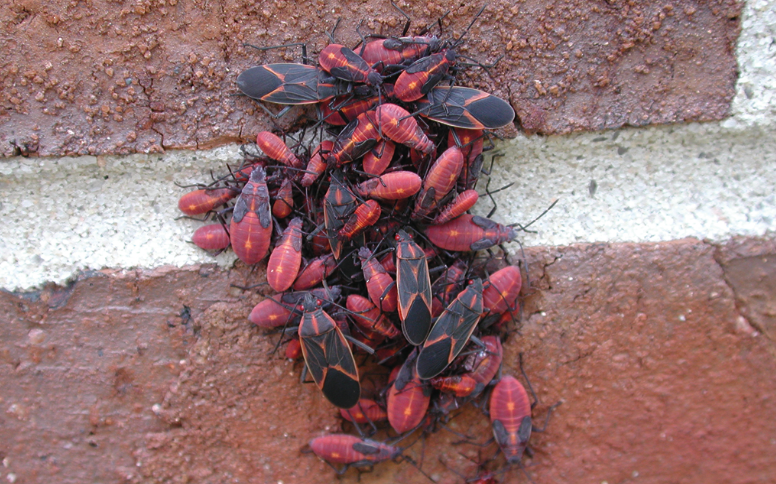
Adults are 1/2 to 5/8 in., with red eyes, and are black with orange to red stripes. Immatures are wingless, black and orange/red.
Habits: Boxelder bugs are a nuisance pest in the fall. In addition to finding individuals, in some cases bugs are found in mixed aggregations of adults and nymphs as they prepare to overwinter. Feeds on leaves and seeds of boxelder and silver maple trees.
Interventions: Because boxelder bugs are harmless, follow suggestions (summer) under section titled Proactive Pest Management. It’s important to ensure window and door screens are intact and that doorsweeps are installed properly. If insect problems are such a nuisance that they require treatment, treat bugs directly with an appropriately labeled residual spray (spray only outdoors). If bugs get inside the best solution is to vacuum them. If bugs die inside walls or in attics their carcasses can accumulate and attract other insects that eat them, especially carpet beetles.
Might Be Confused With: milkweed bugs (Lygaeidae), golden raintree bugs, stink bugs.
Kudzu bugs (Plataspidae: Megacopta cribraria):
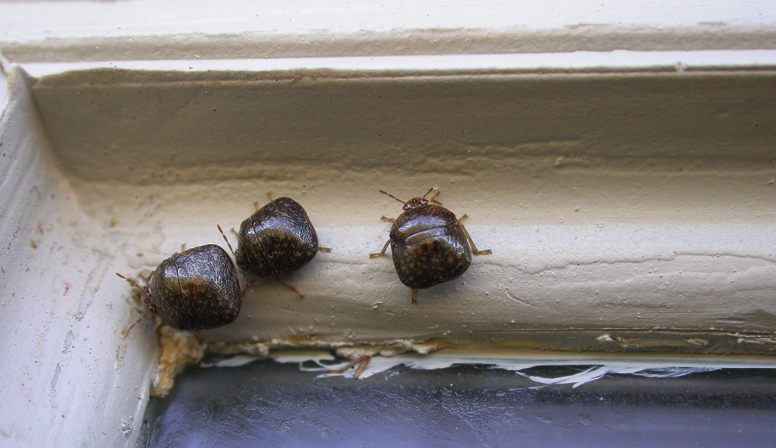
Wider posterior than anterior, about 3/16 to 1/4 in.. Red eyes, green to brown body with stipples present on wing covers. Distinct odor.
Habits: Bugs fly to light-colored surfaces (buildings and automobiles) from nearby kudzu patches in October/November as they look for overwintering sites. Active again in spring (February to April) as they awake from winter slumber. Native to Asia, was discovered in Georgia (and the Western Hemisphere) for the first time in October 2009. Feeds on kudzu as well as other legumes, including soybeans.
Interventions: Before kudzu bugs begin to move indoors (October), take action to (1) seal all cracks 1/8 wide or wider, and (2) spray around all potential entry points with an appropriately labeled residual spray. Reapply insecticide treatments, per label specifications, through the end of November. Interventions should be implemented early enough (mid-September) so that preventative measures are in place before the onset of kudzu bug movement. In summer, remove kudzu if possible. It is especially important to make sure all windows are screened, that doors remain closed, and doorsweeps are installed on all exterior doors. As temperatures decline into the winter months kudzu bugs become less of a nuisance.
Might Be Confused With: lady beetles, brown marmorated stink bugs.
Brown Marmorated Stink Bugs (Pentatomidae: Halyomorpha halys):

Brown marbled- or mottled-colored stink bug, 5/8 in., adults with distinctive white-banded antennae.
Habits: First discovered in northwest Georgia in 2010, this invasive Asian species was first reported in the United States in Pennsylvania in 1996. An important agricultural pest of fruit crops as well as row crops and vegetables. Like the kudzu bug, boxelder bug, and multicolored Asian lady beetle, this bug is attracted to homes in the fall (late September in Georgia) in search of overwintering sites, sometimes in large numbers.
Interventions: Follow suggestions under section titled Proactive Pest Management, especially the installation of doorsweeps and screens. Before brown marmorated stink bugs begin to seek refuge indoors (fall), take action to (1) seal all cracks 1/8 wide or wider, and (2) spray around all potential entry points with an appropriately labeled residual spray. Reapply insecticide treatments, per label specifications, through the end of November. Interventions should be implemented early enough (mid-September) so that preventative measures are in place before the onset of stink bug migration indoors. It is especially important to make sure all windows are screened, that doors remain closed, and doorsweeps are installed on all exterior doors. If bugs get inside the best solution is to vacuum them. Insecticide treatments indoors are not recommended. If bugs die inside walls or in attics their carcasses can accumulate and attract other insects that eat them, especially carpet beetles.
Might Be Confused With: kudzu bugs, lady beetles.
Cimicid “Bat” bugs (Cimicidae: Cimex spp.):
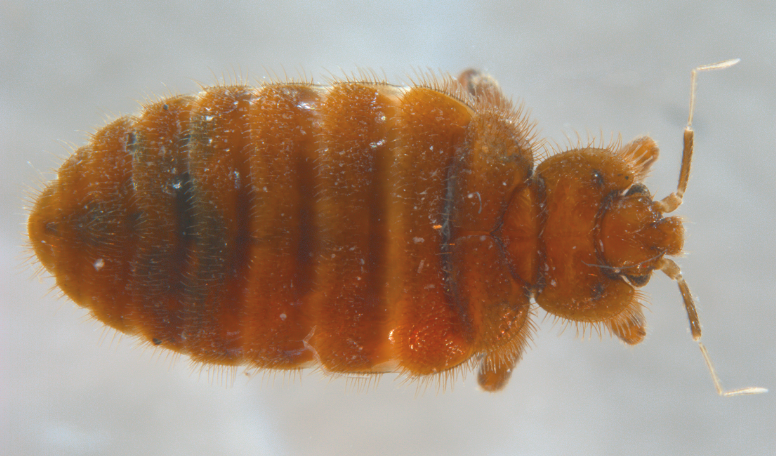
Photo by W. H. Kern,
Univ Fla Ent. & Nem.
Small (1/16 to 3/16 in.), flattened, reddish brown-colored insect nearly identical in visual appearance to the common bed bug.
Habits: Cimicid bat bugs are parasitic insects that prefer to feed on bats and are therefore typically found in attics. Cimicid bat bugs rarely bite people. They appear in areas where it is not logical to find bed bugs (on window sills, in the middle of a room, kitchen, etc.). Cimicid bat bugs may invade human living spaces after bat infestations are eliminated, and can continue to move from the bat infestation site (usually the attic) into living areas for months after bats are excluded.
Interventions: Capture several bugs, place them in a vial or jar, and obtain positive identification from an entomologist. If positive bat bug identification is made, contact a pest management professional. Bat bug control should target (including a thorough inspection) the source of the bugs.
Might Be Confused With: common bed bugs.
Common Bed Bugs (Cimicidae: Cimex lectularius):
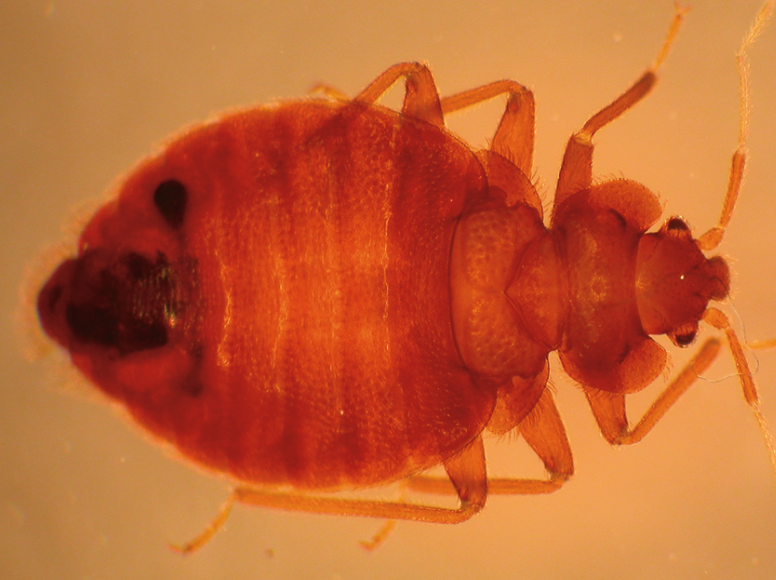
Small (1/16 to 3/16 in.), flattened, reddish brown-colored insect nearly identical in visual appearance to the Cimicid bat bug.
Habits: Bed bugs are parasitic insects that prefer to feed on human blood. Found in locations where people rest, especially bedrooms, couches, etc. Found resting in cracks and crevices from which they emerge at night to feed on blood of their human hosts. Common resting sites include mattress seams, box spring screw holes, under nightstands, behind wall hangings, behind headboards, under the carpet along the baseboard (especially in corners), etc. Like other blood-feeding arthropods (ticks, fleas, and mosquitoes), bed bugs are attracted to carbon dioxide, as it is indicative of a warm-blooded host.
Interventions: Capture several bugs, place them in a vial or jar, and acquire positive identification from an entomologist. If a positive identification is made, contact a pest management professional skilled and experienced in the treatment and elimination of bed bug infestations. Bed bug elimination is very difficult and can involve a number of interventions including the use of heat, physical barriers, as well as a variety of insecticidal formulations, but should be left to an experienced professional. Total release aerosols (bug bombs) are ineffective at controlling bed bugs, and should not be used indoors. For additional information on bed bugs, visit epa.gov/bedbugs.
Might Be Confused With: Cimicid bat bugs, carpet beetles.
Chinch Bug (Blissidae: Ischnodemus sp.):
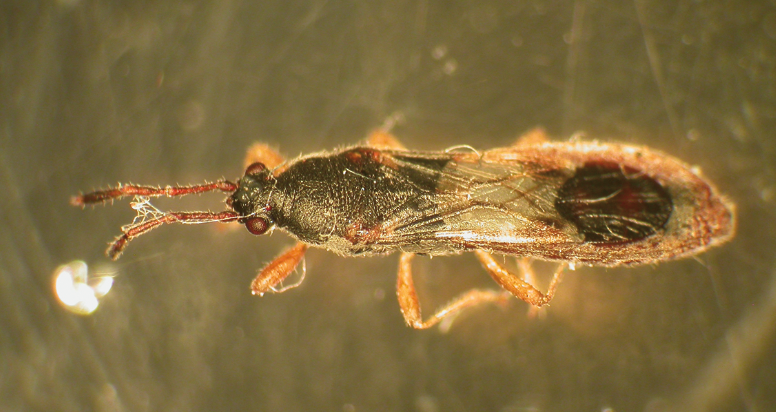
Cigar-shaped, black insect, 3/8 to ½ in., with triangle-shaped head, short antennae, and silver wings.
Habits: In Georgia, found most commonly on exterior walls in the fall (September–November). Adults and nymphs are leaf feeders, causing damage to leaf tissue of mostly grasses (for example, flat sedge and related sedges in Georgia) by disrupting and depressing overall plant growth. Its feeding undoubtedly influences flowering and seed production.
Interventions: Chinch bug populations are likely to subside on their own as the seasons change; if given enough time the problem is likely to take care of itself. Follow suggestions under section titled Proactive Pest Management, especially the installation of doorsweeps and screens. If insect problems are such a nuisance that they require treatment, treat bugs directly with an appropriately labeled residual spray (spray only outdoors).
Might Be Confused With: boxelder bugs.
White-Margined Burrowing bug (Cydnidae: Sehirus cinctus):

White-margined burrowing bug adults are approximately ¼ in., with smooth, shiny black wings with distinct white margins; immature bugs are smaller than ¼ in., wingless, black and bright red, and typically found in aggregations of dozens. Adults and immatures have 4-segmented, straight antennae.
Habits: White-margined burrowing bugs feed on plant seeds, such as henbit and mint. When conditions are conducive, large numbers of bugs may be present in an outbreak. Female bugs lay more than 100 eggs and then provision the newly hatched immatures with seeds (food) in a form of brood care, a condition rare among insects.
Interventions: If bugs are so numerous that they present an exceptional nuisance, the use of an appropriately labeled residual spray will kill most bugs. Alternatively, if given enough time (probably just a few weeks), bugs will likely disappear naturally.
Might be confused with: leaf beetles, other small beetles, stink bugs; immature burrowing bugs can be confused with immatures of the Florida predatory stink bug.
Florida Predatory stink bug (Pentatomidae: Euthyrhynchus floridanus):
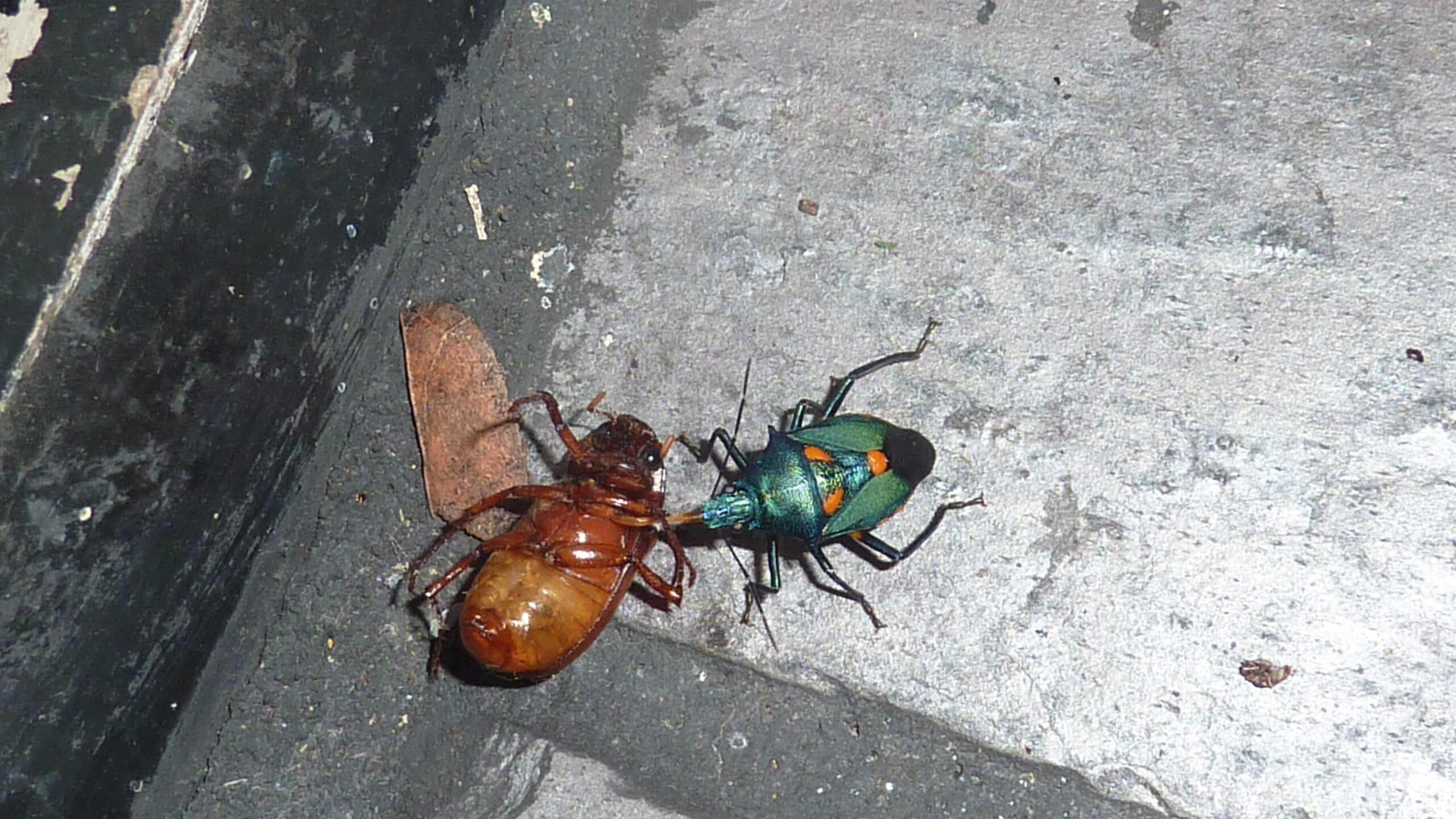
Florida predatory stink bug adults are about ½ to ⅝ in., iridescent blue/black/purple, and have one to three distinct orange/red spots on their back arranged in a triangle. Nymphs are wingless and have a metallic green head and thorax and bright red abdomen.
The gregarious nature of nymphs, combined with their bright colors, draws the attention of homeowners who think the insects might be “up to no good”.

Habits: Florida predatory stink bugs are highly beneficial predators, and are common throughout the Southeastern United States. Like all pentatomids, they have piercing-sucking mouthparts. Their prey consists primarily of insects that eat plants – various species of Hemiptera, beetles, and various caterpillars. Like many predatory Hemiptera, this stink bug may inadvertently bite if handled.
Interventions: None needed, as the Florida predatory stink bug is highly beneficial.
Might be confused with: brown marmorated stink bug, other stink bugs.
Kissing bug (Bloodsucking Conenose) (Reduviidae: Triatoma sanguisuga):
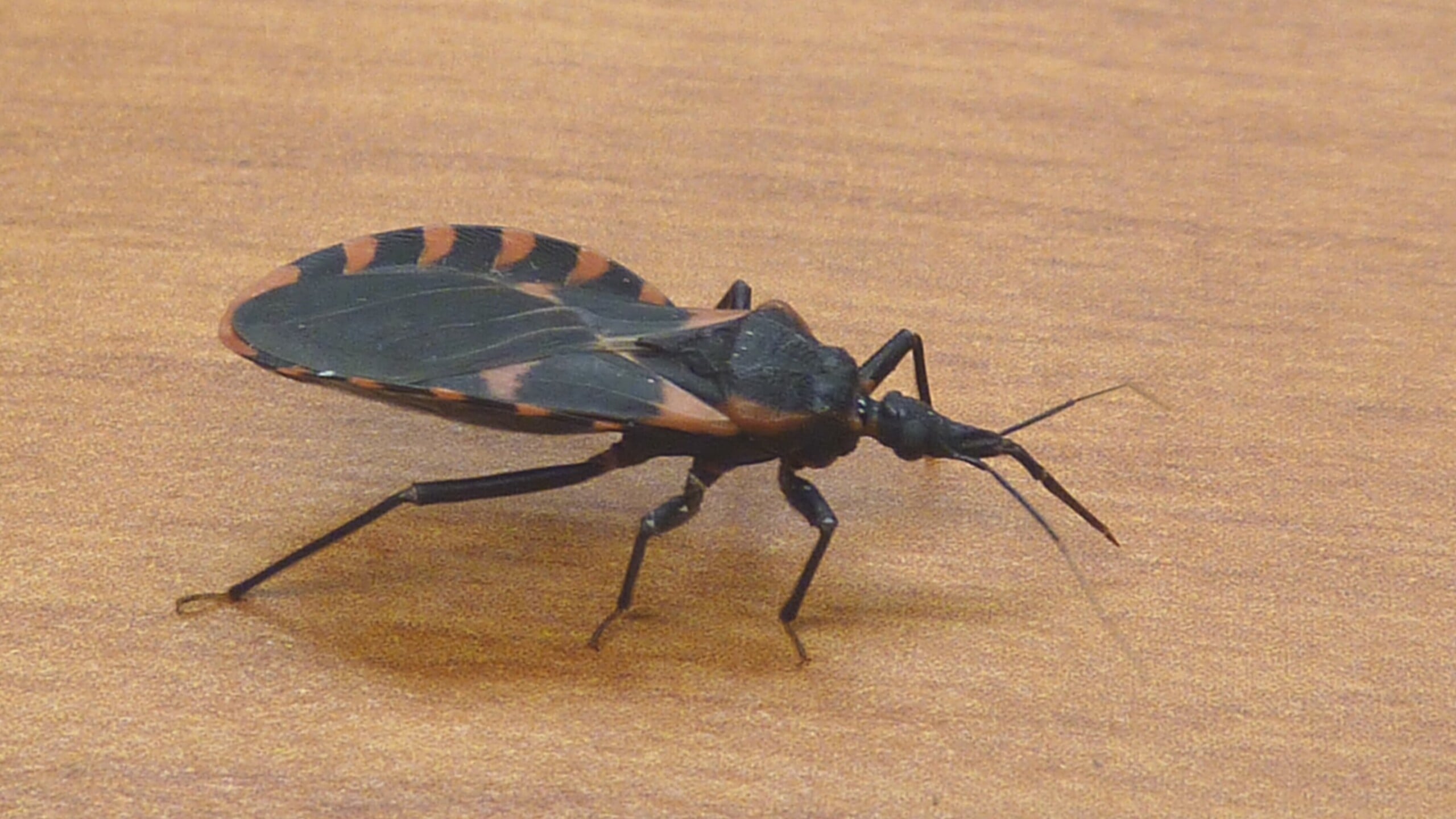
Adult bugs are about 1 in., with a dark brown to cinnamon colored, flattened, elongate-oval body, and a cone-shaped head. The abdomen is wide, with sides extending past the wing margins. Five or six red/orange spots are displayed on each side of the abdomen. They have piercing-sucking mouthparts.
Habits: Triatoma sanguisuga is found in Central and South America and the Southeastern United States. They require blood to survive and reproduce and will feed on myriad vertebrates, including humans. In the Southeastern United States, kissing bugs are found in the nests/sleeping areas of common hosts – e.g., rats, raccoons, opossums, skunks, and armadillos. Like bed bugs, they are most active at night and hide in secluded cracks and crevices during the day. Each immature stage requires a blood meal before it can molt to the next stage, and they are probably attracted to carbon dioxide, as are other blood-feeding arthropods. Triatoma bugs are responsible for Chagas disease. Chagas is a widespread, debilitating, and incurable disease in rural Central and South America, but extremely rare in Eastern North America.
Interventions: If kissing bugs are so numerous that they need to be eliminated, there are some things that can be done. Doors, windows, and other potential entry points need to be screened (including installation of door sweeps) or otherwise sealed, and the crawlspace should be sealed to keep animals from living inside; if a rodent problem exists, it must be solved; other wild animals, and their existing or potential dens/resting sites, must be removed from around the structure; trash piles, including logs and other yard debris, that might serve as daytime harborages for bugs and their vertebrate hosts, must be removed from around the structure; an appropriately labelled insecticide spray can be used to treat the perimeter of the structure; indoors, a thorough inspection might result in the use of liquids and/or aerosols and/or dusts inside cracks and crevices where bugs are found or might harbor; in the bedroom, be sure the bed is at least 1 ft. from the wall and that dust ruffles aren’t allowed to touch the floor; and be sure to inspect the underside of the box, the frame, and behind the head board for bugs, much like inspecting for bed bugs.
Might be confused with: wheel bug, smokybrown cockroach, American cockroach, ground beetle.
Beetles (Order Coleoptera)
All beetles can be recognized by two pairs of wings. The front pair (called elytra) are hard and thickened or shell-like; elytra cover and protect the membranous flight wings underneath.
Ambrosia beetles (Curculionidae: Scolytinae: many species):
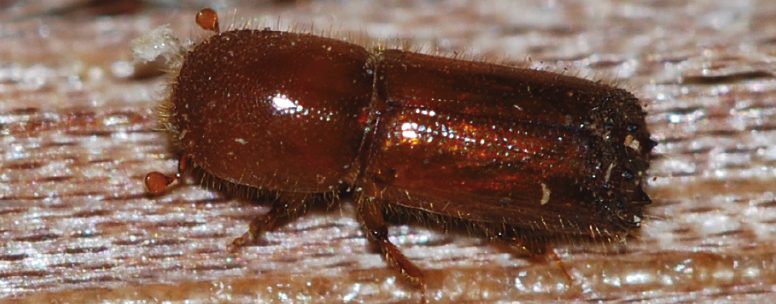
Small (⅛ to 3/16 in.), robust beetles. Head is concealed and protected by rounded pronotum (upper thorax); antennae with large, flat club.
Habits: Adults burrow into wet, newly cut wood to create galleries where they deposit eggs. The adult inoculates the secluded galleries with a fungus, referred to as ambrosia, that the larvae eat. Ambrosia fungus needs wet conditions to grow (i.e., newly cut wood or recently debarked logs). The galleries are stained blue by the fungus. Ambrosia beetles do not eat wood.
Interventions: Beetle problems disappear when the wood dries out. Insecticide treatments are rarely needed and not useful because these beetles (adults and larvae) do not eat the wood.
Might Be Confused With: various powderpost beetles.
“Powderpost beetles” (Ptinidae, incl. former family Anobiidae, and Bostrichidae, incl. Lyctinae):

Powderpost is a term used to describe several species of wood-eating beetles that feed (as larvae) on lumber (e.g., in crawlspaces) and furniture grade wood (e.g., flooring) and that reduce the wood to a fine, flour-like powder (called frass). Frass is insect excrement. The most common families of “powderpost beetles” are the Ptinidae (incl. Anobiidae) and Bostrichidae (including Lyctinae). Anobiid and non-lyctine bostrichid powderpost beetles attack both hardwoods and softwoods, whereas lyctines attack only hardwoods. All three can re-infest the wood from which they have just emerged, but lyctines and anobiids do more than bostrichids. Wood attacked by lyctine and anobiid powderpost beetles can be greatly damaged. Characteristic signs of powderpost beetle activity is the presence of small, round holes (1/16 to 5/16 in. diameter) in the wood. The holes are the result of the adult beetle, having just emerged from its pupal case, chewing its way out of the wood to free itself. When adult powderpost beetles emerge from the wood, they emerge perpendicular to the wood’s surface, creating an almost perfectly round exit hole. Active infestations are characterized by frass streaming from or accumulating around the exit hole on the wood’s surface. Adult powderpost beetles are rarely seen. Exit holes with no frass present is evidence of a prior infestation, but not necessarily one that is still active.
Anobiid powderpost beetles (Ptinidae):

The broad-diet anobiid powderpost beetle, Eurvrilletta peltata, is about ¼ in., and reddish brown to dark brown. Body is cylindrical, elongated, covered by fine, gold-colored hair, with long, serrated antennae. Their elytra is lined with rows of tiny pits. Head is covered by the hood-like pronotum (upper thorax) when viewed from above. Adults, however, are rarely seen. Active infestations in crawslpaces usually are diagnosed by the presence of joists with frass streaming from beetle exit holes. Live adults most commonly are found on crawlspace joists in June in Georgia during their annual 3- to 6-week period of emergence. Other representatives of this group include the furniture beetle (Anobium punctatum), the deathwatch beetle (Xestobium rufovillosum), and the Eastern deathwatch beetle (Hemicoelus carinatus).
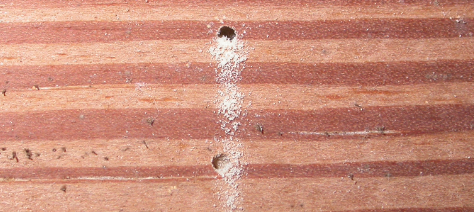
Habits: The most common wood-eating beetle in crawlspace wood is the broad-diet anobiid powderpost beetle. When adult beetles emerge from infested crawlspace joists (May and June in Georgia) they leave a ⅛ in. diameter round hole in wood with frass streaming from holes in crawlspace joists. Following emergence, beetles mate, females lay eggs (typically on the same board they emerged from), and then die within weeks. Eggs hatch and the larvae bore into the wood where they consume it until their emergence 1–3 years later, at which time the cycle repeats. Most commonly infests wood with a high moisture content—typically crawlspaces with no vapor barrier and/or poor ventilation. Also found in buildings that are only intermittently heated or occupied (hunting cabins, second homes, etc.), as moisture is allowed to build in the wood of these structures. Readily re-infests susceptible wood.
Interventions: In crawlspaces infested by this beetle, apply products containing the active ingredient disodium octaborate tetrahydrate (DOT) to all exposed surfaces of unfinished wood in infested areas (where fresh frass is found). Improve overall crawlspace ventilation. Install a vapor barrier if one is not present.
Might Be Confused With: wood borers, ambrosia beetles, drugstore beetles.
True powderpost beetles (Bostrichidae: Lyctinae: principally Lyctus spp.):
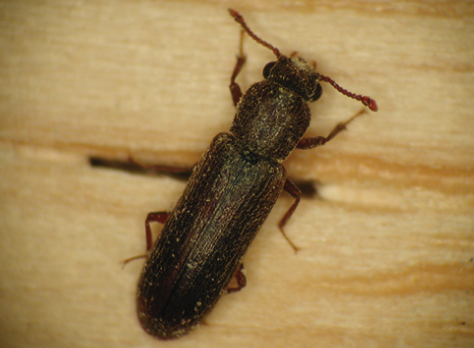


Adult beetles are ⅛ to 3/16 in., cigar shaped, brown to black, with 11-segmented antennae where the last two segments are enlarged and form a club.
Habits: True powderpost beetles infest hardwoods only; they will also infest bamboo. Most commonly reported from hardwood floors less than 5 years old, but can be found emerging from any item made of hardwood. Wood is infested prior to its final use. For example, hardwood floors are infested prior to their installation in the home, and the adults emerge soon thereafter, typically within a year or two of introduction into the home. The best evidence of an active infestation is round holes in wood (1/16 in. diameter) surrounded by frass (or streaming from the hole) the consistency of baby powder and a beetle identified by an entomologist. Can re-infest susceptible hardwoods, and do considerable damage, if conditions are favorable (successful mating and the availability of an unfinished hardwood surface). They do not infest structural wood (softwoods), such as pine or fir, so will not spread from infested items to become a structural pest.
Interventions: Replacement of infested wood (for example, individual planks in a hardwood floor) is the best option.
Might Be Confused With: sawtoothed grain beetle, flour beetle, other small beetles.
False powderpost beetles (Bostrichidae excluding Lyctinae: many species):
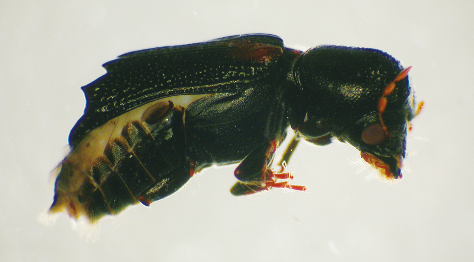
The most commonly encountered false powderpost beetles are 1/8 to 3/8 in., elongate and cylindrical, stout, and black to reddish brown. The head is not visible from above, but is hidden from view by a large, hood-like pronotum (upper thorax) with stout, cuticular spines along the rounded front edge. False powderpost beetles have short, serrate antennae with the terminal three to four segments enlarged (club-like). Elytra often end in distinct spines. Exit holes range in size, depending on beetle species. Exit hole size overlaps with exit hole size made by both true powderpost beetles and anobiid powderpost beetles, but larger false powderpost beetles leave large, round exit holes larger than any hole left by a true powderpost beetle or an anobiid powderpost beetle.
Habits: False powderpost beetles are less economically important than either true powderpost beetles or anobiid powderpost beetles. They can infest rough cut lumber where strips of bark have been left intact. Unlike true powderpost beetles and anobiid powderpost beetles, adult female false powderpost beetles burrow into the wood where they deposit their eggs; true powderpost beetles and anobiid powderpost beetles lay eggs on the outer surface of the wood. False powderpost beetles attack both hardwoods (preferred) and softwoods that have a high moisture content (i.e., newly cut wood). May also infest pithy plants used in dried floral arrangements such as grapevine wreaths. Also attack wicker. Can re-infest, but not wood that has seasoned and dried considerably (to less than 10% moisture) since the initial infestation. Re-infestation is uncommon because aged wood is considerably drier than newly cut wood.
Interventions: Ensure that bark strips are removed from freshly cut wood. Apply products containing the active ingredient disodium octaborate tetrahydrate (DOT) to prevent re-infestation, fumigate, freeze or remove the infested material.
Might Be Confused With: anobiid and true powderpost beetles, ambrosia beetles.
Drugstore beetles (Anobiidae: Stegobium paniceum):
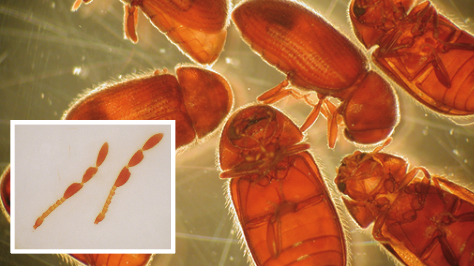
Small, 1/8 to 3/16 in., light brown beetle with antennae ending in three broadened segments. Head concealed by helmet-like pronotum (upper thorax) and elytra with longitudinal rows of pits.
Habits: This somewhat common stored product pest consumes items in the home of animal and plant origin (dried foods in the pantry, dog treats, etc.).
Interventions: Find infested item(s) and discard. Clean up spilled food. Store potentially susceptible items in tightly sealed containers. Never treat human food sources with an insecticide. For more detailed information see University of Georgia Extension Bulletin 1378, Stored Product Pests in the Home.
Might Be Confused With: other beetle pests of stored products, anobiid powderpost beetles.
Carpet beetles (Dermestidae: Anthrenus spp.):

Adults are 1/16 to 1/8 in., oval-shaped, and calico colored. Larvae are 1/8 in., hairy, oval-shaped, slow-moving, and cryptic (slow moving, small, and inconspicuous).
Habits: Most homes are populated by a small number of carpet beetles, but because they are somewhat cryptic, they are rarely seen. Larvae feed on products in the home that are of animal origin (feathers, wool, fur, hair, silk, skins, dry animal food, etc.) but will also feed on dead insects (found on window sills, in wall voids, and in light fixtures). Carpet beetles do not consume modern clothing and carpets, as they are made from cotton or synthetic fibers. Adults feed on pollen outdoors.
Interventions: Find infested article(s) and remove. Vacuum insects and discard bag, and especially watch for re-infestation. Wash, steam-clean, or dry- clean all items of animal origin, especially wool. Have infested textiles professionally cleaned. If desired, apply a spot treatment with an appropriately labeled residual spray to the floor around the infested item(s).
Might Be Confused With: warehouse beetle (Dermestidae: Trogoderma variabile), bed bugs.
Ground beetles (Carabidae: many species, especially Harpalus spp.):
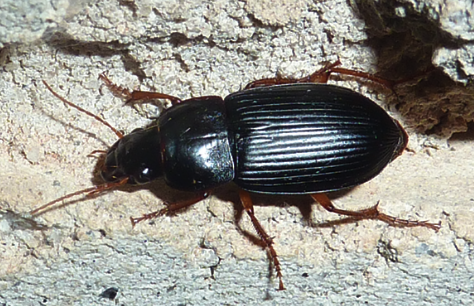
Numerous species, 1/4 to 1 in.. Common species are black—some shiny, some dull or flat black. One species, called the caterpillar hunter, is an iridescent green, 1 in. ground beetle. They have hardened elytra, often with visible, longitudinal furrows or pits. Many species have strongly serrated mandibles, indicative of a predatory insect.
Habits: Fast-crawling, highly beneficial predators of other insects. Some species are attracted by insects that have been attracted to exterior lights. Harbor in log piles, leaf litter, and under flat items, such as boards, lying on the ground. Ground beetles are strongly attracted to lights.
Interventions: Follow suggestions under section titled Proactive Pest Management. It is especially important to eliminate harborage, install doorsweeps, and alter lighting to make structure less attractive at night. Ground beetles are highly beneficial, predatory insects. Attempts should be made to conserve them. However, if desired apply a localized treatment with an appropriately labeled residual spray directly to beetles (spray only outdoors).
Might Be Confused With: cockroaches, other similarly sized beetles.
Multicolored Asian Lady beetles (Coccinellidae: Harmonia axyridis):

Also referred to as ladybugs or ladybird beetles. Oval-shaped, 1/4 in., black and white thorax with or without black spots on red or orange elytra. Common insect in gardens.
Habits: Highly beneficial, predatory beetle as adults and larvae, mostly of aphids and scale insects. Become nuisance in the fall when they begin searching for overwintering sites inside homes and other structures.
Interventions: Follow suggestions under section titled Proactive Pest Management. It is especially important to make sure all windows are screened, that doors remain closed, and doorsweeps are installed on all exterior doors. Before lady beetles begin to seek refuge indoors (fall), take action to (1) seal all cracks 1/8 in. wide or wider, and (2) spot spray around all potential entry points with an appropriately labeled residual spray. Reapply insecticide treatments, per label specifications, through the end of November/early December. Interventions should be implemented early enough (mid-September) so that preventative measures are in place before the onset of lady beetle migration indoors. If lady beetles get inside the best solution is to vacuum them. Insecticide treatments indoors are not recommended. If lady beetles die inside walls or in attics their carcasses accumulate and may attract other insects that eat them, especially carpet beetles. It is often best to seek help and advice from a pest management professional experienced in lady beetle control. For more information see the publication, Multicolored Asian Lady Beetle, at https://ohioline.osu.edu/factsheet/ENT-44.
Might Be Confused With: kudzu bugs, brown marmorated stink bugs, boxelder bugs.
Lesser Mealworm Beetles (Tenebrionidae: Alphitobius diaperinus):
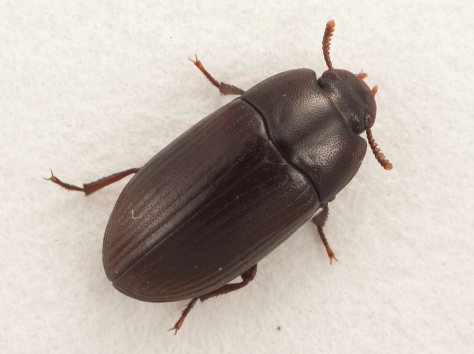
Photo by A. Roche, UGA Ent.
Also referred to as litter beetles or darkling beetles. Adults are small (1/4 in.), broadly oval, moderately convex, black or brownish-black shiny beetles with longitudinal grooves on the elytra. Antennae have increasingly larger segments; each antennal segment is round.
Habits: Often associated with chicken litter. Adults are attracted to lights and are strong fliers that are able to fly long distances from site of origin. Found on products already damaged by molds.
Interventions: For homes with constant pressure (such as homes near chicken production areas or near agricultural fields where chicken litter is spread), exclusion is generally best. Take action to seal all cracks 1/8 in. wide or wider. It is especially important to make sure that all windows are screened, that doors remain closed, and that doorsweeps are installed on all exterior doors. Alter lighting to make structure less attractive at night (see section on Proactive Pest Management). If desired, spray around all potential entry points with an appropriately labeled residual spray.
Might Be Confused With: ground beetles.
Sawtoothed Grain Beetles (Silvanidae: Oryzaephilus surinamensis):
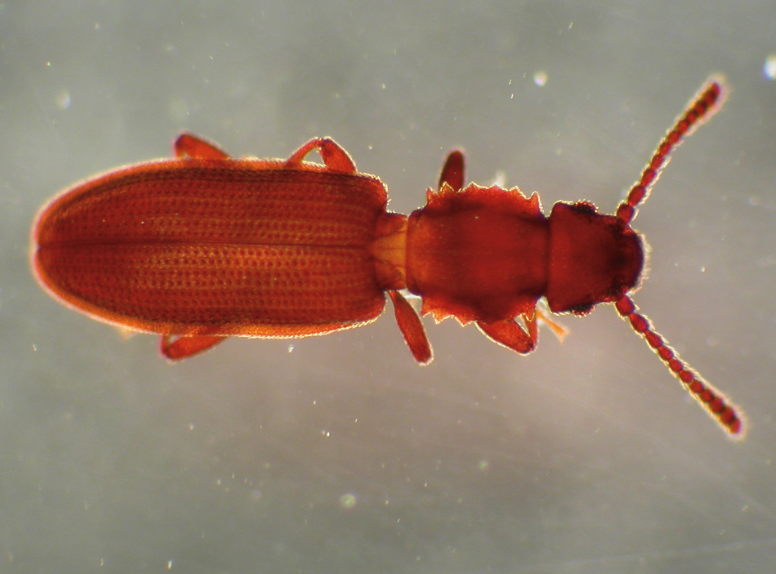
Very small (1/16 in.), slender, dark brown beetle with characteristic teeth along each side of the prothorax.
Habits: One of the most common pests of stored products in the United States. Infests common foods in pantries and food closets. Mostly crawls, rarely flies, and can be long-lived.
Interventions: Find infested food (cereal, bird food, crackers, oatmeal, etc.) and discard. Clean up spilled food. Store potentially susceptible items in tightly sealed containers. Never treat human food sources with an insecticide. For more detailed information see University of Georgia Extension Bulletin 1378, Stored Product Pests in the Home, at https://extension.uga.edu/publications.html.
Might Be Confused With: true powderpost beetles, flour beetles.
Sugarcane Beetles (Scarabaeidae: Euetheola humilis):
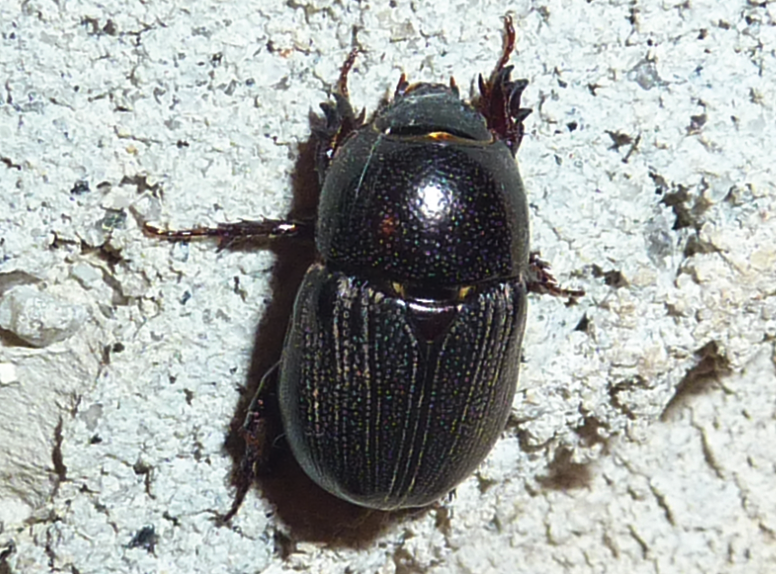
Oblong- to oval-shaped, 1/2 to 5/8 in., flat or shiny black to brownish black robust beetle with longitudinal rows of slight indentations on hairless elytra. They have large, strong, spiny forelegs for digging.
Habits: One or two population peaks (spring and late summer [August]) per year. Beetles may be very numerous when present. Short-lived are adults strongly attracted to lights at night. At sunrise adults attempt to burrow away from sun no matter where they are, sometimes resulting in damage to roof shingles, pliable rubber caulking and sealants along expansion joints, expansion papers, etc.
Interventions: Alter lighting to make structure less attractive at night (see section on Proactive Pest Management). Turn off lights during peak flight times or use flood lights, positioned away from but pointing toward the building, to attract beetles away from the building. If desired, treat with an appropriately labeled residual spray to areas where beetles aggregate, such as in corners and along seams where horizontal and vertical surfaces meet.
Might Be Confused With: numerous other black scarab beetles, ground beetles.
White-fringed beetles (Curculionidae: Naupactus leucoloma):
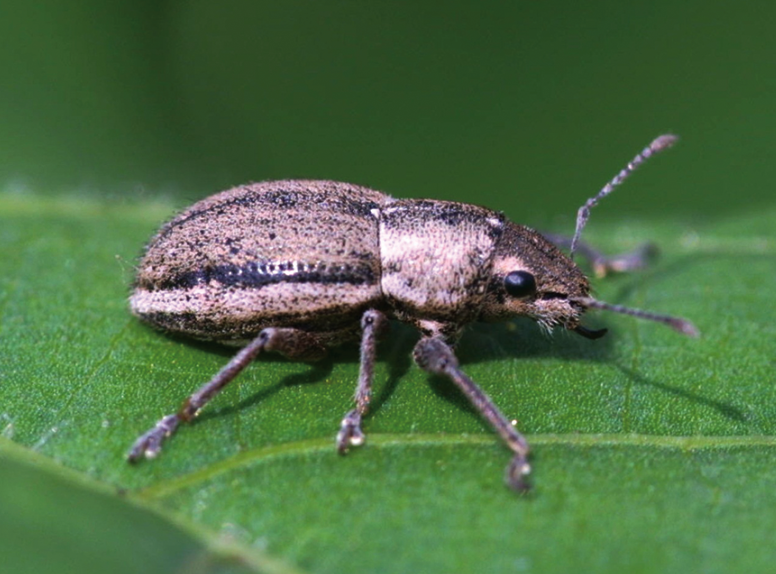
Photo by R. Ottens,
Bugwood.org
Longitudinally striped light to dark brown beetle, 1/4 to 3/8 in., with a somewhat distinct beak (rostrum) and elbowed antennae.
Habits: Larvae feed on roots of grass, and some agricultural crops, followed by punctuated adult emergence in summer, sometimes in large numbers. Can be especially numerous near agriculture fields. White-fringed beetle activity is seasonal and predictable in occurrence.
Interventions: Problems often cease on their own, so insecticides are not needed. Follow suggestions under section titled Proactive Pest Management. It is especially important to install doorsweeps. If desired, spray beetles directly (spray only outdoors).
Might Be Confused With: other weevil species, ground beetles.
Wood-boring beetles (Cerambycidae and Buprestidae: many species):
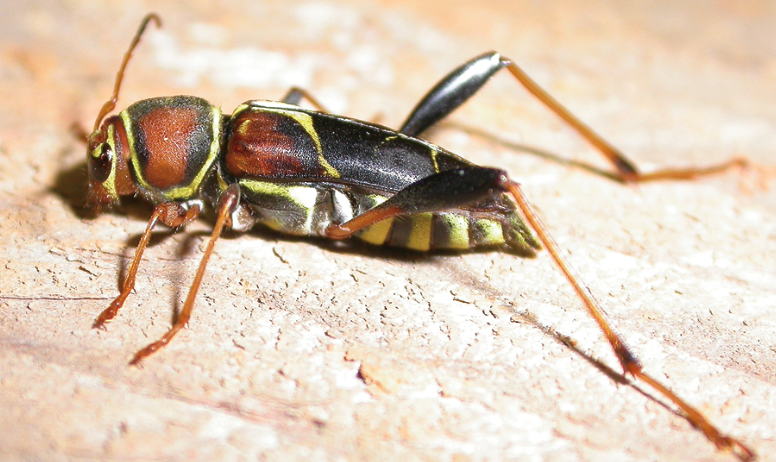
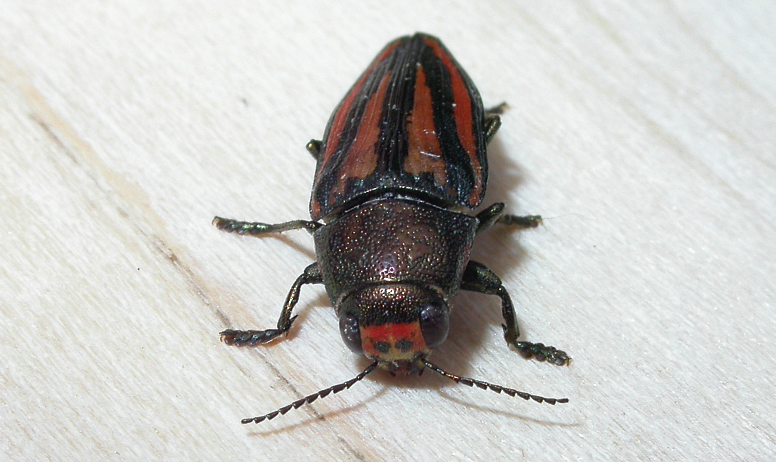
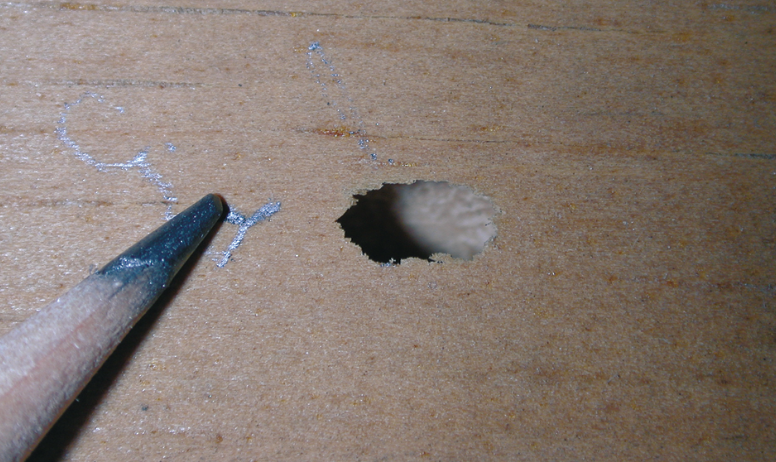
Wood-borer is a general term that refers to the larval form of beetle species in either the family Cerambycidae or Buprestidae. They infest both hardwoods and softwoods. Adult cerambycids (called longhorned beetles) are elongate, cylindrical and 3/8 to 1 in., often with antennae as long as or longer than the body. Larvae are referred to as roundheaded borers. Adult buprestids (called metallic wood-boring beetles) are 3/16 to 3/4 in., bullet shaped and often metallic blue and/or emerald green. Larvae are referred to as flatheaded borers. Because adult beetles are rarely seen or found, diagnosis of infestation in wood is usually dependent upon the morphology and size of the exit hole. Longhorned beetle exit holes are nearly round to slightly oval, with a 1/8 to 3/8 in. long-diameter (the long-diameter is never more than twice the short-diameter), while metallic wood-boring beetle exit holes are elongated, flattened ovals with a 3/16 to 1/4 in. long-diameter (the long-diameter is approximately three to four times the short-diameter).
Habits: Wood-borers infest wood soon after the tree is felled, but before bark is removed. They cannot infest seasoned, processed lumber (in lumberyards or dimensional lumber in service) or trees that have been debarked. Infestations are more common in wood cut from one’s own property, but not kiln-dried or debarked quickly enough. They can also infest rough cut lumber where strips of bark have been left intact. Following mating, females lay eggs on the bark. Eggs hatch, and larvae burrow into and begin feeding just under the bark. They then move to the sapwood where they will remain, consuming the wood, for several years until emergence. For various reasons, larvae may survive the milling process and are then built into structures using infested wood (structural lumber or logs for log homes). Adult wood-borers most often emerge from wood 1–3 years after construction. Generally, development time is quicker in wood with elevated moisture (logs), and can be delayed by several years in dry or drying wood (dimensional lumber). Exit holes are the result of the adult beetle chewing its way out of the wood to free itself. When beetles emerge, they are looking for a mate and then must find a tree with bark on it. Like powderpost beetles, when adult wood-borers emerge from the wood they emerge perpendicular to the wood’s surface. Active infestations are characterized by frass (beetle excrement) streaming from the hole. Exit holes with no frass present are evidence of a prior infestation, but not necessarily one that is still active.
Interventions: None needed as these beetles will not re-infest, unless the wood contains moisture and has bark present and females are successfully mated. Beetle emergence holes are an aesthetic problem. The feeding damage done by larvae is not known to compromise the structural integrity of the wood. Generally, seek help from a professional pest control company to determine (a) beetle identification, (b) whether the infestation is active or not, and (c) options for control, if needed. Obtain help for a positive beetle identification from an entomologist. Control recommendations are entirely dependent upon beetle identification and infestation status.
Might Be Confused With: old house borer.
Old House Borer (Cerambycidae: Hylotrupes bajulus):
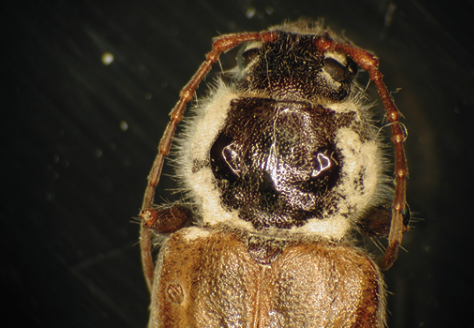


(3 ocelli, blue arrow)

Diagnosis of an old house borer (OHB) infestation is typically based on: (a) exit hole morphology (exit holes are elongated, flattened ovals 1/4 to 3/8 in., where the long-diameter is never more than twice the short-diameter); (b) frass (a fine powdery texture where individual pellets are barrel-shaped); and (c) ridged galleries made by larval feeding. When larvae can be obtained, they can be identified by the presence of three ocelli (eyes) in a row on the head. Larvae can sometimes be heard chewing in the wood. Adults are rarely seen, but are elongated (5/8 to 1 in.), somewhat flattened, brownish black beetles with moderately long antennae (at least one third the length of the body). Margins of pronotum (upper thorax) are covered with numerous gray to white short hairs. The center of the pronotum is naked, and contains two knobs that appear eyelike.
Habits: The OHB feeds only on softwoods (mostly pine) and it prefers wood less than 10 years old with a moisture content greater than 10%. It is a species of wood-boring beetle in the family Cerambycidae (see section above on wood-boring beetles). It is not native to the United States. It is singled out here because unlike the other wood-borers in North America it can infest seasoned, dimensional lumber (at the lumber yard) before it is used in construction; like other cerambycids, it can also attack recently felled, barked or debarked, trees. Most OHB infestations are built into structures by using previously infested softwoods (e.g., construction materials, pine floors, log homes) during construction. What makes the OHB different is that if conditions are favorable (successful mating upon emergence from infested wood and then location of a softwood with an adequate moisture content), it can then infest and continue to re-infest structural softwoods in the home. In contrast, the wood borers (mentioned above) cannot. Because they are built into homes, detection of OHB infestations is most typical in structures that are less than 10 years old. Development time (egg to adult emergence from wood) is strongly dependent upon wood moisture. Under the most favorable conditions (wood moisture content 15 to 25%; for example, logs in a new log home), beetles can develop in 2–5 years, but development may take up to 10 to 15 years in exceptionally dry wood (wood moisture content less than 10%; for example, dry and drying seasoned dimensional lumber). The senior author of this bulletin once acquired a piece of OHB-infested pine flooring (age unknown) and an OHB adult emerged from it 5 years later. Even though OHBs can infest susceptible wood in the home, survival of first instar larvae is low in wood with exceedingly low moisture content (less than 10%). Because of changes in wood-handling procedures over the past few decades, incidence of OHB infestations in homes has declined dramatically. Although the vast majority of OHB infestations found in the home do not result in spread into other structural softwoods, the initial infestation (built into the structure) can do considerable damage to structural softwoods prior to adult emergence. When an OHB emerges, it must find a mate, successfully mate, and then the female must find a piece of susceptible softwood—i.e., wood with a moisture content greater than about 10%
Interventions: Application of products containing the active ingredient disodium octaborate tetrahydrate (DOT) to the surface of lumber can act as a deterrent to infestation and re-infestation. Localized treatment of active infestations or wood replacement, if possible, are other options. Fumigation should be considered for widespread infestations. Consult with a pest management professional in severe infestations.
Might Be Confused With: many other species of wood borers in the family Cerambycidae and Buprestidae.
Root borers (Cerambycidae: Prioninae: various species):
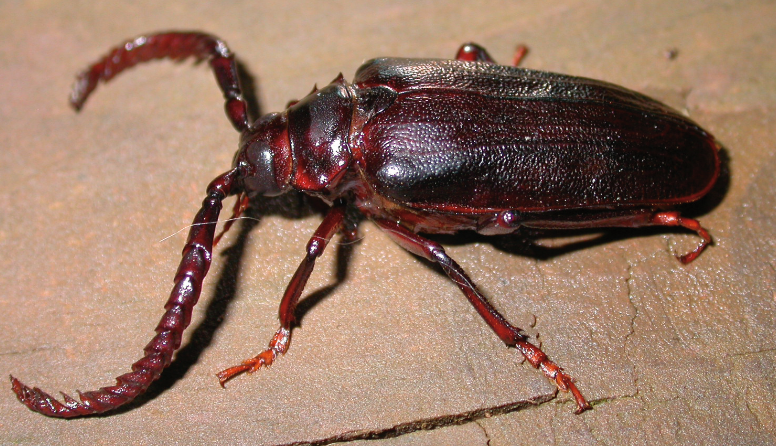
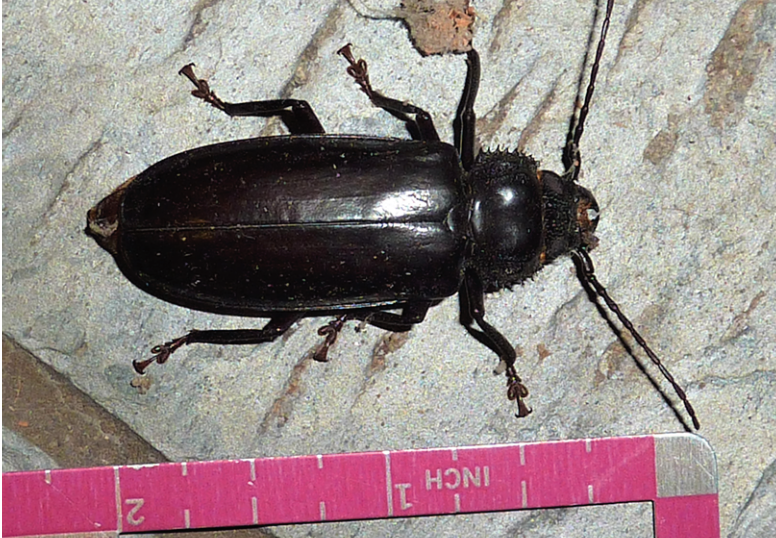
Adult beetles (called longhorned beetles) in the subfamily Prioninae are large (1½ – 2½ in.), reddish-brown, and with moderate to long, stout antennae and large mandibles; elytra often do not completely cover their abdomen. Larvae, referred to as roundheaded borers, can be up to 4 in..
Habits: Larvae feed on the roots of various tree species, rotting and dying stumps, and sometimes can cause significant damage to, or kill, trees. The life cycle of root borers is 3 to 5 years. During the late spring or early summer (especially), following a rain, adult beetles emerge from the softened soil, where they had pupated, and like many species in this family have a strong attraction to lights. At this time of year many homeowners will notice these large, noisy beetles on the outside of screens of opened windows. Their large size and noisy flight behavior, when attracted to lights, is sometimes concerning to homeowners.
Interventions: Beetles are harmless and will disappear when the lights are turned off. Should beetles manage to get inside, simply sweep them outdoors with a broom.
Might be confused with: smokybrown cockroach, American cockroach.
Eastern Hercules beetle (Scarabaeidae: Dynastinae: Dynastes tityus):
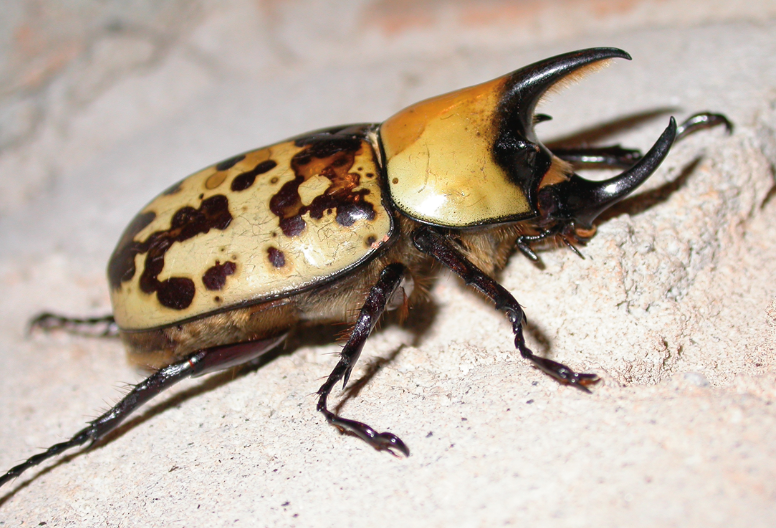
The Eastern Hercules beetle is one of the largest insects in the United States. It measures approximately 1¾ – 2½ in.. Males and females are sexually dimorphic: male beetles have a horn like structure that is used during competition with other males. The horn is absent in female beetles. Although the color patterns of Eastern Hercules beetles vary widely, beetles are commonly dull green with black or brown mottling on the wing covers; the thorax may or may not be spotted.
Habits: The Eastern Hercules beetle is native to Georgia and the Eastern United States. It is not an exotic species from a foreign land. Beetles live in the soil as larvae, eating rotted logs and other debris. During the summer adult beetles emerge from the soil where they had pupated, and like many species in the Scarabaeidae have a strong attraction to light. This tendency to move toward light attracts attention because of the insect’s visibility and large size. They are often found in parking lots and on front porches after having been attracted to outdoor lights in the summer.
Interventions: None needed, as these insects are harmless. These beetles are sometimes kept as pets.
Might be confused with: Because of their large size, many homeowners believe the Hercules beetle is an invasive/exotic species. It is not.
Blister beetles (Meloidae):
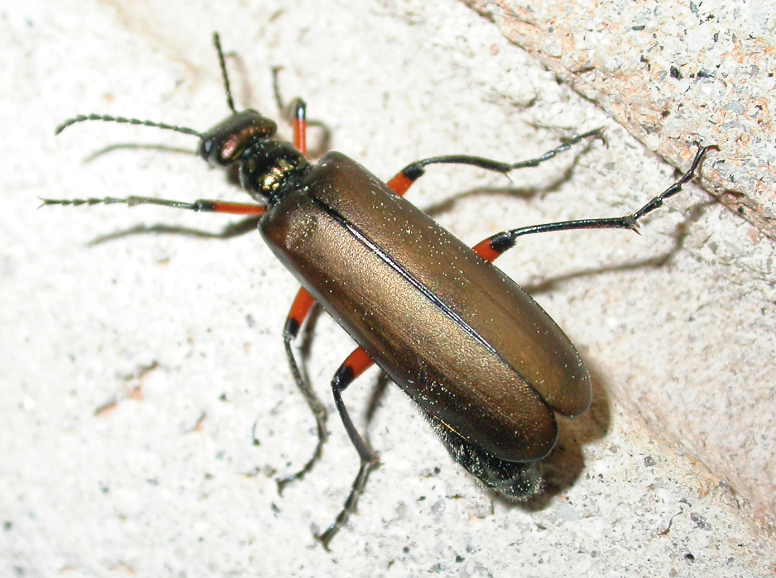
Adult blister beetles are ½ to 1½ in. with a narrow, cylindrical, soft body. Blister beetles are long-legged, and have an obviously exposed head on a narrow thorax separated from the rest of their body by a long prothorax (neck). Many are various shades of gray with black highlights on their thorax and elytra, while others are vibrantly colored. Numerous species occur in Georgia and the Southeast. More than three dozen species are recorded from Georgia. There are more than 2,000 species worldwide.
Habits: Adult blister beetles are medically important. Their blood (hemolymph) contains a chemical called cantharidin. When skin is exposed to cantharidin, severe blistering occurs – thus the name blister beetle. When ingested, cantharidin can be extremely toxic, or even deadly. Horses can become sickened, abort a foal, or die after eating alfalfa hay that is contaminated with blister beetles. Adult blister beetles are commonly found on flowers. They eat both leaves and flower petals, and in many cases numerous individuals of the same species can be found aggregating on a single flower head. Continued adult feeding on leaves can result in almost complete defoliation. The larvae of many species are predators of the immature stages of native bees.
Interventions: None needed. If beetles are handled, resulting in blistering, or consumed, seek advice from a medical doctor or veterinarian if consumption was by an animal. It is advisable that hay used for feeding horses be inspected for the presence of blister beetles.
Might be confused with: other beetles, especially darkling beetles.
Tiger beetles (Carabidae: Cicindelinae):
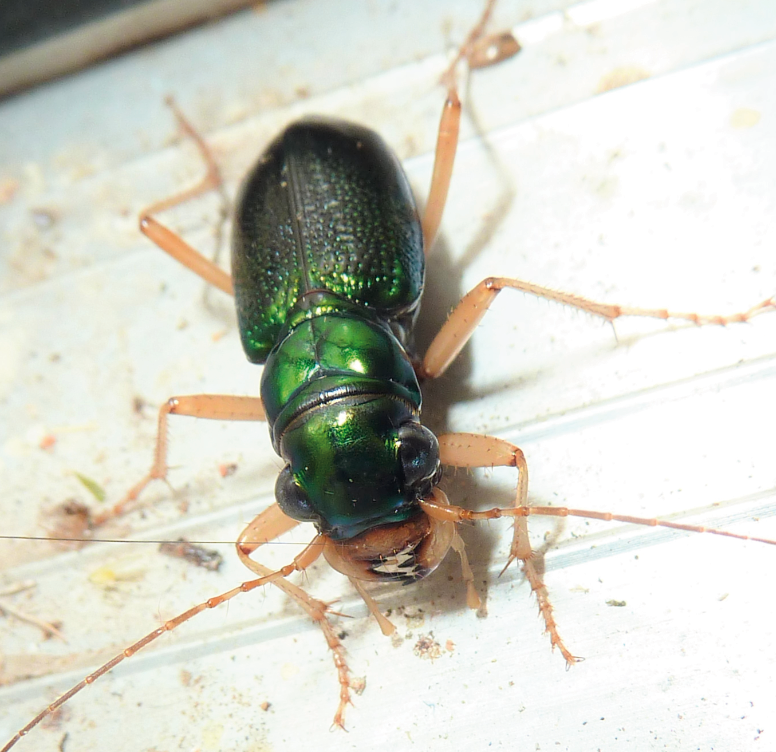
Adult tiger beetles are ½ in., and have large eyes, long legs, and serrated mandibles. Many species are metallic green or blue, are quick to fly (and are fast fliers). Larval tiger beetles, with similar mandible types, are up to 1 in. and live singly in vertical burrows constructed on barren ground. Burrow openings are round, without a soil collar, ¼ in. diameter, and 8 to 10 in. deep (some deeper).
Habits: There are more than 100 species of tiger beetles in the United States, with some species threatened or endangered because of habitat loss. Tiger beetles are predatory as adults and larvae. As is typical of many predatory invertebrates, tiger beetles are extremely fast runners. They are attracted to light and can be found taking moths and other prey at lights. Tiger beetle larvae sit in their vertical burrow, with their head at the burrow’s entrance, lying in wait for prey to come close; ants are common prey of larval tiger beetles.
Interventions: None needed. Tiger beetles are beneficial insects and do not bite or sting.
Might be confused with: ground beetles and other beetles.
Bombardier beetles (Carabidae: Brachininae: Brachinus spp.):
Adult bombardier beetles are approximately ¾ in., with black or iridescent black/blue/green elytra, an orange/red pronotum with rounded edges, and a pronounced red head with large eyes. Antennae are about half the length of the body and are fibrous. There are nearly 50 species in North America.
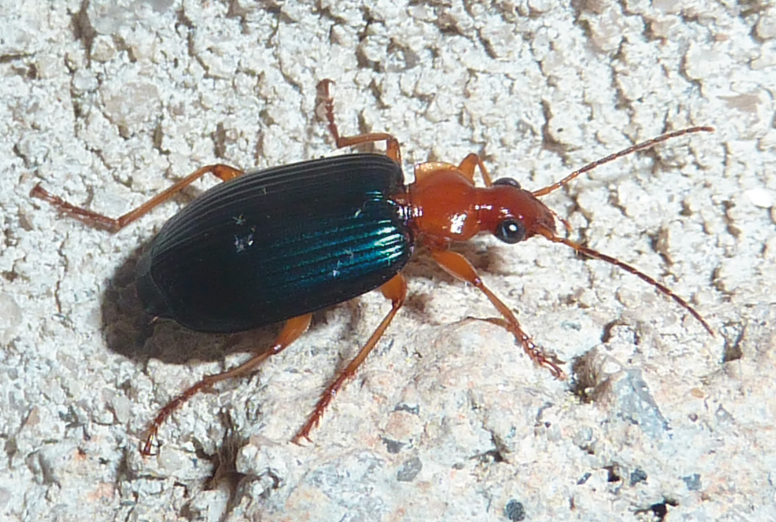
Habits: Adult bombardier beetles are fast crawling, predatory beetles and, like other carabids, are often found at lights at night where they hunt prey. Bombardier beetles get their name because of their unique ability, when threatened, to mix several compounds together creating a chemical reaction that they shoot in a stream, reportedly at the temperature of boiling water. In his youth, the senior author of this bulletin picked up a bombardier beetle, against the better advice of his female co-author LMA (and wife since 1994). It burned him and left a mark like one left by a burning match.
Interventions: None needed, as bombardier beetles are beneficial predators. Should the handling of a bombardier beetle result in a chemical burn, chalk it up to lesson learned and don’t do it again.
Might be confused with: ground beetles, tiger beetles, other beetles, especially false bombardier beetles.
Corn sap beetles (Nitidulidae: Carpophilus dimidiatus):
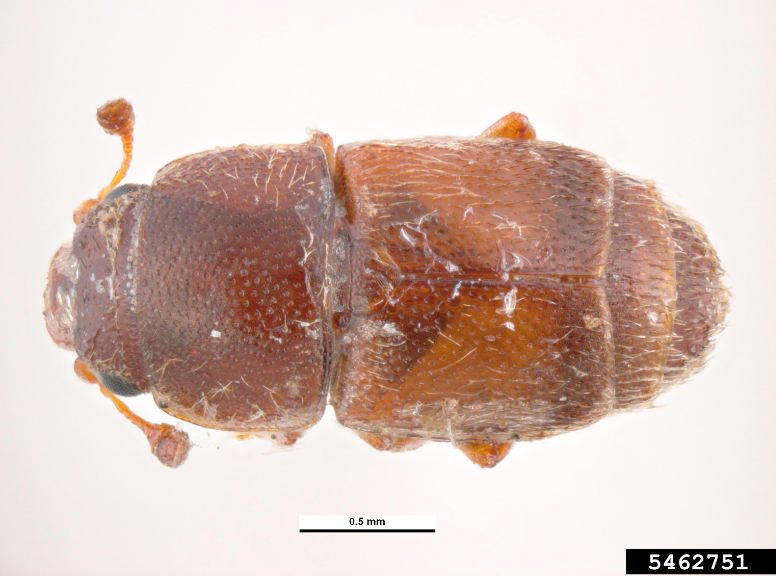
Adult corn sap beetles are about ⅛ to ¼ in. and stout. Unlike most beetles, their elytra (wing covers) are truncated and do not completely cover their abdomen, leaving about ⅓ of the abdomen exposed. They are generally brownish colored, with a matte or flat finish (not shiny). The antennae have a 3-segmented distinct club, or lollipop appearance.
Habits: The presence of sap beetles in a home suggests excessive moisture somewhere in the structure. Sap beetles feed on decaying plant matter (fruit), fungi, and molds, which only grow under conditions of high or excessive moisture and humidity.
Interventions: Because corn sap beetles feed on fungi and mold, the key to resolving their presence is to find the source of moisture and to dry it. Adult beetles migrate from their breeding site and should thus be viewed only as an outward sign of an underlying moisture issue. Targeting only the adult population will do little to solve the problem unless the breeding source (area of high moisture) is found and eliminated. The underlying moisture issue must be located and remedied.
Might be confused with: Anobiid powderpost beetles, numerous other small beetles.
Mold and fungus feeding beetles indicating excessively high humidity and moisture:
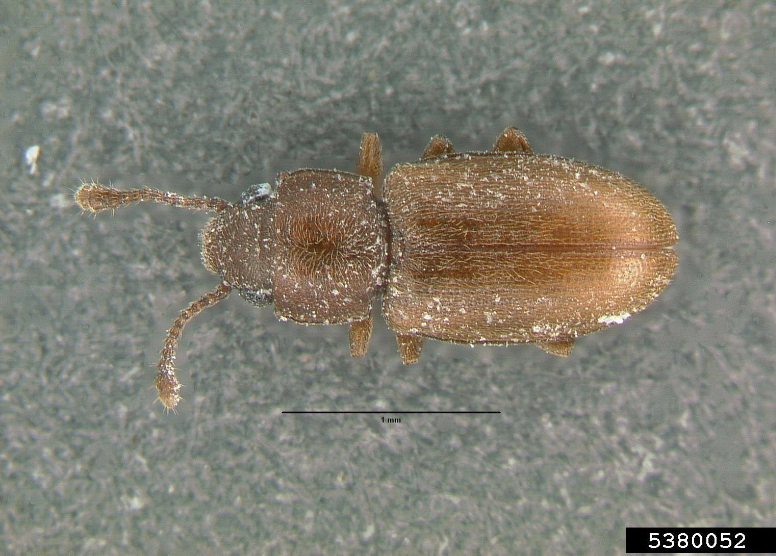
A diverse group consisting of small (1/16 to ⅛ in.), brown or black beetles (Order Coleoptera). Notable families, and representative species (with common name), include: Nitidulidae (corn sap beetle, Carpophilus dimidiatus); Cryptophagidae (Cryptophagus sp.); Latridiidae (mold & plaster beetles, minute ground scavenging beetles, Corticaria serrata); Anthicidae (ant-like flower beetle, Vacusus vicinus); Silvanidae (foreign grain beetle, new house bug, plaster beetle)
Habits: Food for common groups: fungal tissues such as slime molds, molds, mildew, and spores of higher fungi (for Latridiidae) and decaying habitats with fungal growth, including rotting wood (for Cryptophagidae).
Interventions: The primary food of these small beetles are mold, fungi, mildews, and spores which require elevated and sustained moisture and humidity to grow and flourish. The presence of the beetles is simply an indication that these microorganisms are growing somewhere, and, by extension, there is likely a moisture issue that must be found and remedied. The key is to eliminate their food source, which requires finding and eliminating the source of the moisture. Eliminate the moisture, and the beetle problem will cease.
Might be confused with: powderpost beetles, myriad other small beetles.
Rove beetles (Staphylinidae):
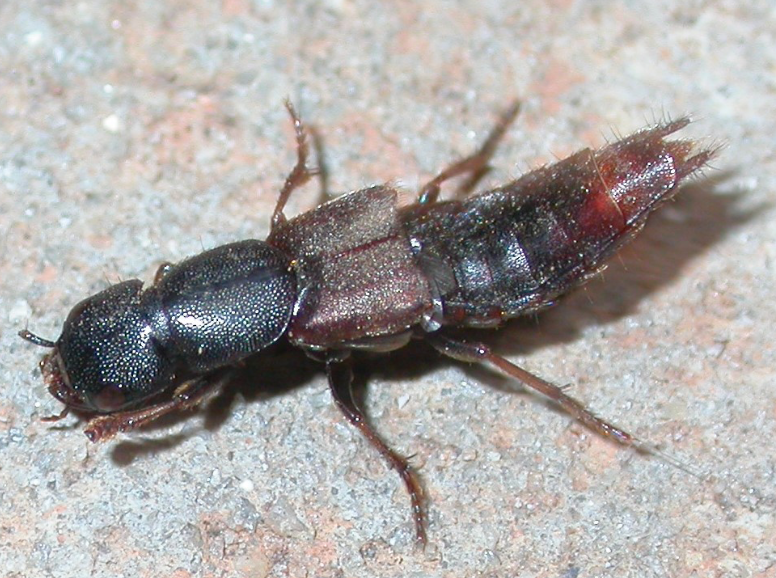
There are more than 60,000 known species in the Staphylinidae, making this group one of the largest of all beetle families. Adult rove beetles are commonly slender and vary widely in size (1/16 to more than 1 in.) and appearance. The most common visual identifying characteristic of adults are very short elytra that only cover about ¼ of the abdomen.
Habits: Rove beetles are biologically diverse. Many species, especially those that show up in homes and structures, are predaceous and their presence is an indication of an abundance of prey – e.g., fly larvae (maggots), booklice, springtails, and other small invertebrate prey. The presence of prey is indicative of some underlying condition allowing their presence to flourish. Rove beetles are present secondarily and are feeding on some stage of the primary pest(s). Some species are strongly attracted to lights.
Interventions: Rove beetles feed on other insects, so the food source of their prey must be addressed. For instance, excessive moisture can lead to an abundance of booklice and springtails (prey) that feed on mold and fungi. Elimination of the high moisture condition(s) reduce the population of fungus-feeding insects and is they key to reducing rove beetle numbers. Rove beetles can be attracted to lights and resulting accumulation of prey. Alter lighting to make structure less attractive at night (see section on Proactive Pest Management).
Might be confused with: dealated termite swarmer, earwigs.
Moths (Order Lepidoptera)
Species of Lepidoptera are characterized, in part, by the scales covering four wings and by a proboscis, or sucking mouthparts. Moths, and particularly their larvae, are major agricultural pests in many parts of the world.
Clothes moths (Tineidae: Tineola and Tinea spp.):

Shiny, gold-colored, 1/4 in. moth with fringed wing margins. The most common species in Georgia is the casemaking clothes moth (Tinea pellionella). Larvae of casemaking clothes moths build rectangular to elliptical cases about 1/4 in. that are open at both ends and spun from materials and/or fibers in their immediate environment, often fibers they have been feeding on. Larvae live, protected, inside the case. Larvae have a dark band just behind their head, which is visible only when the larva projects its head out of the case to feed.
Habits: Moths fly at night, usually in an erratic pattern, in search of mates and food. Adults lay eggs on items of animal origin, commonly feathers and wool. Larvae crawl around and on the item while feeding from inside their case. In preparation for pupation, larvae of the casemaking clothes moth crawl away from the item they are infesting and attach their case to the wall or other nearby vertical surface.
Interventions: Wash, steam-clean, or dry-clean all items of animal origin, especially wool. Have infested textiles professionally cleaned. If items cannot be washed or steam-cleaned (large quantities of material, such as area rugs) then consider small-scale fumigation or storage for at least a month in a freezer. Before cleaned items are put back in the home, remove by hand any visible pupal cases from vertical surfaces and from shelves. Consider storing susceptible fabrics in sealed containers to prevent re-infestation. Use pheromone traps to capture male moths. If desired, apply a localized treatment with an appropriately labeled residual spray to the area where moths and larvae are found.
Might be confused with: Indianmeal moths; other, small, incidental moths that fly inside when doors are open.
Casemaking clothes moth larva eating wool carpet, and adult (inset).
Indianmeal moths (Pyralidae: Plodia interpunctella):

Wings are half-copper and half-tan with a black band in between. Indianmeal moths are about 3/8 to 1/2 in..
Habits: The most common pest of stored products in the United States. Infests common foods (especially hot and cold cereals) in pantries and food closets. A very common pest of birdseed. Flies at night in search of mates and food.
Interventions: Find infested material (cereal, bird food, crackers, oatmeal, etc.) and discard. Clean up spilled food. Pheromone traps capture only male insects. Store potentially susceptible items in tightly sealed containers. Never treat human food sources with an insecticide. For more detailed information see University of Georgia Extension Bulletin 1378, Stored Product Pests in the Home, at https://extension.uga.edu/publications.html.
Might be confused with: clothes moths; other, small, incidental moths that fly inside when doors are open.
Meal moth (Pyralidae: Pyralis farinalis):
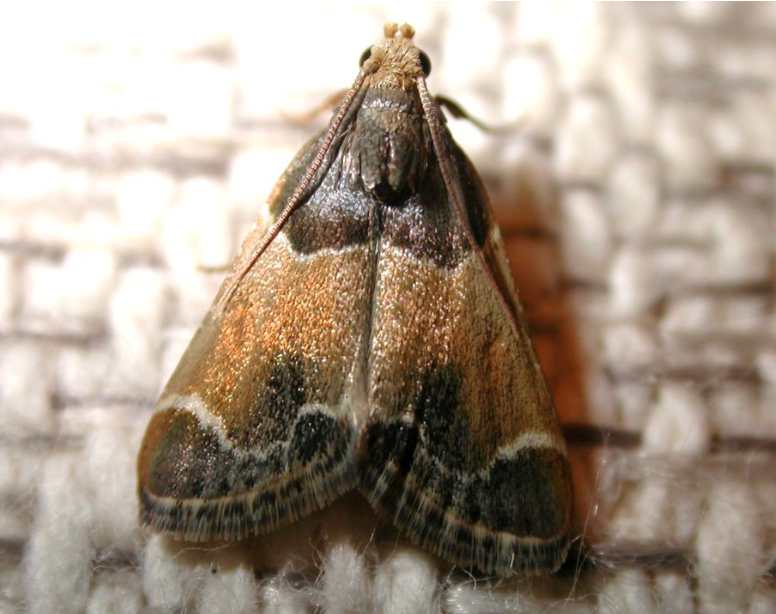
The body size of meal moth adults is about the same as adult Indianmeal moth, but when at rest have a much wider wingspan. The base and outer portion of the front wings are brownish red with the middle portion whitish.
Habits: Meal moths are classic stored product pests, and are generalist feeders. The larvae feed on flour, meal, grain, seeds, and animal feed, like oats, straw, and hay. They prefer environments that are cool and damp and where the grain is spoiled. Commonly found with other stored product pests. The larva is 1 in., with a black head and tail end with an orange tinge. Meal moths can complete a life cycle in 8 weeks.
Interventions: Like the Indianmeal moth, as well as myriad other stored product pests, find infested material (cereal, bird seed, crackers, oatmeal, etc.) and discard. Clean up spilled food, and store potentially susceptible items in tightly sealed containers. Never treat human food sources with an insecticide. For more detailed information on stored product pests, see UGA Extension Bulletin 1378, Stored Product Pests in the Home, at https://extension.uga.edu/publications.html.
Might be confused with: Indianmeal moth, clothes moth, other, small, incidental moths that fly indoors when doors are open.
Bagworms (Psychidae):
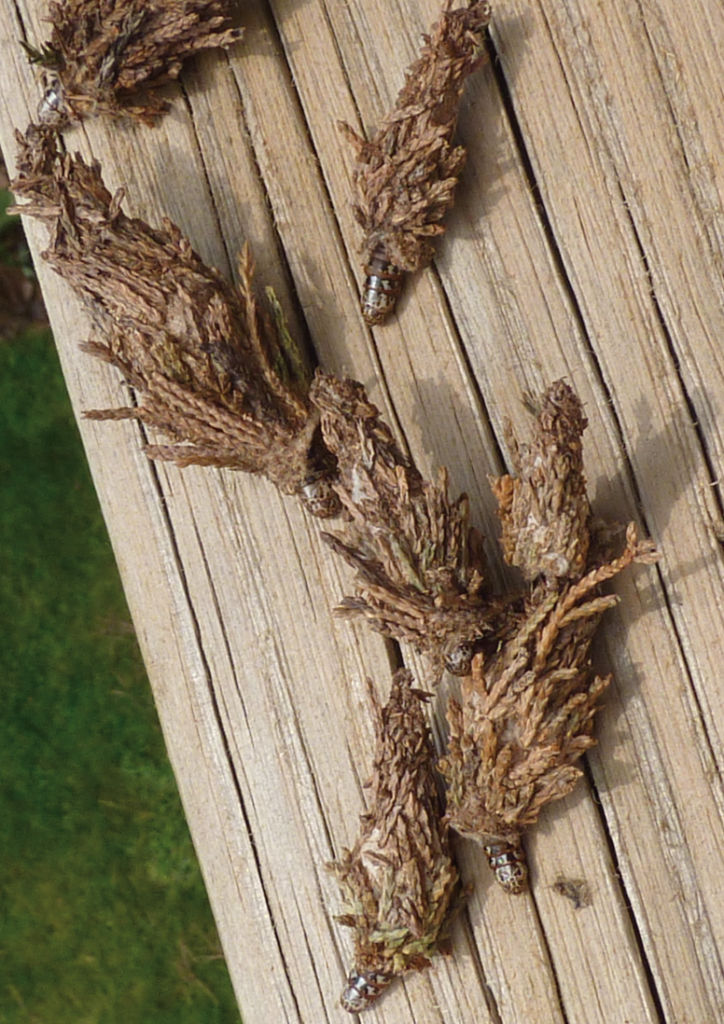
The bag of a bagworm is a hollow container inside of which lives a wingless, adult female moth or a larva. Adult male moths are winged and look nothing like the wingless female, who remains hidden and protected inside the bag. Males are short-lived and are rarely seen because they live only a couple days. It is typically the mere presence of the bag that initiates interest from property owners and precipitates calls to pest management professionals or entomologists.
Habits: Eggs, having overwintered inside a full-sized bag, hatch in the spring. During the summer, larvae progress through seven stages while feeding on their host plant. Bagworms are plant-feeders and consume vegetation from a wide variety of shrubs and trees, sometimes to the point of near defoliation. While feeding, larvae construct and expand the size of their protective bag, which is made of silk and bound together pieces and parts of plant material from the host plant. The larva’s head protrudes from the open end of the bag (the posterior end is closed) so the insect may remain feeding and mobile throughout development. Each time the larva molts it increases the size of the bag to accommodate a larger larva. The last instar larva (1 in.) may wander away from the host plant, attach a silken strand to a substrate, and pupate. At this time, the insect and bag are inactive, immobile, and the bag is as large as it will be. Oftentimes the bags will attract the attention of the property owner because they may be attached to walls, piers, sides of buildings, and other substrates that make them highly visible and out of the ordinary. If the bag is attached to a plant, it garners little attention because it typically goes unnoticed. During the fall adult males emerge from pupation as free-flying moths, while adult females emerge from pupation but remain inside the bag as a caterpillar-like insect with small eyes but no antennae, wings, mouthparts, or legs. Following emergence, adults mate (with the female still inside the bag), the female lays up to 1,000 eggs inside her bag, and then both males and females die shortly after egg laying. Neither adult is capable of feeding, and adult males live only a couple days while adult females live only a couple weeks. Eggs overwinter and do not hatch until the following spring.
Interventions: While feeding, bagworm larvae can cause considerable defoliation of infested plants, and for this reason it might be advisable to treat infested plants with a liquid insecticide labeled for this purpose. Unsightly bags can simply be scraped off the substrate to which they are attached.
Might be confused with: immature green lacewing (trashbug), plaster bagworms, case-making clothes moth.
Flies (Order Diptera)
Adult flies are recognized by two functional front wings and by two small structures, called halteres (modified hind wings), that are club-shaped and probably function in a flight-balancing manner. This group of insects is good at, as their common name suggests, flying. Therefore the best interventions are aimed at finding and eliminating the larval (immature, non-flying stage) feeding sites. The larvae of most pest species leave the feeding site and ‘wander’ some distance from their food source (usually wet conditions) to pupate (usually dry conditions). Proper sanitation is the key to pest fly management. Remove garbage and other refuse at least twice per week to avoid fly problems.
Crane flies (several families represented, especially Tipulidae and Trichoceridae):
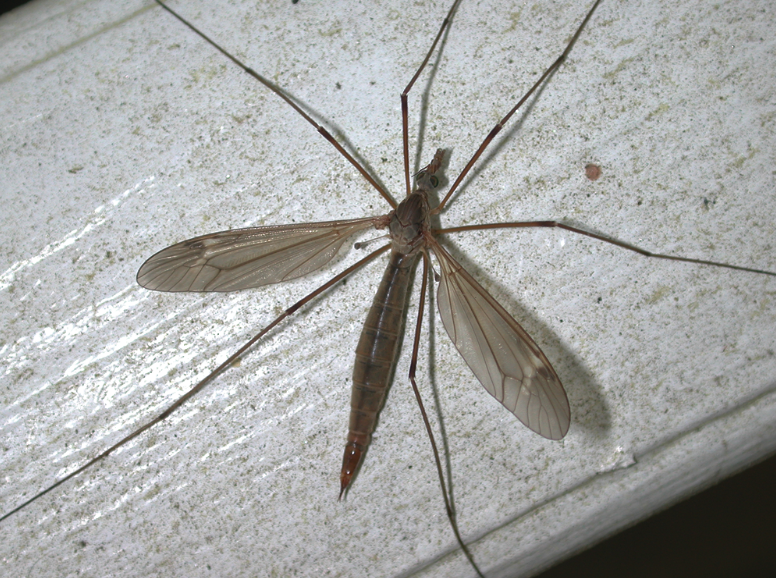
Crane flies have long legs, a long slender body, and vary in body length from 1/16 to 1 in.. Some crane flies may resemble large mosquitoes. Color will vary depending on species, but many common species are light brown or tan. The larvae are called leatherjackets and can damage lawns by feeding on the roots of grass.
Habits: Crane flies generally rest with their legs spread widely. Adults feed on nectar or do not feed at all; many have vestigial (non-functioning) mouthparts. Once they become adults, most crane flies simply mate and die, all within a few days. They do not bite humans.
Interventions: No action recommended.
Might be confused with: mosquitoes.
Fruit flies (Drosophilidae):
The most common species have red/orange eyes, but not all fruit fly species have red/orange eyes. Fruit flies often hover around and just above food (most often decomposing vegetable matter) prior to landing. Flies are 1/8 in..
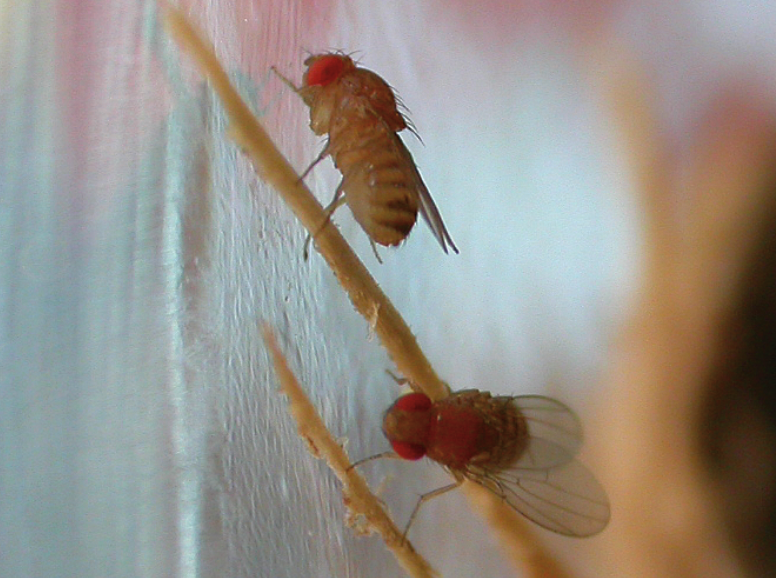
Habits: Feed mainly on decaying vegetable matter, compost, rotting fruit, etc. Often found around salad bars and restaurants where vegetable matter and juices collect. Also called vinegar flies, since vinegar (acetic acid) is a decomposition product of some rotting vegetable matter.
Interventions: Find larval fly feeding site(s) and clean or otherwise throw away rotting fruit or vegetable matter. Remove garbage, including the plastic liner, and other refuse at least twice per week. Thoroughly clean all garbage receptacles at least twice per month.
Might be confused with: humpbacked flies, fungus gnats, moth flies.
Fungus gnats (several families represented; mostly Sciaridae):

venation (inset)
Photo by D. Cappaert,
Bugwood.org
Small to medium sized flies often with smoky black wings. Y-shaped wing venation is characteristic of Sciaridae.
Habits: Often found in overwatered plants indoors or in otherwise wet conditions.
Interventions: Find larval fly feeding site(s) and clean or otherwise dry out. If desired, apply a soil drench with an appropriately labeled liquid insecticide.
Might be confused with: mosquitoes, fruit flies, humpbacked flies, moth flies.
Black soldier flies (larva) (Stratiomyidae):
Strongly-segmented larva, 3/4 to 1 in., with two 1/16 in. protrusions from one end. Adult flies are rarely seen, but are 3/4 in. and appear wasp-like with two clear spots on the upper abdomen.
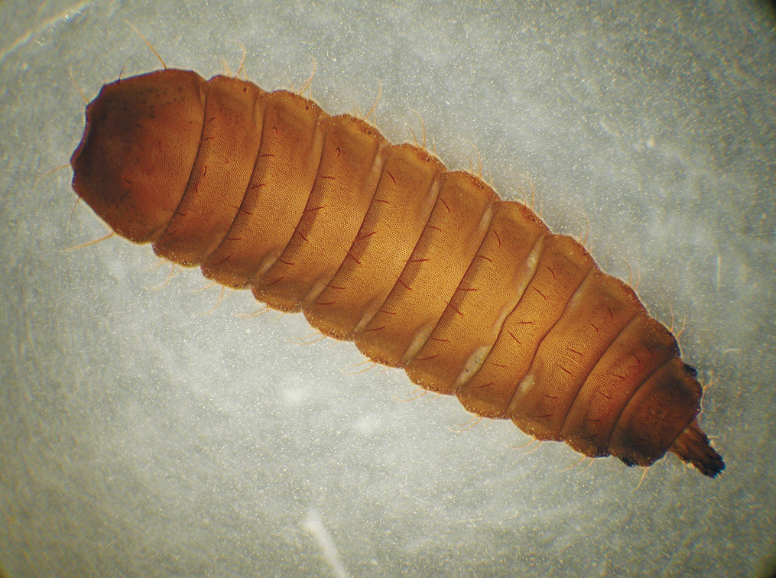
Habits: In homes, larvae usually are found in the bathroom. Presence in the bathroom may be indication of sanitary (sewer drain or septic tank) problems because larvae feed in putrid, wet conditions. This insect also lays eggs and larvae develop in piles of damp organic matter such as compost piles. Like many fly species, larvae are known to wander well away from their breeding site into areas where they pupate.
Interventions: Find the larval food source and address the problem by sanitation or moisture management. Sewer line exhaust pipes can be screened to prevent fly access. Might be confused with: adults look like wasps.
House flies (Muscidae: Musca domestica):
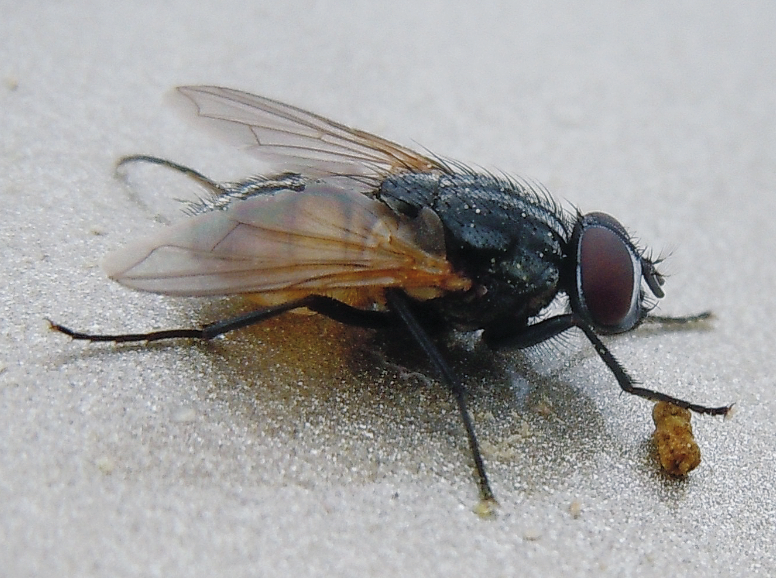
Photo by N. Hinkle,
UGA Entomology
The most recognizable of all fly species. Black, drab, 1/4 in., fast-flying, often numerous around garbage cans and related refuse areas.
Habits: Breeds in garbage, trash, animal waste, and other organic refuse. Like most flies, they are found most frequently breeding in overly liquid or wet conditions. Often associated with unsanitary, unkept conditions, such as areas abundant in animal waste or human garbage/landfills. The term maggot is most commonly used in reference to this fly’s larval stages. Because flies are pushed by prevailing, local winds, their source may be from some distance away.
Interventions: Proper sanitation and exclusion is an effective means of reducing fly numbers. Indoors, deploy and maintain sticky traps associated with attractive lights (commercial insect light traps) and/or the chemical attractant Z-9-tricosene. Be sure that indoor light traps are situated so that they cannot be seen by flies from the outside. There is no scientific evidence to support claims that a hanging bag full of water serves as a deterrent to house flies. Remove garbage and other refuse at least twice per week.
Might be confused with: blow flies.
Eye Gnats (Chloropidae: Liohippelates spp.):
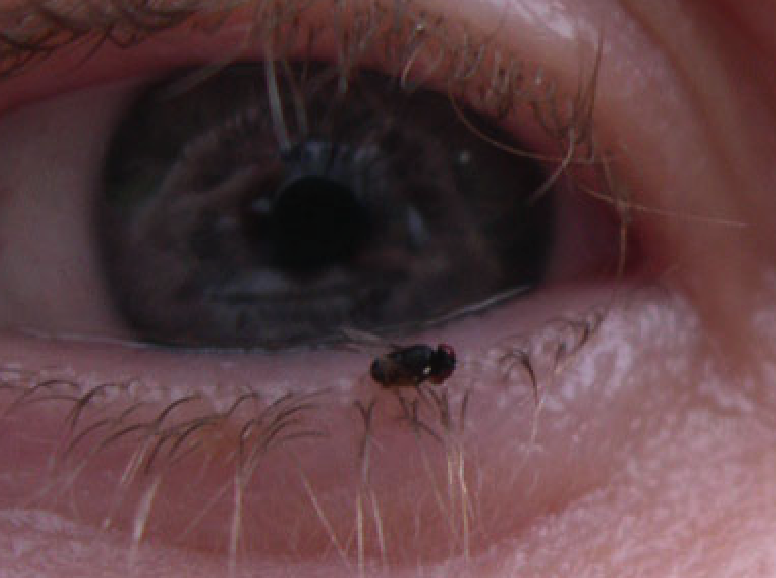
Photo by N. Hinkle,
UGA Entomology
In Georgia, this is the insect most-commonly referred to as a gnat. Eye gnats are small (1/16 in.), annoying, relentless flies found from central to south Georgia and south of the commonly referred to “gnat line”, or Fall Line (that natural, historic shoreline of the Atlantic Ocean running from Columbus, through Macon, and to Augusta that separates Georgia’s northern Piedmont [clay soils] from its southern Coastal Plain [sandy soils]).
Habits: Eye gnats are attracted to fluids secreted by the eyes, nose, ears, other natural orifices, and open wounds where they hover around, relentlessly and annoyingly. They eventually can consume fluids (protein) from these sources that they need for egg production. Although they do not bite, eye gnats are known to mechanically transmit, on their body parts, the bacteria that leads to human acute conjunctivitis, or pink eye. Eye gnats prefer to lay eggs just below the surface of moist, loose, well-drained sandy soils with fresh organic matter present (cut grass, hay, crop stubble, manure, etc.). Due to their small size eye gnats can be wind-blown from their breeding site. They are not very strong flies, and when flying remain close to the ground.
Interventions: Like all flying insect pests, it is best to find the eye gnat’s breeding source and address the problem there. Admittedly, this may be difficult because breeding sites are often unknown. At potential breeding sites, sanitation is important. Reduction of organic debris and drying the habitat are recommended at these sites. To deal with existing eye gnat problems, physical barriers such as screens should be in good shape. The insect repellent DEET may also provide temporary relief. Because eye gnats fly close to the ground, an 8-foot-tall screen fence reportedly excludes them. Trapping eye gnats, with raw eggs and water, may reduce their numbers locally. Spraying residual, contact insecticides is not recommended, but if they are applied should be directed to vegetation where adult eye gnats rest.
Might be confused with: fruit flies, phorid flies, fungus gnats, black flies, numerous other small, flying insects.
Humpbacked flies (Phoridae):
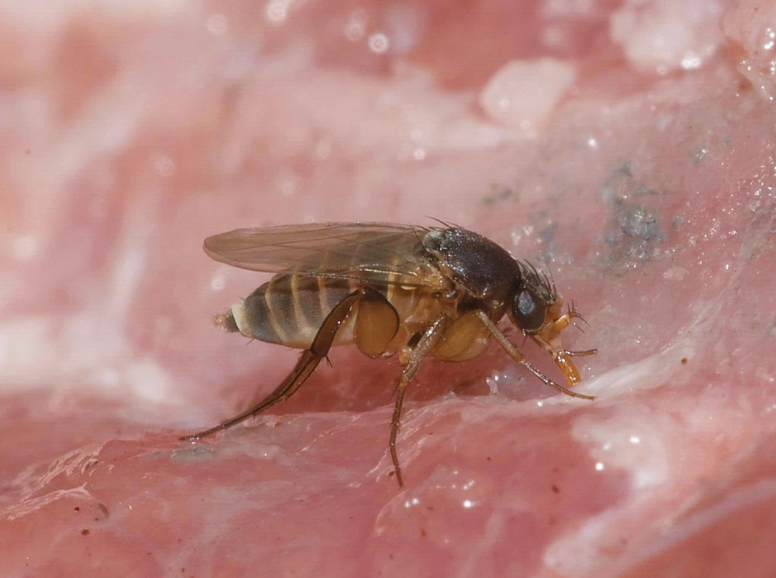
Photo by S. Ellis,
Bugwood.org
Also referred to as scuttle flies or coffin flies. Often scuttle about on the surface around and on infested materials. Humpbacked flies are about 1/8 in..
Habits: Often associated with dead and decaying animal or plant matter (e.g., dead insects, rotting potatoes), bacterial buildup in drains (drain and sewer scum) in bathrooms and kitchens, and in/around garbage cans.
Interventions: Find and clean fly breeding site(s) and/or clean out drains. Make certain that the water trap in the drain line (especially common in less frequently used sinks) is filled—if the water trap dries out, flies and other pests that live in the drain lines will be able to enter the building. Remove garbage and other refuse at least twice per week.
Might be confused with: fruit flies, moth flies, fungus gnats.
Midges (Chironomidae):
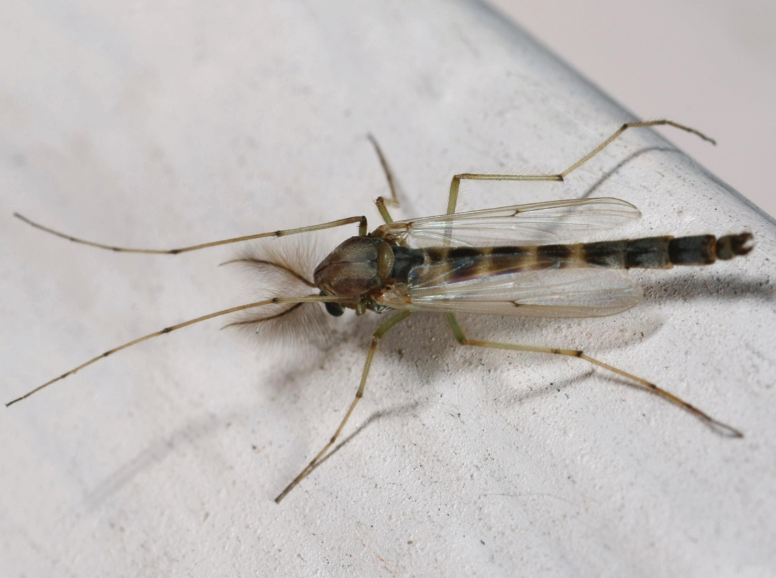
Photo by J. Berger,
Bugwood.org
Visual appearance like mosquitoes, but lack a proboscis and scales on their wings. Males with long, feathery antennae similar to male mosquitoes. Usually numerous.
Habits: Midges are sometimes associated with polluted lakes and ponds, but always associated with water because larvae, referred to as bloodworms because of their red color, are aquatic and live on the floor of ponds, lakes, and other bodies of non-flowing water. Midges do not bite. In fact, adults are short lived and do not feed. They can, however, become a major nuisance because of their strong attraction to lights. Adult midges typically emerge from their aquatic habitat in large numbers and are attracted to light-colored surfaces, such as the sides of nearby buildings with bright lighting.
Interventions: To address the nuisance aspect of adult midges on structures, keep lights off during mass emergences from nearby bodies of water and/or deploy fans to discourage midges from settling on walls and other surfaces where they are not wanted. If desired, apply a localized treatment with an appropriately labeled residual spray to the side of buildings, especially around lights, where midges are most abundant. Never, however, apply a pesticide near or directly to water. Many residual, contact, acute pesticides are highly toxic to fish and other aquatic life – including those available in the homeowner market. Read and follow label directions prior to applying any pesticide spray. For a more permanent solution, the source of the problem must be addressed by application of a larvicidal product to areas where larvae are found in the aquatic substrate. One product specifically developed for this purpose is Bactimos PT. This granular bait product contains a bacteria (Bacillus thuringiensis supsp. israelensis) that must be eaten by the larvae. It is therefore applied directly to aquatic, larval habitats where it sinks and is later consumed by the midge larvae. Application and use of Bactimos PT must be conducted by a licensed professional. Other larvicidal products, applied directly to water, contain the insect growth regulator methoprene. Products containing methoprene are known to disrupt normal insect developmental physiology.
Might be confused with: mosquitoes.
Blow flies (Calliphoridae) and flesh flies (Sarcophagidae):
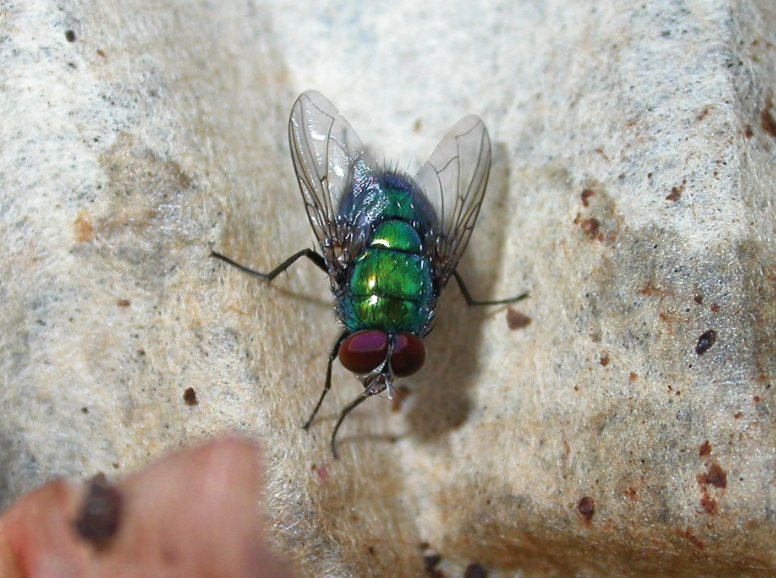
Some species referred to as bottle flies (blue or green). Large, robust, fast-flying flies, 1/4 to 3/8 in., commonly shiny and with metallic blue, green, copper, or gray coloration. Flesh flies are strongly bristled, some have stripes on their pronotum (upper thorax), and some have large, reddish-brown eyes. They resemble house flies in their flying behavior.
Habits: Flies are attracted to and breed in recently dead and decaying animals and animal waste. When suddenly present in large numbers, and when present indoors (typically at windows sills), highly suggestive of a dead animal indoors (e.g., attic, crawlspace, wall void, fireplace, etc.).
Interventions: Find dead animal and remove it. Maintain window and door screens to prevent entry into the house. Remove garbage and other refuse at least twice per week.
Might be confused with: house flies (especially the maggots).
Black flies (Simuliidae):
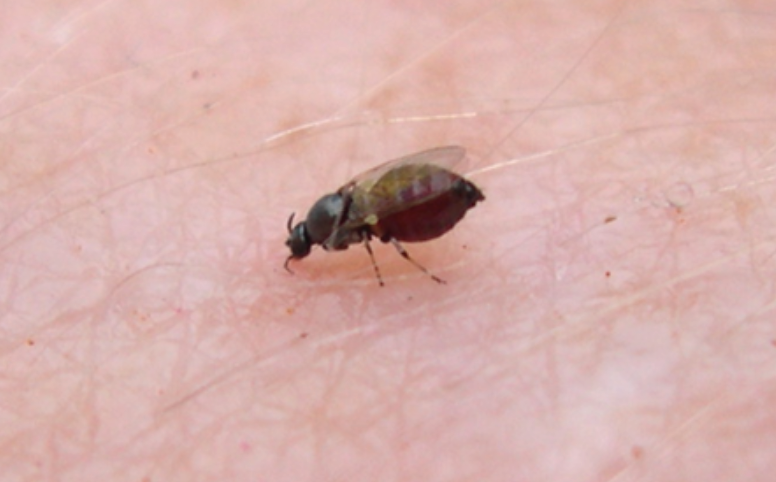
Photo by N. Hinkle,
UGA Entomology
Black flies are small, up to 1/16 in., biting flies that require a blood meal to produce their full complement of eggs. They are a nuisance because they bite and swarm about the head and face.
Habits: Black fly larvae are aquatic and require flowing water to develop. There are more than 240 species in North America alone. Adults are notoriously strong fliers; movement of 20 or more miles has been documented. Adults are day active. Female flies lay 200–500 eggs in or near flowing water, and larvae attach to substrates in the flowing water where food particles (detritus, algae, bacteria, and small invertebrates) are filtered from the flowing water. Larvae typically develop through 7 instars over 10 days to many months depending on the black fly species and environmental conditions, especially water temperature. Pupation occurs on the larval substrate and the adult flies emerge in the following days to months, depending on species and environmental conditions. Adults emerge from spring to late summer, mate, and begin laying eggs. Blood is required for the protein it provides for developing eggs. Females live about a month and may lay several clutches of eggs; males do not bite and die soon after mating.
Interventions: Control of black flies should be left to a professional. One of the more difficult aspects of black fly control is determination of their larval development site(s). Adult females can be found miles from flowing water.
Might be confused with: sand flies, thrips, mosquitoes, eye gnats
Deer flies (Tabanidae: Chrysops spp.):
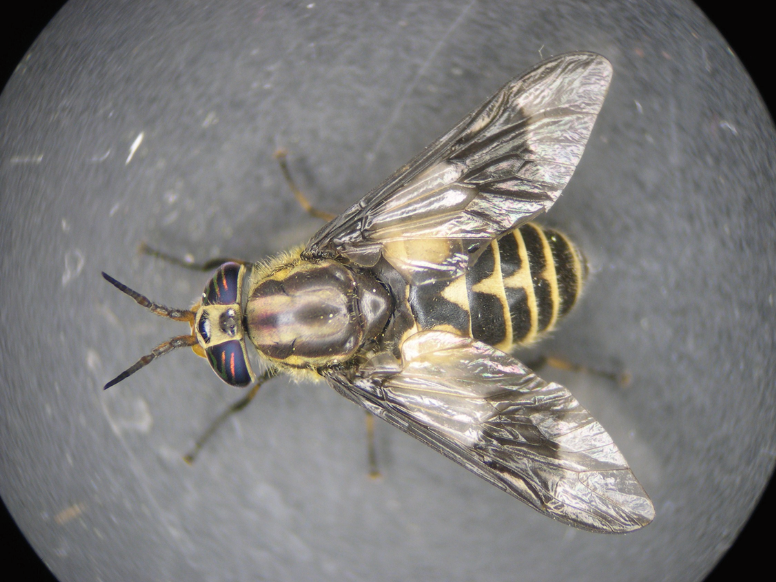
Photo by N. Hinkle,
UGA Entomology
Adult deer flies are very fast fliers, and very difficult to swat or catch. They are about ½ in., yellow to black, with stripes on the abdomen and thorax, and mottled wings with dark patches. They have large, green/blue, iridescent eyes because their hunting is primarily visual.
Habits: The presence of deer flies is associated with a nearby marsh where the larvae develop in wet organic matter. Deer fly adults are a nuisance because they bite. They use sight to locate a host, and are readily attracted to moving, dark objects. Only female flies bite because they need protein (blood) to produce their eggs. The bite from a deer fly is quite painful. When biting, deer fly mouthparts cut into skin in a saw- or scissor-like manner, resulting in bleeding at the wound site. During biting, flies inject an anticoagulant to keep the blood from clotting, then suck up the pooling blood with their sponge like mouthparts. In the spring/early summer, overwintered larvae resume development, pupate, emerge as adults after 2–3 weeks, and then mate. Adults live for just 1–2 months. When the female lays eggs, she deposits several hundred on a horizontal surface—usually aquatic vegetation—above water or wet soil. After a week, eggs hatch and the larvae fall into the water, develop through 6–9 larval stages, overwinter as larvae and the following spring the process repeats.
Interventions: Control is difficult because of their breeding habitat. Without manipulating the marsh habitat (removing or reducing aquatic vegetation in the early spring), there are no good methods for reducing deer fly bite rates. Avoiding bites by wearing long sleeves and long pants and using skin- or clothing-applied repellents (especially to hats) is the best approach. Sticky traps and funnel traps will attract and kill some adults. Because adults are attracted to dark, moving objects, a classic deer fly trap consists of hanging a round, black ball, coated with sticky glue, from a tree, or below a funnel trap. When the ball moves, it attracts flies that get stuck in the glue. Insecticide use is not recommended.
Might be confused with: mosquitoes, house flies, stable flies.
Mosquitoes (Culicidae):
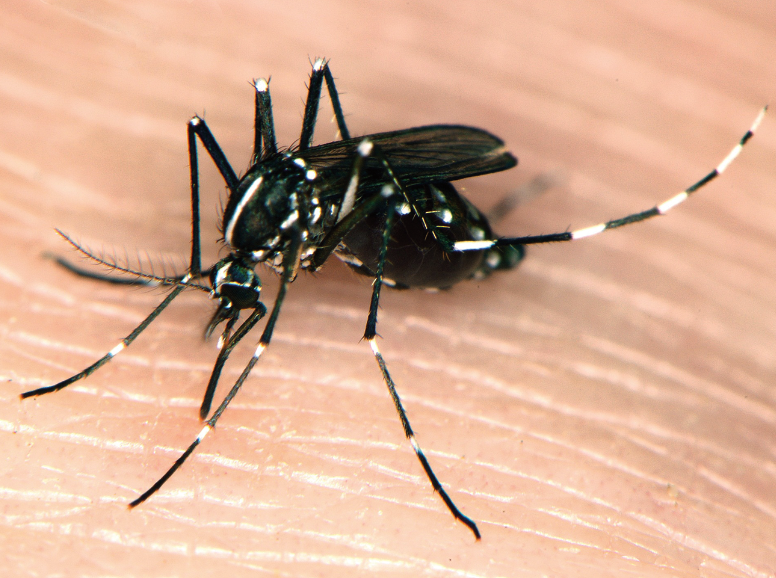
Photo by S. Ellis,
Bugwood.org
Delicate, long-legged, 1/8 to 1/4 in. flying insect. Distinct buzz from flying mosquitoes is the sound of their wing beat. The Asian tiger mosquito (Aedes albopictus), one of 60-plus mosquito species in Georgia, has distinct black and white legs, while other species are dull brown.
Habits: Female mosquitoes bite because they require blood to produce the protein needed for egg production. Males of most species feed on nectar from flowers, but do not bite humans. Like other blood-feeding arthropods (ticks, fleas, and bed bugs), mosquitoes are attracted to carbon dioxide, as it is indicative of a warm-blooded host. Some people are indeed more attractive to mosquitoes due to chemicals on the skin that make them more attractive than other people. Mosquitoes require standing water for larval development. The adults are common in shaded, wind-protected areas with abundant vegetation (low growing ground covers and tall grass). Many human-biting species are most active at dusk and dawn.
Interventions: The larval stage (wriggler) is least mobile and most vulnerable stage to any management strategy. Eliminate standing water, clean gutters and remove containers that can hold rainwater. Follow recommendations in the section Proactive Pest Management. Apply floating briquettes that contain Bti (Bacillus thuringiensis subsp. israelensis) to kill the larvae in standing water. Avoiding bites by wearing long sleeves and long pants and using skin- or clothing-applied repellents (especially to hats) is the best approach. See EPA website on repellents at https://cfpub.epa.gov/oppref/insect: Find the Repellent that is Right for You. For more information see University of Georgia Extension Circular 782, Stinging and Biting Pests, at https://extension.uga.edu/publications.html.
Might be confused with: midges, crane flies.
Drain flies (Psychodidae: Psychoda spp.):

Also referred to as moth flies. Oblong or oval, they appear moth-like, and are about 3/16 in., with fuzzy wings. Larvae are up to 1/2 in..
Habits: Commonly found in bathrooms (breeds in scum in drains, showers, overflows, toilet bowls, etc.). Adults rest motionless on walls until disturbed, and then fly well. Need wet conditions to breed. When toilets have gone unflushed for an extended period, moth flies may lay eggs in the toilet tank, and larvae can be found there. When the toilet is finally flushed, larvae can make their way into the toilet bowl, where they are discovered.
Interventions: Clean the inside of the drain of all scum and detritus using a mild cleanser and a bristled brush. Never pour insecticides into drain. Pouring bleach into drains is not effective. Make certain that the water trap in the drain line is filled—if the water trap dries out (especially common in less frequently used sinks), flies and other pests that live in the drain lines will be able to enter the building. To help determine whether a particular drain is infested, invert a clear cup over the drain. If flies emerge from the drain, they will be trapped by the cup and can be seen.
Might be confused with: fungus gnats, humpbacked flies, fruit flies, and small moths.
Hover flies (Syrphidae):
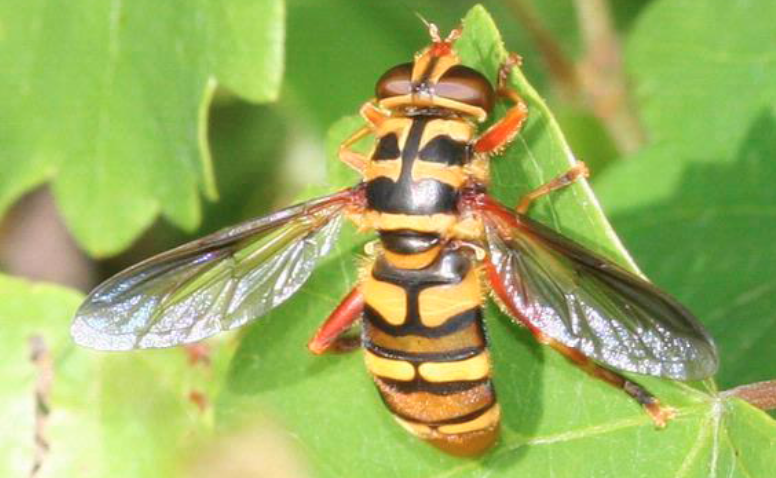
Photo by J.N. Dell
Some adult hover flies closely resemble, or mimic, yellowjackets, and because they are fast flying, and the threat of sting from a yellowjacket is readily anticipated, getting close enough to the hover fly to realize that it is indeed harmless is unlikely.
As such, when hover flies are encountered, they are often avoided because they are presumed to be a stinging wasp.
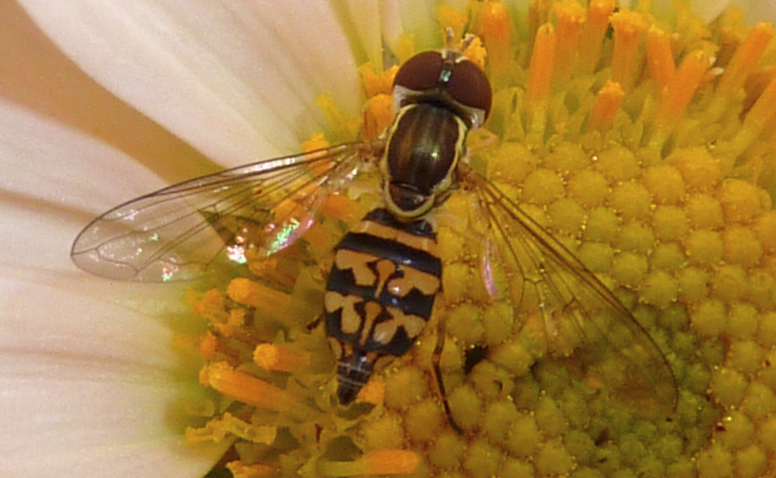
Habits: Hover flies are harmless, highly beneficial insects. Adults are pollinators and can often be seen visiting flowers or feeding on the sweet honeydew produced by aphids and scale insects. The larvae of some hover flies are predatory on plant-eating aphids.
Interventions: None needed. Hover flies are harmless, beneficial predators on aphids (plant pests) in the larval stage, and as adults serve as pollinators. They are all around beneficial. Might be confused with: yellowjackets.
Tiger bee fly (Bombyliidae: Xenox tigrinus):
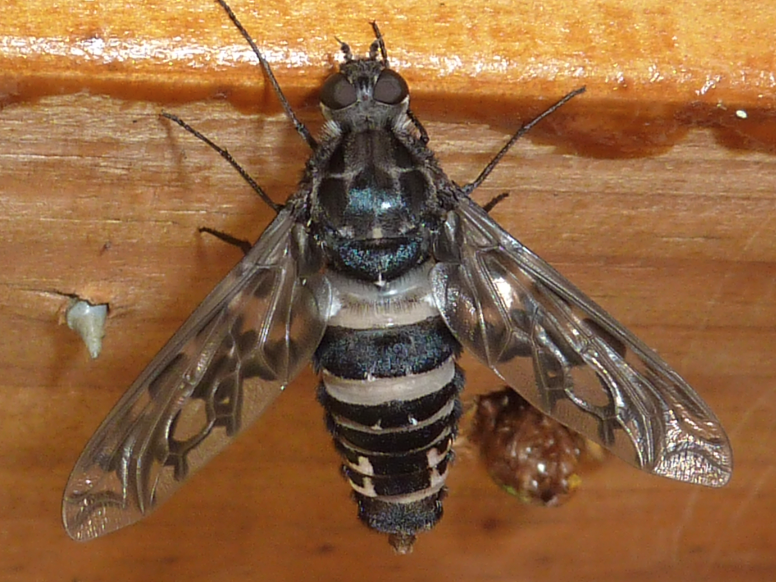
1 in., robust, mottled, fast-flying insect often seen in late spring/early summer hovering around and frequenting areas where carpenter bees have been, or are, active; wing coloration is light and dark mottling, thus the name tiger. Bee flies generally have a long proboscis and large eyes, and are sometimes mistaken for horse flies or carpenter bees.
Habits: Bee flies mimic bees, and other large flies such as horse flies, in flight because they are fast, and details of their appearance are difficult to see. Tiger bee flies are true flies and are harmless. The tiger bee fly is a natural enemy of carpenter bees and is why they are most often seen flying furiously around areas where carpenter bees have been or are active.
Interventions: None needed. Do not kill tiger bee flies. They are harmless. Because they are natural enemies of carpenter bees, and thus highly beneficial, they should be left alone.
Might be confused with: carpenter bees, horse flies, large wasps and bees.
Ants, Bees, and Wasps (Order Hymenoptera)
This group of insects contains some of the most beneficial insects known. Besides the honey bee, the Hymenoptera also contains many species that are parasites and predators of highly destructive insect pests. However, there are also Hymenoptera that are considered pests. Some sting and can create a life-threatening medical condition called anaphylaxis in people allergic to that particular venom. Generally, all mature, adult members of this order have four membranous wings, with the hind wings smaller than the front wings.
Ants
All ants belong to the family Formicidae. It is important to correctly identify the type of ant involved in an infestation because of the diversity of lifestyles represented by this group of insects. Interventions that include insecticidal baits are most effective against ants because of their social nature (no one has trouble with a single ant, but does with many ants), so the main target of an ant management program should be the nest. Ant social structure involves sharing food so it is often simplest to feed ants insecticidal bait and let them carry it back to the nest rather than spending time trying to locate the nest(s).
Acrobat ants (Crematogaster spp.):
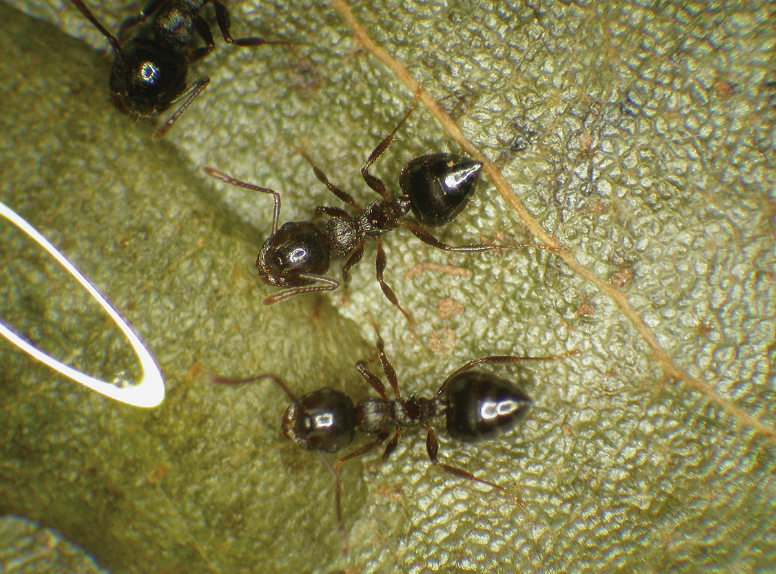
All worker ants in the colony are the same size, about 1/8 to 3/16 in., and are shiny black to brown. The abdomen is distinctively heart shaped when viewed from above. Ants often walk with the abdomen projected into the air at a 45 degree angle.
Habits: Acrobat ants commonly trail onto buildings from trees via branches and overhead power and telephone cables that touch the building. Ants commonly nest in foam board insulation, leaving insulation dust on areas directly below the nest site that reappears after it is cleaned up. Debris from acrobat ant nest sites often contains bits and pieces of uneaten insects that have been only partly consumed, dead acrobat ants from the colony, and pieces of sawdust and/or insulation the ants have chewed.
Interventions: Cut limbs away from structure. Bait (liquid and/or gel bait) where ants are found foraging. If baiting is not successful, apply a localized treatment with an appropriately labeled residual spray where ants are found (outdoors only), especially on tree trunks and limbs.
Might be confused with: other, similarly sized ants.
Argentine ants (Linepithema humile):
All worker ants in the colony are the same size and about 1/8 in., light brown. Fast-crawling.
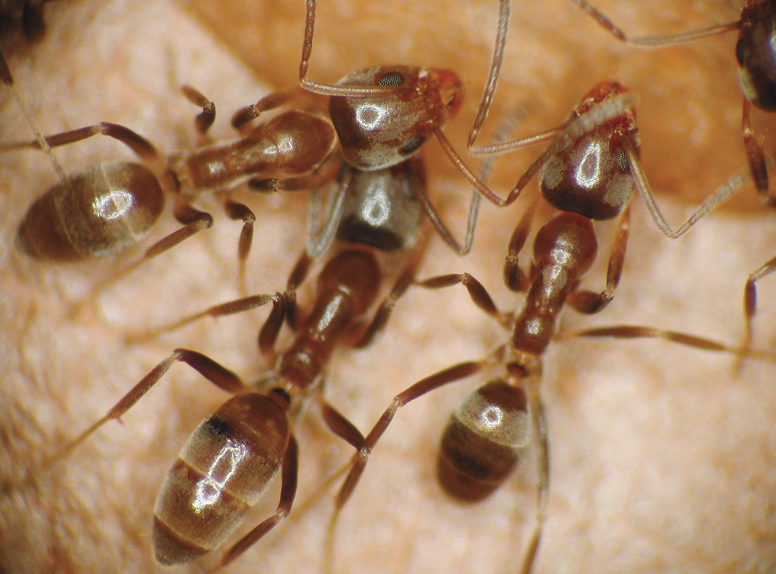
Habits: Primary nuisance ant pest in Georgia. Long, well-established trails visible during summer. Colonies are large, containing tens of thousands of ants. They nest mainly outdoors, in mulch and leaf litter, while foraging into the canopy of trees. Can be difficult to control in winter, as they move indoors to escape cold temperatures. Not native to the United States. Sometimes referred to as sugar ants.
Interventions: Bait (liquid and/or gel bait and/or bait stations) both indoors and outdoors at the same time if ants are found in both areas. Place baits where ants are found foraging. In addition to baiting, reduce mulch, extensive ground covers, and vegetation around the foundation. Follow recommendations under section Proactive Pest Management. If baiting and cultural practices do not provide relief, apply a localized treatment with an appropriately labeled residual spray around windows, doors, and nest sites where ants are found. For more information see University of Georgia Extension Circular 926, Argentine Ants, at https://extension.uga.edu/publications.html.
Might be confused with: other, similarly sized ants, especially the odorous house ant.
Black pyramid ants (Dorymyrmex smithi):

Inset photo courtesy Antweb.org
Dull black, 3/16 in., slender, very fast moving ant with a pyramid-shaped projection on its thorax. All worker ants in the colony are the same size. Crawling behavior characterized as fast, erratic, and seemingly random.
Habits: Found outside mainly in sandy, well-drained, dry habitats. When present, ants can be so numerous that they are seemingly everywhere. Do not bite or sting, but may quickly overcome any item, animate or inanimate, placed on the ground. Reach peak population size in July and August in Georgia. Entrances to nest sites are single holes in the ground at the bottom of a funnel-shaped depression in the typical sand habitat.
Interventions: If desired, apply a perimeter treatment with an appropriately labeled residual spray around the foundation of the structure. Treat grassy areas around entire perimeter of structure.
Might be confused with: other, similarly sized ants, such as fire ants and Argentine ants.
Black carpenter ants (Camponotus pennsylvanicus):
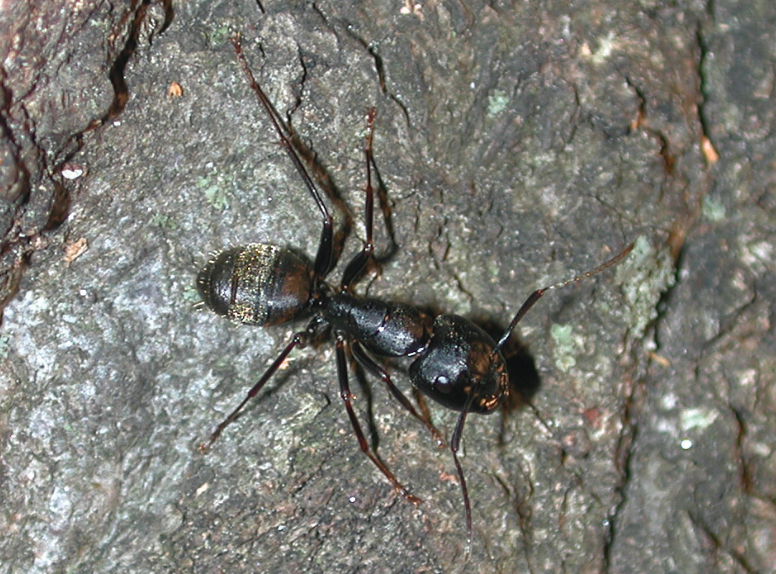
Worker ants from the same colony vary in size (1/4 to 1/2 in.) and are dull black with small gold hairs on the abdomen. The largest of Georgia’s pest ants.
Habits: Carpenter ants live primarily in knotholes in large hardwood trees. They are nocturnal and forage along permanent trails from nest sites to feeding sites. Indoors, they can be found in dishwashers, under insulation, and sometimes in moisture-laden wood.
Interventions: At night, when ants are most active, provide them bait, especially gel bait. Do not use bait stations. Apply bait on active trails, or in a location where ants are found. For more information see University of Georgia Extension Circular 929, Carpenter Ants, and Bulletin 1225, Biology and Management of Carpenter Ants, at https://extension.uga.edu/publications.html.
Might be confused with: other, similarly sized ants, such as mound ants.
Red imported fire ants (Solenopsis invicta):
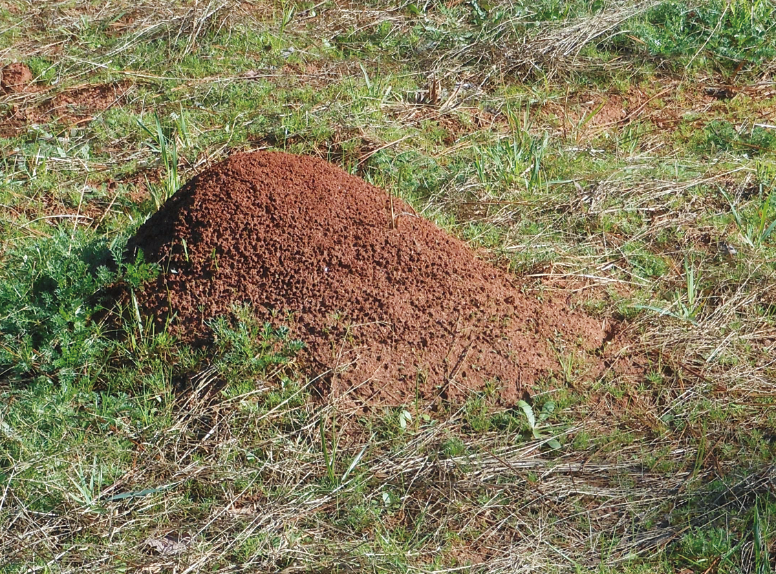
Reddish-brown workers vary in size (1/8 to 3/16 in.) in a single colony.
Habits: Inflicts a painful sting. Builds easily distinguishable mounds in sunny, often disturbed habitats (yards, pastures, right-of-ways, parks, playgrounds, etc.). Not native to the United States.
Interventions: Spring through fall, spread bait granules in late afternoon (when temperatures are warm and the ground is dry) to entire yard or sprinkle one handful of bait around (never on top of) the perimeter of each active mound. Never disturb mounds prior to applying bait. Ten to 14 days after bait application, if active mounds remain, treat them by applying an appropriately labeled liquid insecticide (at least 1 gallon of diluted material—the volume is important to reach the deepest part of the nest under the mound) directly to the top of each active mound. For more information see University of Georgia Extension Bulletin 1191, Managing Imported Fire Ants in Urban Areas, and Circular 782, Stinging and Biting Pests, at https://extension.uga.edu/publications.html.
Might be confused with: other, similarly sized ants, especially pyramid ants.
Asian needle ant (Brachyponera chinensis):
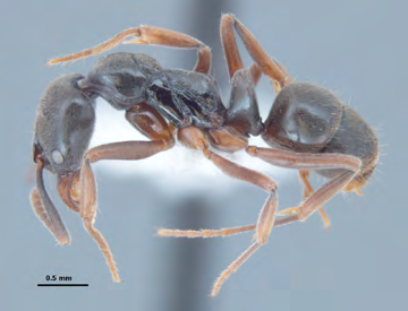
Photo by J. MacGown,
MSU Ent. Mus.
Asian needle ants are approximately 3/16 in. and blackish brown. All ants are the same size. It is an invasive species of Asian origin, and was first identified in the Southeastern United States in the 1930s. It is now found throughout the southeast and is common in Georgia.
Habits: The Asian needle ant is a medically important pest. It has a well-developed sting, and when stung, allergic individuals are known to have experienced anaphylaxis. It nests under items and debris lying on the ground (pavers, patio stones, railroad ties, etc.) and under the bark of decaying trees and logs lying on the ground. Colonies have multiple queens, and up to several thousand workers. Asian needle ants are predatory and will take most small invertebrates in their environment; they are reported to be specialist predators on termites. This ant does not form foraging trails to food, as do most other pest ant species found in the urban and suburban environment. When present, numerous ants will be seen crawling on the substrate in what appears to be a random, chaotic fashion. When foraging, workers can sometimes be seen carrying a nestmate in their mandibles back to a food source they have found.
Interventions: Granular baits should be scattered, and not piled. Alternatively, nest sites can be found and drenched with an appropriately labeled liquid insecticide.
Might be confused with: other ant species.
Mound ants (Formica spp.)
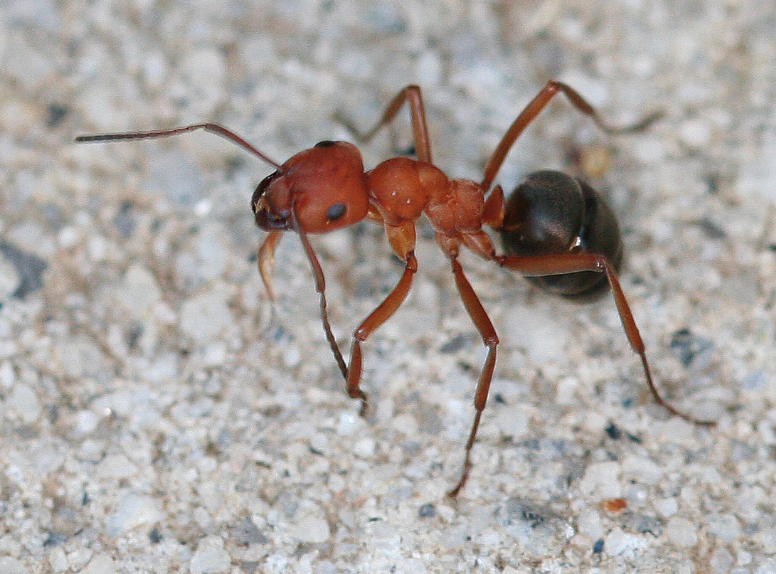
Ants in a single colony are different sizes and about 1/4 to 5/16 in., with a reddish-brown head and thorax and shiny black abdomen.
Habits: Colonies are often very large, encompassing acres of land. Ants make permanent foraging trails in grass and sandy areas where they live (commonly oak forest with open understory). Ants commonly pile large quantities of leaf litter and debris around nest sites. These ants do not sting, but are aggressive and will bite while releasing copious quantities of pungent formic acid. In Georgia, generally restricted to the northwest.
Interventions: Apply granular bait that these ants will take. Because ant colonies are large, a large quantity of bait may be needed. If desired, apply a perimeter treatment with an appropriately labeled residual spray next to the structure.
Might Be Confused With: other, similarly sized ants, such as carpenter ants.
Odorous house ants (Tapinoma sessile):
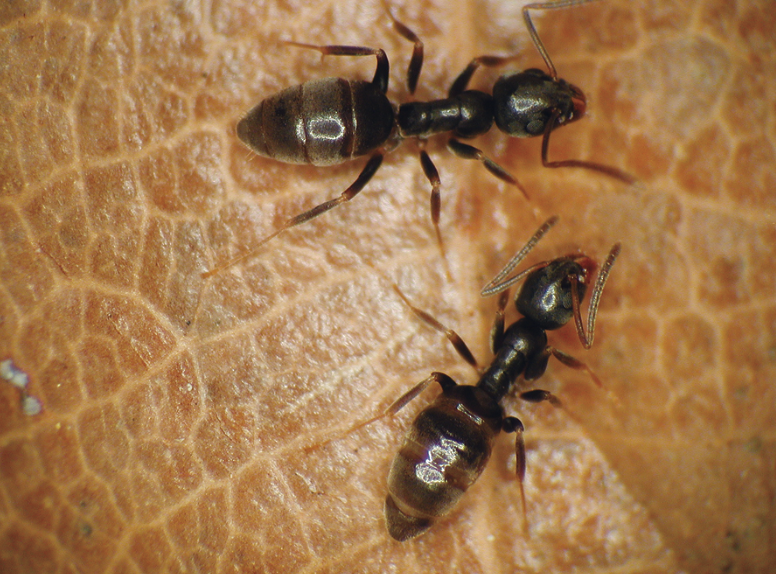
All worker ants in the colony are black and the same size (about 1/8 in.). When crushed, these ants have a pungent odor somewhat like suntan lotion.
Habits: A moderate to major nuisance ant pest, more moisture-dependent than most other ant pests. This ant nests mainly outdoors, in areas where moisture is abundant (heavy ground cover, mulch, ivy, etc.).
Interventions: Bait (liquid and/or gel bait and/or bait stations) both indoors and outdoors at the same time if ants are found in both areas. Place baits where ants are found foraging. In addition to baiting, reduce mulch, extensive ground covers, and vegetation around the foundation. Follow recommendations under section Proactive Pest Management. If baiting and cultural practices do not provide relief, treat with an appropriately labeled residual spray around windows, doors, and to nest sites where ants are found.
Might be confused with: other, similarly sized ants, such as Argentine ants.
Dark rover ants (Brachymyrmex patagonicus):
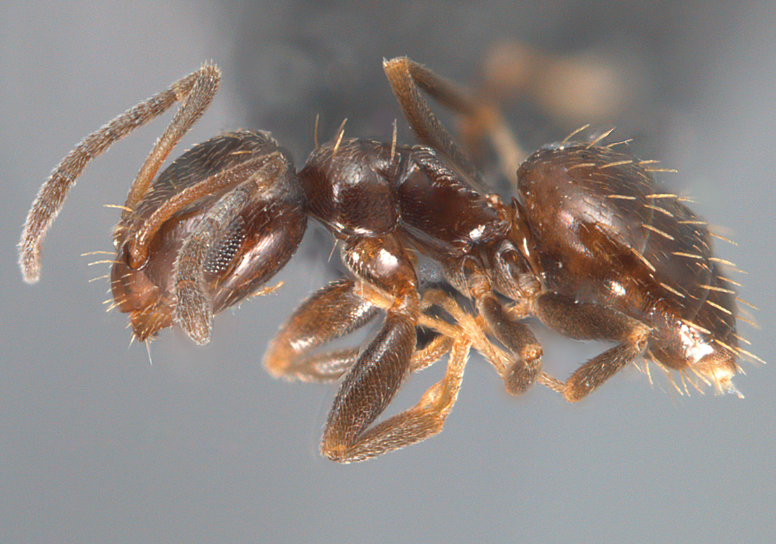
Photo by J. MacGown,
MSU Ent. Mus.
Black or dark brown ants with round abdomen. Workers from the same colony are the same size (1/16 in.). This ant is one of the smallest of the pest ants in Georgia.
Habits: Feeds on honeydew in the canopy of trees. Not native to the United States.
Interventions: Bait (liquid and/or gel bait and/or bait stations) both indoors and outdoors at the same time if ants are found in both areas. Place baits where ants are found foraging. In addition to baiting, reduce mulch and extensive ground covers and vegetation around the foundation. Follow recommendations under section Proactive Pest Management. If baiting and cultural practices do not provide relief, treat with an appropriately labeled residual spray around windows, doors, and to nest sites where ants are found.
Might be confused with: other, similarly sized ants, such as fire ants, odorous house ants, and Argentine ants.
Bees and Wasps
Several groups are represented including honey bees, bumble bees, carpenter bees, yellowjackets, paper wasps, hornets, and various other commonly encountered bees and wasps.
Bumble bees (Apidae: Bombus spp.):
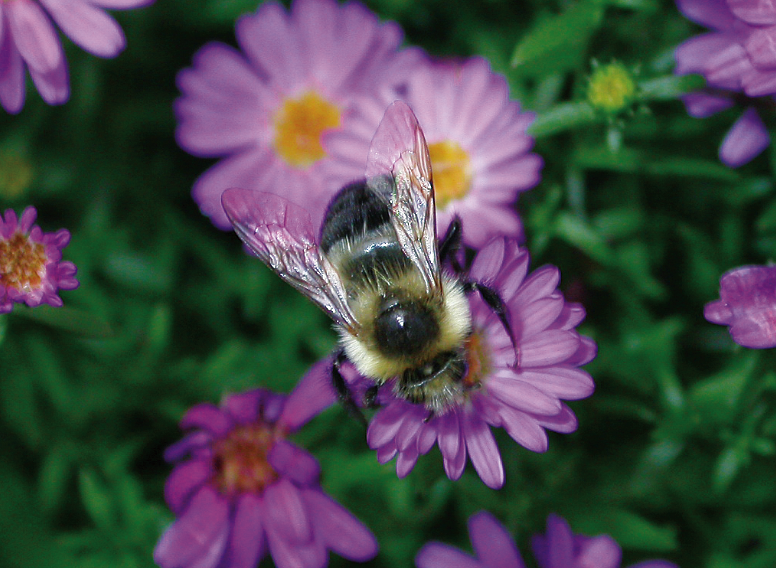
Large, black bees (3/4 in.) with bright yellow hairs on the thorax and/or abdomen. Bees from the same colony are different sizes.
Habits: Bumble bees are common inhabitants of gardens, where they are most commonly found visiting and pollinating flowers. Highly beneficial. Bumble bees are social, and live in a colony with nest mates. Like yellowjackets, colonies nest in the ground. When their nest is threatened, bumble bees can be aggressive and may sting.
Interventions: If the nest is not a threat to the health and welfare of humans, leave it alone as bumble bees are excellent pollinators. If the nest must be eliminated, find the entrance and treat with a labeled insecticide formulated as an insecticidal dust or one of the various wasp and hornet aerosol sprays that shoot their contents up to 20 ft. For more information see University of Georgia Extension Circular 782, Stinging and Biting Pests, at https://extension.uga.edu/publications.html.
Might be confused with: carpenter bees, digger bees, yellowjackets.
Large carpenter bees (Apidae: Xylocopa virginica):
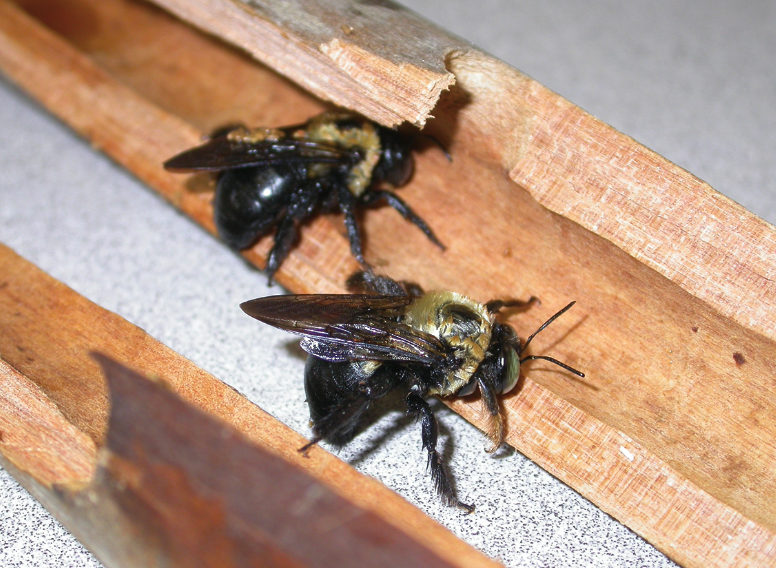
Large, black bees (3/4 in.). Appearance similar to bumble bees but with naked, hairless abdomen. Abdomen is black to blackish blue.
Habits: In Georgia, March–May this bee can be found chewing dime-sized holes in wood boards, logs, etc. It does not eat wood, but chews galleries to create a nest site where eggs are laid. Some bees (males, which cannot sting) appear aggressive. Cedar boards are particularly susceptible to extensive damage by carpenter bees.
Interventions: Apply an appropriately labeled dust, liquid spray, or jet aerosol directly into carpenter bee holes while bees are active. Begin treatment when bees are first found, and re-treat as needed. In late summer, when all bees have left their nest sites, fill holes with wood filler, sand, and paint (or apply a quality wood finish).
Might be confused with: bumble bees, tiger bee fly, giant resin bee.
Cicada killers (Sphecidae: Sphecius speciosus):
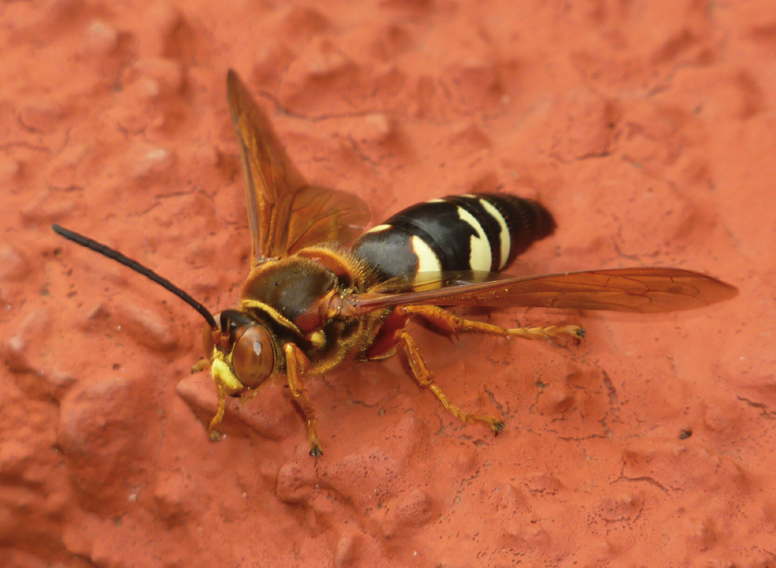
Large (1 to 1.5 in.), fast-flying, yellow and black-striped, solitary wasp with large eyes.
Habits: Although they appear intimidating, wasps are not aggressive. Most active in mid- to late-summer when adults can be found digging holes in loose soil. Like carpenter bees, patrolling wasps are males (and cannot sting), while females actively search for their cicada prey. Female wasps can sometimes be seen dragging their cicada prey into a hole, on which larval wasps feed. Often moderate to large numbers of wasps aggregate at one site at the same time for the purpose of mating and reproduction.
Interventions: The use of mulch (or other ground covers) or improving turf growth and vigor may discourage cicada killers from nesting in these sites in subsequent years. Because these wasps are not aggressive and typically appear for only a 2-3 week period each year, killing them is not advisable. If desired, apply a localized treatment with an appropriately labeled residual spray or dust formulation into each hole at night when the wasps are resting in the nest. For more information see University of Georgia Extension Circular 782, Stinging and Biting Pests, at https://extension.uga.edu/publications.html.
Might be confused with: hornets, yellowjackets.
Digger bees (Apidae: Anthophorinae):
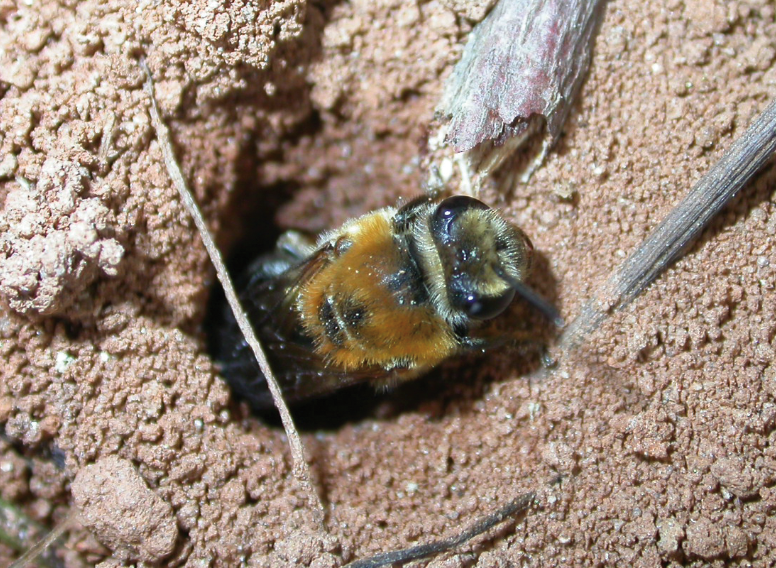
One common species is a gray-colored bee closely resembling the honey bee, 1/2 to 5/8 in.. Females are slightly larger than males.
Habits: In the spring (March and April), this otherwise solitary bee aggregates, often in large numbers, for the purpose of mating and reproduction. Typical aggregation/nest sites are barren, grassless ground, sometimes near a water source. When numerous, dozens to hundreds (even thousands) of bees can be seen flying in an erratic fashion approximately 1 ft above the ground. Bees are beneficial pollinators, and not aggressive even at their nest site.
Interventions: Digger bees are harmless, and killing them is not recommended. To discourage future nest-site aggregations, barren areas should be covered with mulch or new turfgrass should be planted. Irrigating the area on successive days may cause bees to abandon the location.
Might be confused with: honey bees.
Giant resin bees (Megachilidae: Megachile sculpturalis):
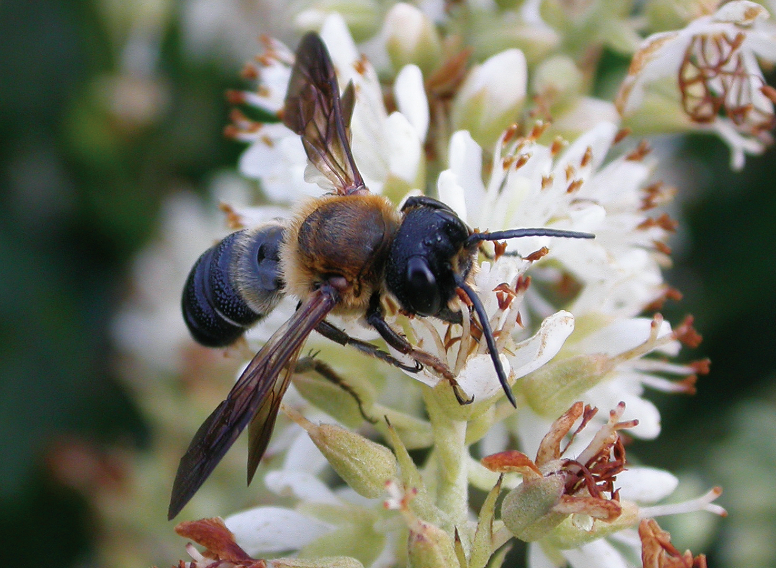
A solitary bee introduced into the Southeastern United States from Asia. Adult bees are large and impressive because of their size, 1/2 to almost 1 in.; larger than most native bees in North America. Belonging to a family called leaf-cutter bees. Somewhat resembles carpenter bees.
Habits: These bees, generally found around buildings and wooden decks, are opportunistic by nesting in existing wooden cavities. In late summer, they are sometimes seen entering and occupying vacant carpenter bee tunnels. They do not chew, eat, or otherwise damage wood.
Interventions: None needed.
Might be confused with: carpenter bees.
Honey bees (including Africanized honey bee; Apidae: Apis mellifera):
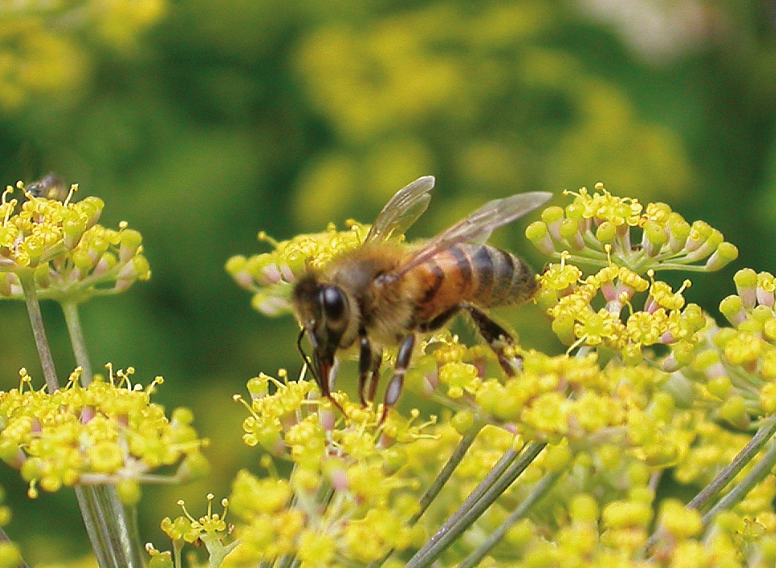
Caramel-colored, 1/2 to 5/8 in., hairy bee sometimes with large accumulations of yellow pollen on their hind legs. Commonly found in gardens visiting flowers while collecting nectar. Africanized honey bees can be differentiated from non-Africanized honey bees only by a professional entomologist.
Habits: Honey bees are one of the best known, most recognized, and beneficial of all insects. They pollinate billions of dollars worth of crops each year. The Africanized honey bee, a more aggressive and potentially dangerous honey bee, was found in Georgia in 2010.
Interventions: The most common problem associated with honey bees is that they sometimes nest inside walls of structures. Do not kill these nests, but call a professional beekeeper or pest management specialist because the bees and honeycomb must be completely removed. Find a beekeeper to remove the bees, then hire someone to remove the honeycomb and replace the wall. All honey bee material and honeycomb residue must be completely removed or secondary pest problems may arise. A carpenter’s skills are often needed. In Georgia, contact the Georgia Department of Agriculture to locate a person licensed by the state in Honey Bee Removal & Control (HBR). For more detailed information see University of Georgia Extension circulars #824, Honey Bee Swarms and Bees in Walls, and #782, Stinging and Biting Pests, at https://extension.uga.edu/publications.html.
Might be confused with: yellowjackets, digger bees.
European hornet (Vespidae: Vespa crabro):
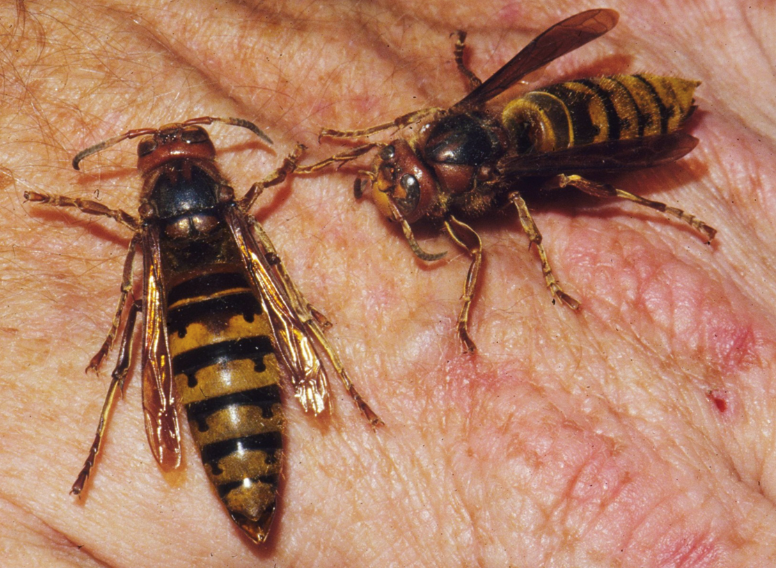
Photo by J. Baker,
Bugwood.org
The European hornet was accidentally introduced into North America about the middle of the 19th century. It is a large eusocial wasp with the wings reddish-orange and the petiolate abdomen brown and yellow striped. There are no native hornets in the United States.
Habits: European hornets build large, aboveground nests, usually in trees. Similar to yellowjackets and paper wasps, European hornets build a new nest each year. Each fall all hornets die, with the exception of several queens, which overwinter. The following spring these overwintered, mated queens initiate the construction of a new nest. European hornets are attracted to lights at night. They are not attracted to human foods and food wastes, as are yellowjackets, but they can damage fruits, such as apples, while the fruit is still on the tree.
Interventions: If European hornets are found around the house at night, because these wasps will forage after dark and are attracted to lights, examine and change the lighting regime (see section on Proactive Pest Management: Other Practices). Do not attempt to remove or treat a nest; call a pest management professional to remove nests near areas of human habitation or activity. For more information see University of Georgia Extension Circular 782, Stinging and Biting Pests, at https://extension.uga.edu/publications.html.
Might be confused with: cicada killers, yellowjackets.
Mud daubers (Sphecidae):
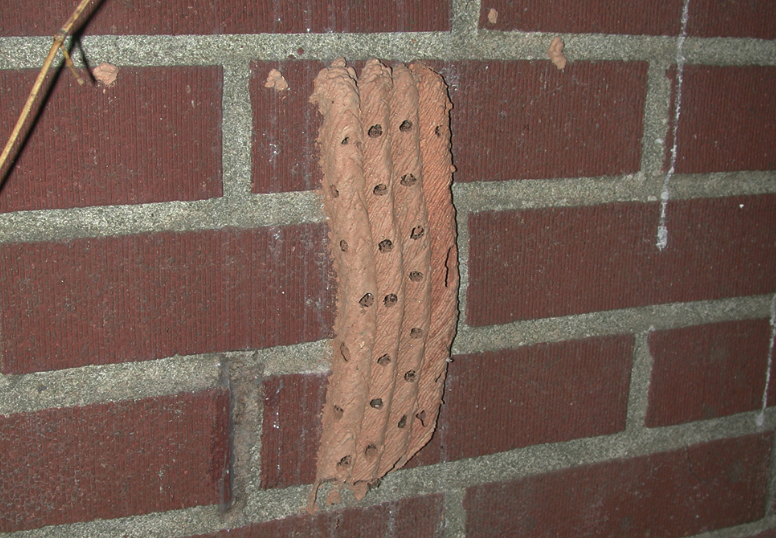
Long, slender, solitary wasps 1 to 1.5 in., with long, slender waists. Commonly glossy black or blue, some species with yellow highlights.
Habits: Builds series of 4- to 6-in. long vertical mud tubes on walls in areas protected from rain and adverse weather. Commonly found under eaves, decks, etc. Each tube is comprised of individual cells housing a single larva and spider prey that wasp larvae feed on.
Interventions: Knock down dry mud nests with a broom and wash mud from wall with soap and water. For more information see University of Georgia Extension Circular 782, Stinging and Biting Pests, at https://extension.uga.edu/publications.html.
Might be confused with: paper wasps, potter wasps.
Mud Dauber tubes
Paper wasps (Vespidae: Polistes spp.):
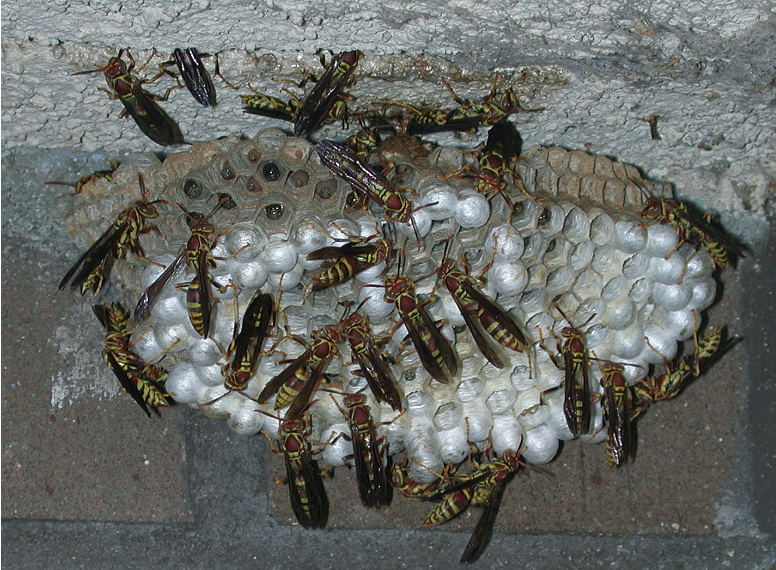
Large (1 in.), aggressive wasps when at their nest. Various species, but all build paper-like, multi-celled, inverted umbrella nests under rain- and wind-protected eaves where wasps can enter and exit easily.
Habits: Each fall all wasps die, with the exception of several queens, which overwinter in an inactive form in a well-protected, secluded environment such as under and in fallen logs and other ground debris. The following spring, queens initiate and build a small paper nest where they lay eggs. Paper wasps build a new nest each year. Colonies grow and reach peak size in the fall, at which time the cycle repeats. Like other social bees and wasps, paper wasps are aggressive when protecting their nest, and may inflict a painful sting in its defense. Adult wasps are excellent predators in vegetable gardens, and are more docile when not protecting their nest.
Interventions: If nests are out of the way, leave wasps alone as they are highly beneficial predators. If desired, spray nest and wasps directly with an aerosol jet spray. Early in the year, before the nest contains too many adult wasps, consider knocking down the nest with a long stick but be prepared—and able—to quickly flee the area as the nest is dislodged. Make certain no one in the area is allergic to wasp venom (stings). For more information see University of Georgia Extension Circular 782, Stinging and Biting Pests, at https://extension.uga.edu/publications.html.
Might be confused with: mud daubers.
Velvet ants (Mutillidae):
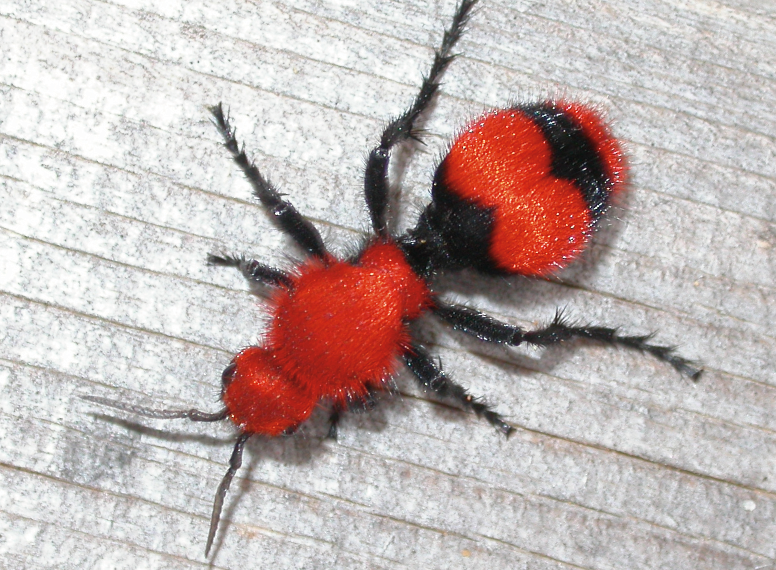
Also referred to as cow killers; they are black and red, velvety, 1 in., appear ant-like, are fast-crawling, and rarely at rest. Females are wingless, males have black wings. Other species are 1/4 in. and orange to red-orange.
Habits: Velvet ants are not ants. They are solitary, wingless, parasitic wasps, and may inflict a painful sting if handled. Never handle or pick up a velvet ant. They commonly parasitize the larvae of other solitary wasps, such as cicada killers.
Interventions: Usually these wasps are not so common that extensive chemical control is required. If desired, crush individual wasps or directly spray them with an appropriately labeled aerosol insecticide. Wide scale insecticide treatments are unnecessary.
Might be confused with: large ants.
Yellowjackets (Vespidae: Vespula squamosa [the Southern yellowjacket] and Vespula maculifrons [the Eastern yellowjacket]):
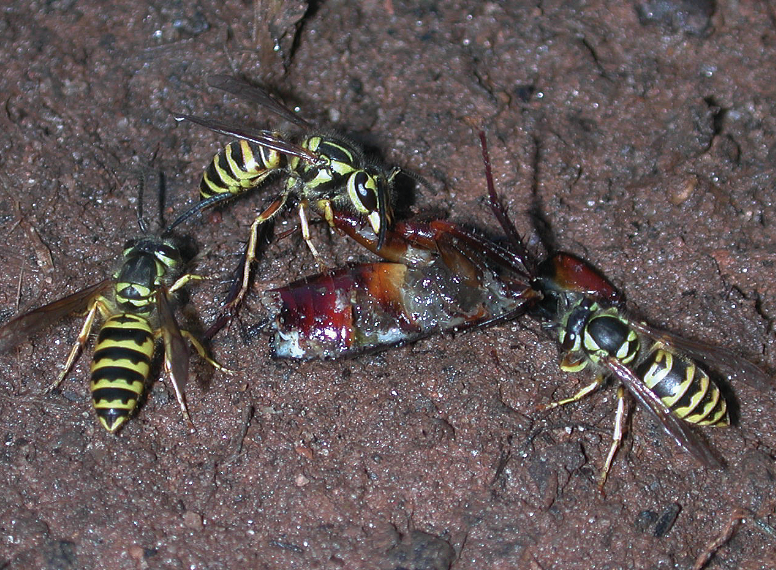
Fast-flying, 1/2 in., black and yellow striped, social predators living in colonies containing workers (hundreds to thousands), queens, and males. The Southern and Eastern yellowjackets are the two most common yellowjackets in Georgia.
Habits: Yellowjackets nest in the ground and will sting en masse when their nest is threatened. Colony threat typically occurs at the nest entrance, where guards are posted, signaling an alarm to all the yellowjackets in the nest (away from the nest, individual yellowjackets are rarely aggressive). Nests are often found by accident as a result of some disturbance near the nest entrance—e.g., while operating a chainsaw, mower, or string trimmer near the nest entrance. Each fall all yellowjackets die, with the exception of several queens, which overwinter under and in fallen logs and other ground debris. The following spring these overwintered, mated queens initiate the construction of a new nest where they lay eggs. Yellowjackets build a new nest each year. Colonies grow through the summer and reach peak population size in the fall, at which time the cycle repeats. Colonies may remain active well into November in Georgia.
Interventions: If nests are out of the way, leave yellowjackets alone as they are highly beneficial predators. If desired, treat the nest entrance (the hole in the ground) with an appropriately labeled jet-stream aerosol insecticide or insecticidal dust at night when all these day-active insects are in the nest. Make certain no one in the area is allergic to venom (stings). Alternatively, seek help from a pest management professional to remove nests near areas of human habitation or activity. NOTE: A mistake during treatment can result in hospitalization or even death from excessive stings. For more information see University of Georgia Extension Circular 782, Stinging and Biting Pests, at https://extension.uga.edu/publications.html.
Might be confused with: European hornets, paper wasps, honey bees.
Southern yellowjacket queen (Vespidae: Vespula squamosa):
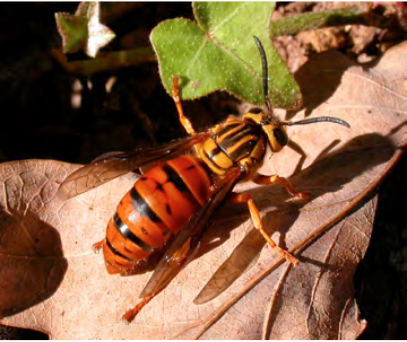
Southern yellowjacket queens are larger and darker colored than worker yellowjackets. Southern yellowjacket queens fly as well as worker yellowjackets. They may resemble hornets or cicada killers.
Habits: Southern yellowjacket queens are seen for only a few months during the spring and fall each year. Each fall, Southern yellowjacket colonies usually die, but not before leaving behind mated queens that spend the winter in outdoor, protected habitats such as under rocks or stones, in logs, and in and under protective litter. While searching for overwintering sites, queens sometimes are encountered after they accidentally wander inside buildings. The following spring mated queens awaken and begin searching for inground voids, like abandoned animal burrows and the voids left by rotted tree stumps and roots, to start a new colony. While searching, it is common for them to come under doors where door sweeps are not present, and when inside are attracted to the sunlight in closed windows.
Interventions: None needed, unless there is concern that a new yellowjacket colony might be founded nearby. In this case, queens should be killed. If queens are of no threat, they can be captured and released to the outside. Yellowjacket nests located in the ground, near high traffic areas or in wall voids of a building, should only be treated with a registered insecticide at night when all foraging yellowjackets are back in the nest. Treatments should preferably be performed by a pest management professional.
Might be confused with: European hornet, Asian giant hornet, cicada killer.
Blue-winged wasp (Scoliidae: Scolia dubia):
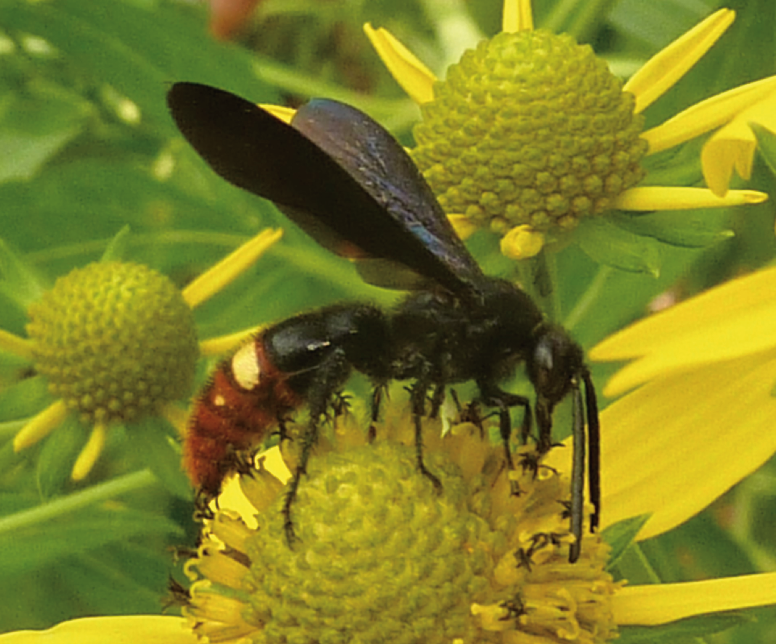
The blue-winged wasp is about 1 in. and is a strong flier. It has black/blue wings, and the abdomen is characteristically fuzzy; the front half of the abdomen is black while the back half is cinnamon to dark red with two characteristic yellow spots on the third abdominal segment.
Habits: The blue-winged wasp is a parasitoid of soil-dwelling beetle larvae in the family Scarabaeidae (e.g., June beetles and Japanese beetles). It routinely visits flowers to take nectar. Scarab beetles are common pests of lawns. When scarab larvae are present in the soil, numerous blue-winged wasps may be seen flying, in a zig-zag fashion, just over the soil surface while searching for the beetle grubs (larvae). Female wasps dig into the soil to locate a host larva and sting it (and paralyze it) then lay an egg on the grub. The wasp egg hatches and then consumes the grub.
Interventions: Blue-winged wasps are highly beneficial insects. They do not harm the lawn but eat grubs that may indeed be harming the lawn. Because of this, no action need be taken to kill the wasps. Control of the beetle grub pests will eliminate the presence of the wasps.
Might be confused with: yellowjacket, cicada killer, velvet ant/cow killer (male).
Spider wasps (Pompilidae: Auplopus spp.):
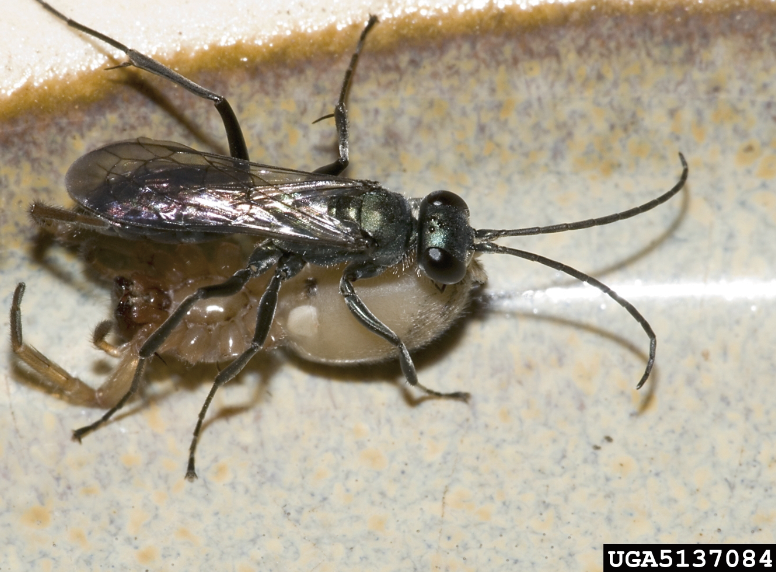
Spider wasps are about 1 in., with black/blue wings, and black/blue bodies (head, thorax, and abdomen). In the field, their erratic foraging behavior is characteristic. They run rapidly, from location to location, when hunting for their spider prey, and twitch their wings constantly.
Habits: Spider wasps can and will inflict a painful sting if handled or trapped next to skin. Spider wasps are solitary (do not live in a nest, like paper wasps or yellowjackets) and predatory on spiders. Because they are solitary, they are not as aggressive as truly social wasps whose aggressive nature is geared toward protecting a central nest site and an egg-laying queen. They can be seen on flowers or on the ground, erratically walking while searching for spider prey. When a spider is found, it is usually stung and paralyzed and then taken back to a single cell, prepared by the wasp, where a single egg is deposited on it and the cell then sealed. Some species leave the paralyzed spider in or below the web. The wasp egg hatches and consumes the spider as its sole food source.
Interventions: Spider wasps are beneficial in that they help eliminate spiders. If they need to be controlled, it is advisable that treatments be made to reduce spider populations, thereby eliminating the spider wasp’s food.
Might be confused with: mud daubers, paper wasps, cicada killers, European hornets.
Potter wasps (Vespidae: Eumeninae):
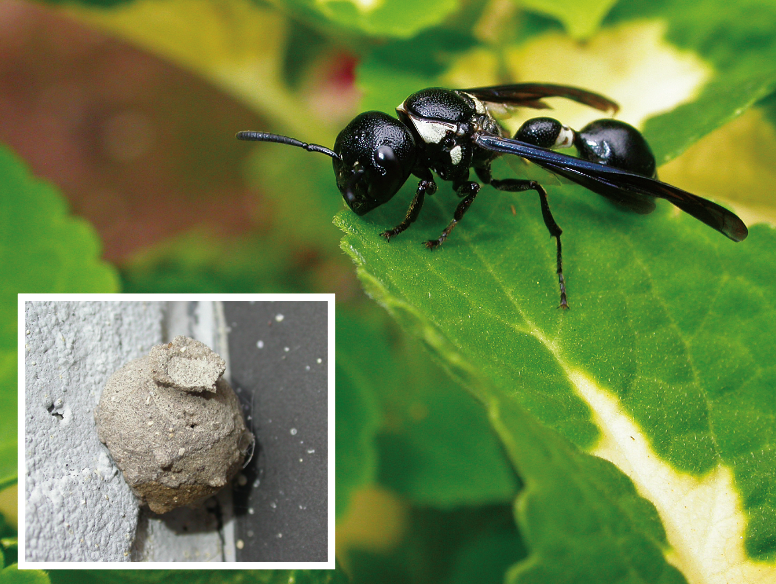
Also referred to as mason wasps. Common species are dark blue or black with yellow or white highlights on abdomen and/or thorax. Solitary. Common species are 3/4 to 1 in.. Strongly sclerotized.
Habits: This wasp builds characteristic, oval-shaped (1/2 to 5/8 in. diameter) nests that appear pot-like with a knob-like opening. Pots are ornate and constructed of mud, as if built by a mason. Pots may contain paralyzed spiders or insects.
Interventions: If desired, knock down ‘mud pot’ nests with a broom and wash mud from wall with soap and water.
Might be confused with: mud daubers.
Void nesting wasps (Vespidae: Eumeninae: Symmorphus canadensis):
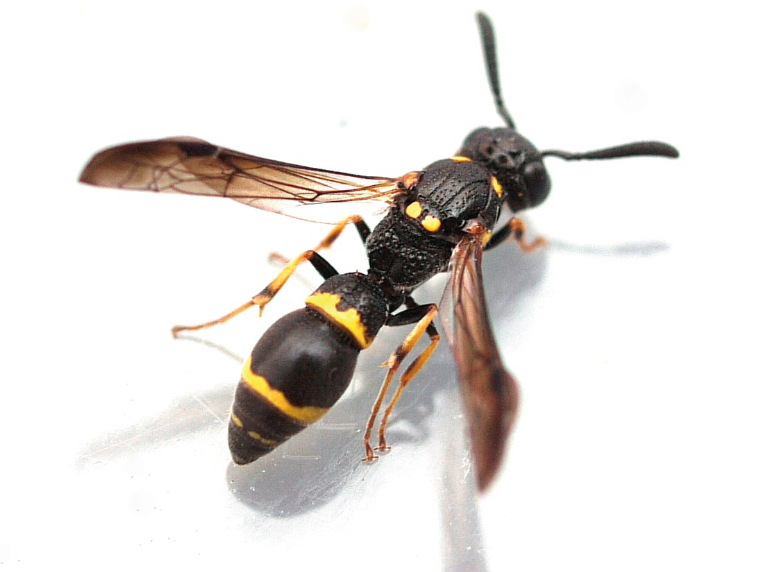
Photo by I. Loser
Moderate sized solitary wasp, strongly sclerotized, black to dark blue, with yellow stripes encircling the abdomen. Additional yellow to ivory highlights may appear on the head and thorax.
Habits: Related species include potter wasps, so-called because they utilize wet, clay soil (mud) to build protected nest chambers, sometimes resembling a small tea pot, to house their offspring during development. S. canadensis nests in existing voids in wood and twigs, including borings made by other insects, such as wood-eating beetle exit holes and accompanying galleries in log homes and carpenter bee holes, where it lays eggs and when finished seals the opening with mud. It does not chew or eat wood in either the adult or larval stage. As an adult it sometimes takes advantage of existing, potential nest sites made by other insects.
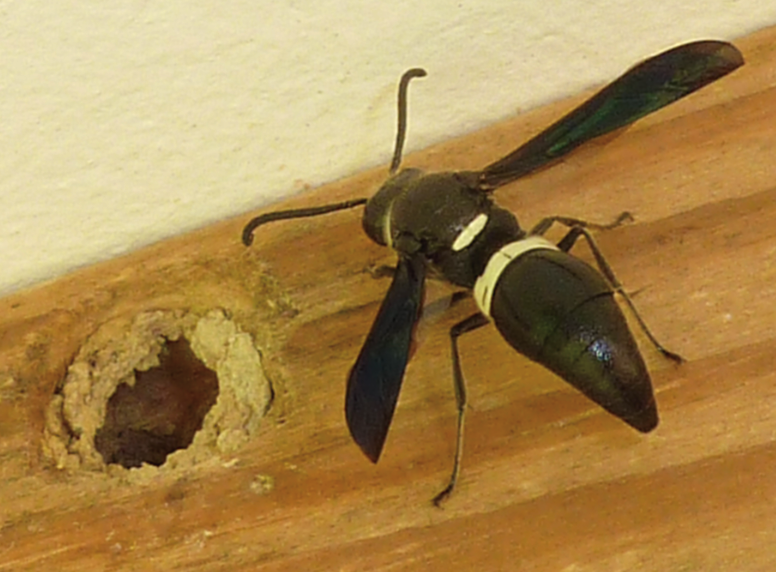
Interventions: It is important to understand that these solitary Hymenoptera are not wood-eating or wood-boring. They are simply utilizing existing voids as nest sites. Should a property owner still find this objectionable, especially in logs of a log home, then a dry, insecticidal dust or liquid, residual insecticide spray (wettable powder or microcap formulation) can be applied into and around holes where bees or wasps are active.
Might be confused with: Wood wasps.
Minor Orders of Insects—Occasional Pests
Green Lacewing (Neuroptera: Chrysopidae):

Green lacewing adults are about ¾ in., lime green to tannish brown (fall coloration), and when at rest carry their wings over their abdomen in a tent-like fashion. They have large, highly visible, round eyes and the wings have clearly visible veins. The antennae are thin and nearly as long as the insect itself. Immatures are wingless, and have large, saw-like mandibles used in their predatory behavior.
Habits: Both adults and immatures are highly beneficial because they feed on soft-bodied, plant-feeding insects such as aphids. Lacewings play a crucial role in natural, biological control programs. Adult lacewings are attracted to lights at night and may come indoors, especially during the fall; adults fly well. Immatures of some species of green lacewings attach random debris from their environment to their abdomen to camouflage themselves, and for this reason are often referred to as trashbugs. Debris that inexplicably begins to move is a clear indication of an immature green lacewing.
Interventions: Turn off outside lights or switch to non-attractive lighting. Green lacewings are highly beneficial insects and should not be killed.
Might be confused with: winged termites especially during fall coloration (=tannish brown).
Eastern Dobsonfly (Megaloptera: Corydalidae: Corydalus cornutus):

Dobsonflies are large, 4 to 5½ in., distinctive insects. Male dobsonflies have large, 1½ in., ornamental mandibles that are often crossed. Female dobsonflies have shorter, but stronger, mandibles capable of drawing blood if handled.
Habits: Dobsonflies are native insects found throughout the eastern half of the United States. Immature dobsonflies (called hellgrammites) live in rocky streams of clean, unpolluted water. Upon emergence from the pupal stage, adults are strongly attracted to lights. Females deposit egg masses near stream environments on bridges, trees, and sometimes on human structures. Egg masses, containing thousands of eggs, are white and look like bird droppings.
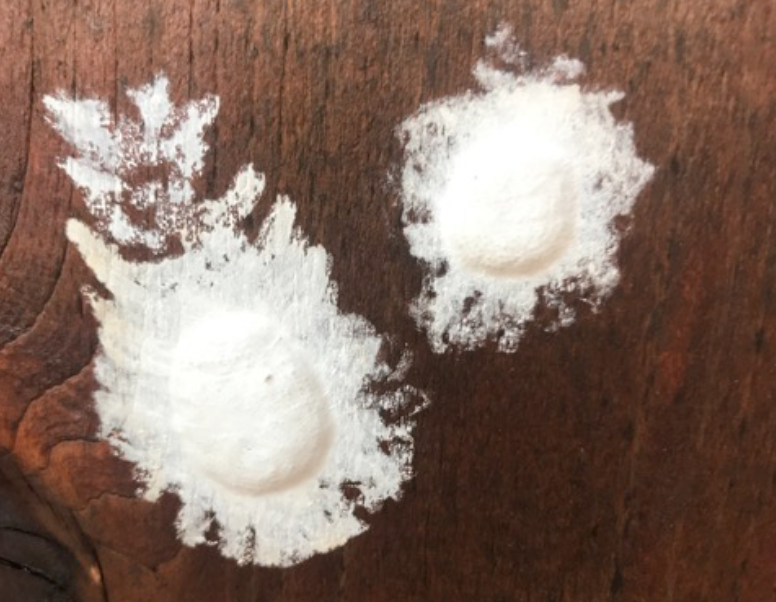
Photo by T. Tuggle
Interventions: If dobsonflies are so common at lights that they become bothersome, alter lighting to make structure less attractive at night (see section on Proactive Pest Management). Adults live only about 7 days. Egg masses can simply be scraped off the sides of buildings and discarded.
Might be confused with: antlions; dobsonfly egg masses can be confused with bird droppings.
Stoneflies (Plecoptera: many species):
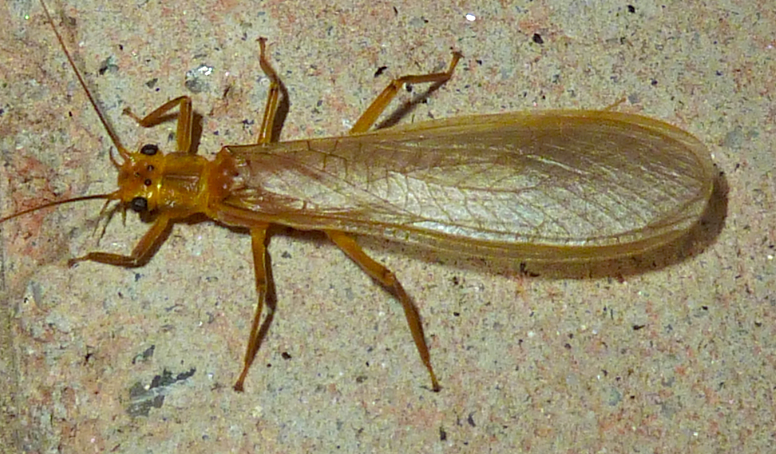
Stonefly adults are about 1 in., drab green/brown, hold their wings flat over the abdomen when at rest, have prominent and bulging eyes, and long, filament-like antennae; also have two long, obvious, abdominal cerci and chewing mouthparts.
Habits: Female stoneflies lay up to 1,000 eggs, in water, among several egg masses. Immature stoneflies are aquatic and live in clean, unpolluted, cool-water streams and lakes where they take refuge under rocks and stones and feed on algae, mosses, diatoms, and immature aquatic invertebrates. Immatures develop through 1 to 3 dozen stages over a 1–3-year period prior to emerging as adults. The presence of abundant populations of stoneflies suggests a clean body of water. Likewise, their disappearance over time may suggest the onset of pollution. In the spring and summer, when adults emerge, they are often found resting on vegetation and other surfaces close to their immature development site. Adults do not feed. They are night-active and attracted to light so are often found at porch lights of homes and businesses where they may be mistaken for winged termites.
Interventions: None needed. Adult stoneflies are harmless, and their presence indicates the presence of clean, unpolluted water.
Might be confused with: alate (swarmer) termites, mayflies, webspinners.
Earwigs (Dermaptera):
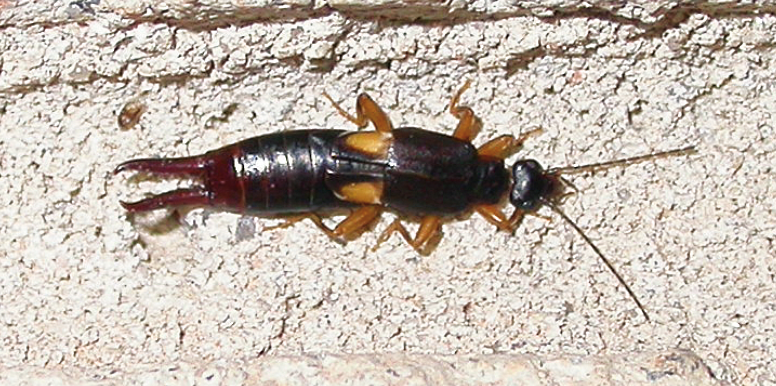
Dark brown to cherry-colored wingless or abbreviated-winged insects with a pair of distinct pincers on the tail end. Earwigs are 1/2 to 5/8 in..
Habits: Typical occasional invader found outdoors in wood piles and under flat items (such as boards) lying on the ground. Also found in heavily mulched areas. Occasionally very numerous.
Interventions: Follow suggestions under section titled Proactive Pest Management. It is especially important to eliminate harborage and install doorsweeps. Earwigs are harmless and are simply a nuisance pest. Chemical control is rarely needed. If desired, spray earwigs directly with an appropriately labeled residual spray (spray only outdoors).
Might be confused with: ground beetles, swarmer termites.
Thrips (Thysanoptera):
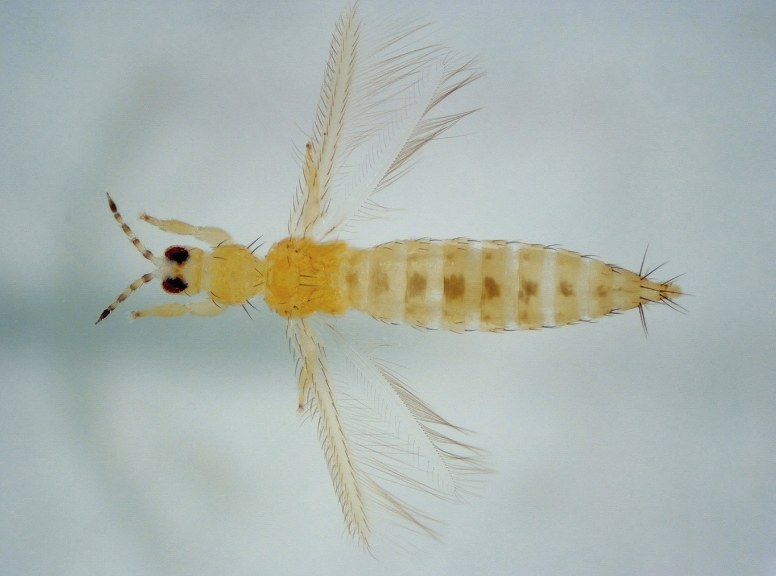
Photo by J. Reed,
Bugwood.org
Thrips (singular and plural) are very small (1/64 to 1/32 in.), yellow- to tan-colored insects with fringed wings that are only visible under a microscope. Thrips are barely visible to the naked eye.
Habits: Thrips are exclusively plant feeders. With their sandpaper-like mouthparts, they scrape the surface of plant tissue and drink the juices that flow from the plant wound. Thrips are small enough to pass through standard window screens, and are known to inadvertently bite humans.
Interventions: Problems with thrips indoors often subside on their own. Thrips originate from plants, therefore the first step is to remove or move indoor plants to the outside and/or close windows to keep thrips from entering from outside.
Might be confused with: small, biting flies.
Booklice (Psocoptera):
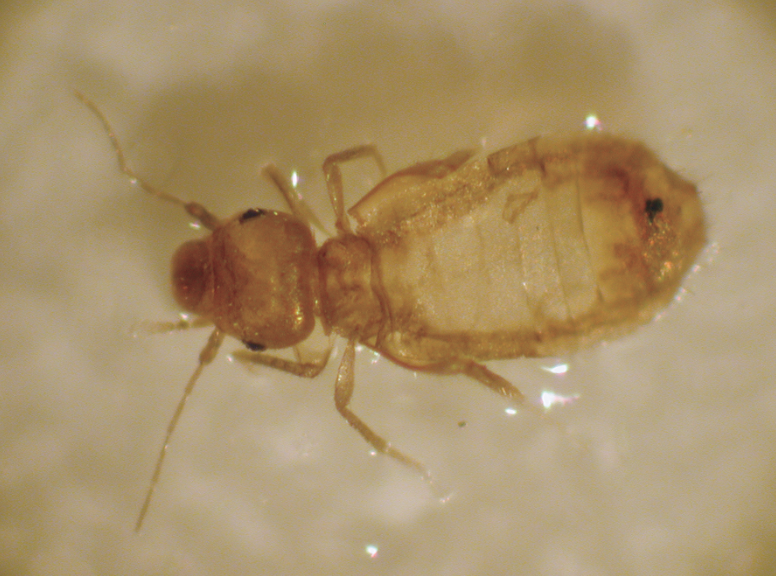
Booklice, also referred to as psocids, are very small (1/32 in.), usually wingless, whitish insects. Barely visible to the naked eye.
Habits: The presence of booklice is an indication of excessive moisture. Booklice feed on microscopic mold and fungi, which grow on substrates such as books, paper, and cardboard housed where humidity is high. Mold and fungi thrive only in environments where humidity is persistent and high. When found, booklice are usually abundant.
Interventions: The ultimate remedy, because of the importance of humidity, is dehumidification to reduce moisture in the area.
Might be confused with: springtails, young bed bugs.
Barklice (Psocoptera):
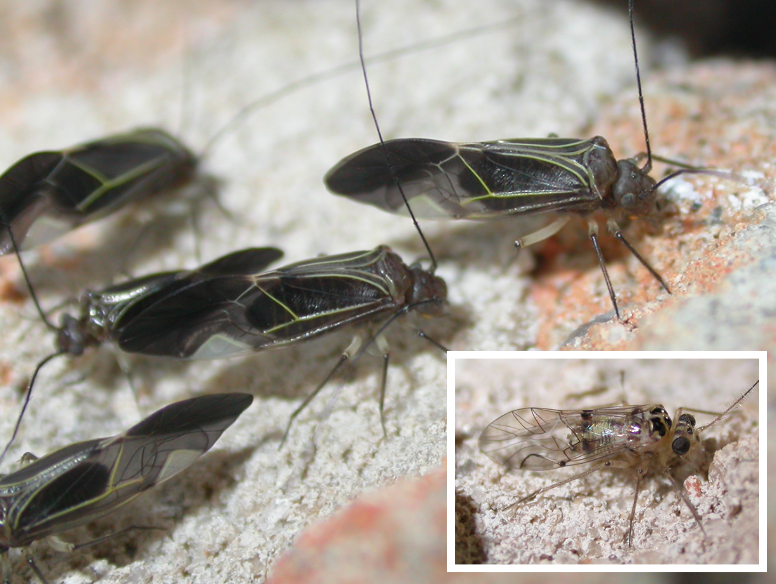
Barklice (singular barklouse) are soft-bodied, gray/brown, and ⅛ to ¼ in.. They are also commonly referred to as tree cows. When winged (only part of the year), their darkened, membranous wings are held roof-like over their back. They have chewing mouthparts, long filamentlike antennae, prominent eyes and are related to booklice, but are much larger than booklice which are only about 1/32 in..
Habits: Barklice are harmless. They are often found on the bark of tree trunks and branches in large groups (referred to as herds) that move in unison, like a school of fish, when disturbed. Barklice may produce obvious, copious quantities of silken webbing on the bark of trees as a means of protection. Neither the insects nor the webbing is harmful to the tree or humans. They feed on mold, fungi, algae, lichens, and other organic debris growing on the tree’s bark.
Interventions: None needed. Barklice and their webbing are harmless to trees and humans.
Might be confused with: booklice, winter aphids.
Cat fleas (Order Siphonaptera: Ctenocephalides felis):
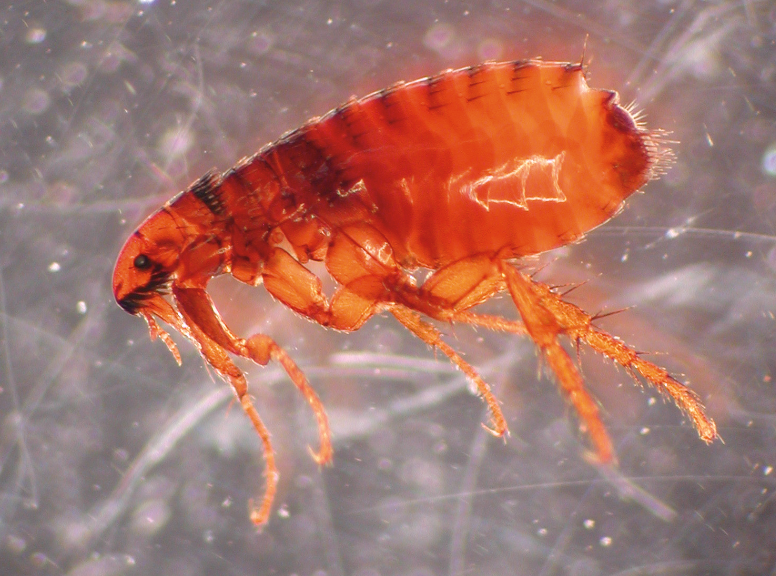

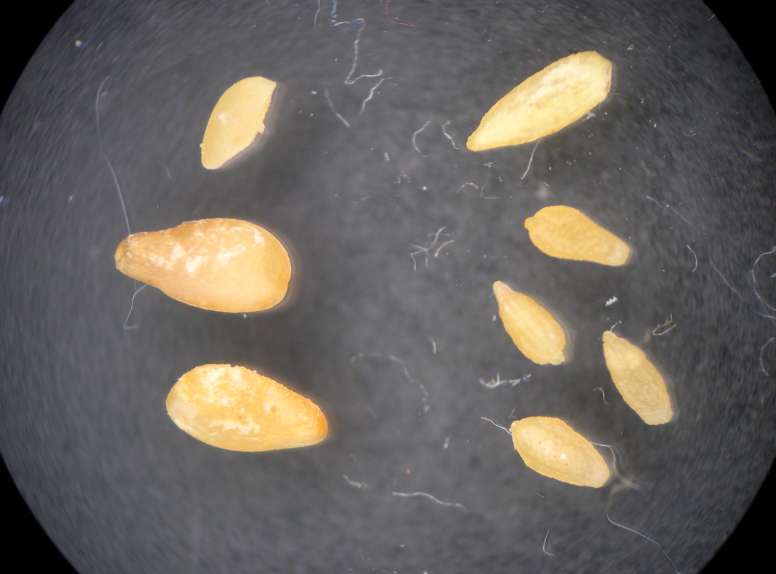
Photo by N. Hinkle,
UGA Entomology
Wingless, brown, vertically-flattened 1/16 in. insects that readily jump. Obligate parasites of warm-blooded hosts.
Habits: Although referred to as the cat flea, it is the most common flea associated with cats and dogs. Commonly found on wild animals such as raccoons, opossums, and coyotes, which can serve as the source of pet infestation and re-infestation. As the female flea lays eggs (one per hour), they fall from the animal’s coat and onto the substrate below, where they hatch. As female fleas feed on the pet’s blood some is absorbed but most is passed, where it collects as dried particles in the same location as the eggs (commonly, pet resting areas). The newly hatched larvae eat the dried blood, develop through three larval instars, pupate, complete development, re-infest the animal, and the cycle repeats. Adult fleas can remain in the pupal cocoon for months prior to emergence and re-infestation of the animal. Following emergence from the cocoon, adults must find and infest a host within a few days or they will desiccate and die. Adult fleas spend all but the first few days of their life on a warm-blooded host. Like other blood-feeding arthropods (ticks, bed bugs, and mosquitoes), fleas are attracted to carbon dioxide, as it is indicative of a warm-blooded host. Since fleas require warm, humid conditions to flourish, flea problems are cyclical and most severe during the warmest part of the year. Another concern over the presence of a flea infestation is that fleas can carry tapeworms. Yes, this is gross. One tapeworm species that infects both dogs and cats, the double-pored dog tapeworm (Dipylidium caninum) is transmitted only by fleas. Tapeworm eggs are consumed by larval fleas, develop in the fleas, and are passed to the animal host when it consumes an infected flea, typically while grooming. The tapeworm breaks out of the flea in the animal’s gut and attaches to the intestinal wall where it completes its development. The tapeworm periodically breaks off egg-containing segments (proglottids) that pass out of the animal’s anus. Tapeworm proglottids are found in the animal’s environment, and look like sesame seeds. Dogs and cats cannot get tapeworms from eating tapeworm eggs, only from swallowing fleas that contain tapeworms. Over-the-counter de-wormers are not effective against tapeworms, so a prescription medication must be obtained from a veterinarian. All animals in the household must be treated for tapeworms and for fleas. If fleas are not eliminated, pets risk continued tapeworm reinfection.
Interventions: Management should address flea populations on and off the animal. Indoors, target areas or rooms that pets frequent to get at the most vulnerable stage—the larva. Vacuum these areas regularly, using a vacuum with a beater bar on carpeted areas, in addition to washing pet bedding. Steam clean carpeted areas frequented by pets. When applying a properly labeled insecticide, use products containing an insect growth regulator such as pyriproxyfen or methoprene. Concurrently, treat infested pet with a topical product containing any of these active ingredients: imidacloprid, fipronil, or dinotefuran, or an oral medication containing spinosad. Short-term animal relief from adult fleas can also be obtained with oral administration of a product containing selamectin or nitenpyram. When an on-animal treatment is chosen, always follow a veterinarian’s advice. Do not bathe pet 1 week before or after application of any on-animal treatment. Keep pet resting areas clean. If pets spend time outdoors, concurrent with indoor and on-animal actions, identify areas of flea activity, especially areas that pets frequent—shaded areas, dog runs and pens, areas under decks, etc.—and treat those areas with an appropriately labeled residual spray or granular product. For more information see University of Georgia Extension Circular 782, Stinging and Biting Pests, at https://extension.uga.edu/publications.html.
Might be confused with: springtails, booklice.
Silverfish (Zygentoma, formerly known as Thysanura):
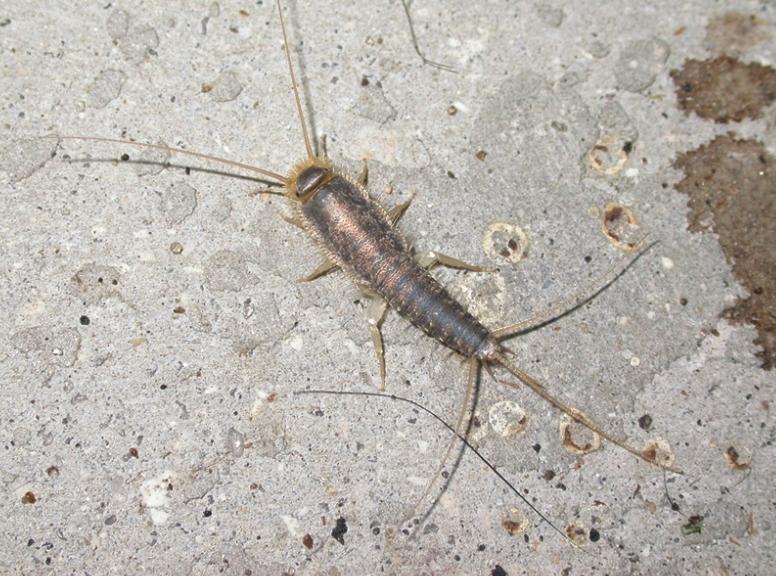
Wingless, silver, up to 1 in. insect with long antennae and three long tail filaments.
Habits: Found in undisturbed (often unmaintained), indoor, humid environments. Sometimes found in attics. Eats mold and fungi, paper, etc.
Interventions: Moisture is very important to these pests, so an effective strategy is to dry the environment with dehumidifiers. In conjunction with dehumidification apply a granular bait or apply a spot treatment with an appropriately labeled residual spray to areas where these insects are found.
Might be confused with: cockroaches, crickets, earwigs.
Non-Insectan Organisms

Land planaria, most commonly hammerhead flatworm (Class Turbellaria: Tricladida: Geoplanidae: Bipalium kewense): Land planaria are slow-moving, caramel-colored flatworms with a dark line or lines down their back, 6 to 8 in., and with a spatula-like head (think of a hammerhead shark). They appear glossy because of their natural slime covering.
Habits: Land planaria are invasive, and probably originated in southeast Asia. They have been in the United States for more than 100 years and are moved from place to place in potted plants. They are widespread in the Southeastern U.S.. Because land planaria are highly susceptible to desiccation, they harbor in cool, damp retreats in or under objects lying on the ground (rocks, patio stones, bark of dead trees, termite bait stations). They are most active at night, when humidity is high, and temperatures are low. In the landscape they are predators of earthworms, slugs, insect larvae, and are cannibalistic.
Interventions: To reduce populations of land planaria, remove clutter or trash in the landscape to reduce potential harborage sites. Pesticides are not recommended. Might be confused with: earthworms, flukes, leeches.
Springtails (Class Collembola: many families):
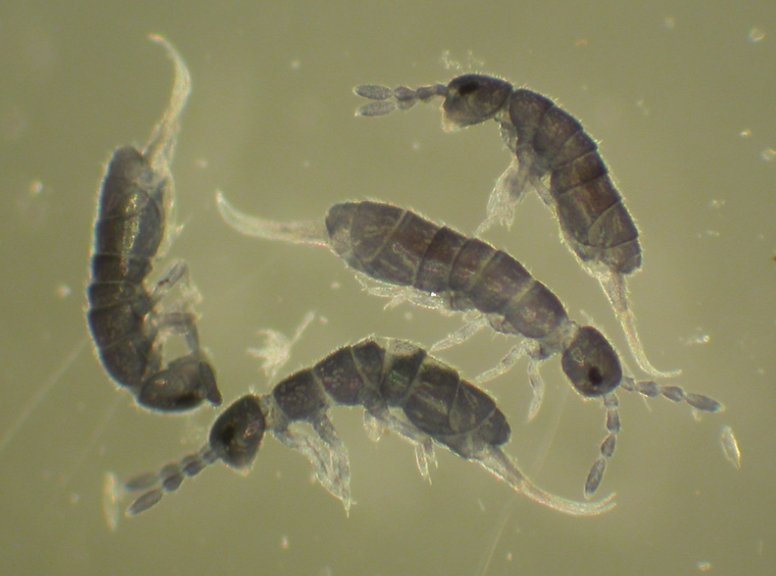
Very small (1/32 to 1/16 in.), usually numerous, jumping insects. Some species referred to as snow fleas. Springtails vary in color from blue to gray to green to brown to white.
Habits: Highly moisture-dependent. Outbreaks often occur where there exists persistent, excessive moisture and optimum temperatures. Springtails feed on mold and fungi. Recurring problems indoors suggest an indoor moisture problem or moisture source—such as in bathrooms where insects are sometimes found in bathtubs and sinks or coming from inside damp walls or other damp voids. Springtails are perhaps the most common insect in the soil/leaf litter habitat. Outdoors, outbreaks often occur from thatch or mulch. When this occurs, numerous springtails can be seen jumping, as their name suggests.
Interventions: Reduce or eliminate moisture or humidity indoors and outdoors where springtails are found; this may require fixing a leak or eliminating another obvious moisture source. Install a dehumidifier. If springtails are a problem outdoors, follow suggestions under section Proactive Pest Management. When moisture problems are remedied, springtail problems often cease. If desired, apply a localized treatment to mulch/thatch with an appropriately labeled residual spray to areas where springtails are found.
Might be confused with: fleas, booklice.
Centipedes (Class Chilopoda: House centipede [Scutigera coleoptrata] and Eastern Bark centipede [Hemiscolopendra spp.]):
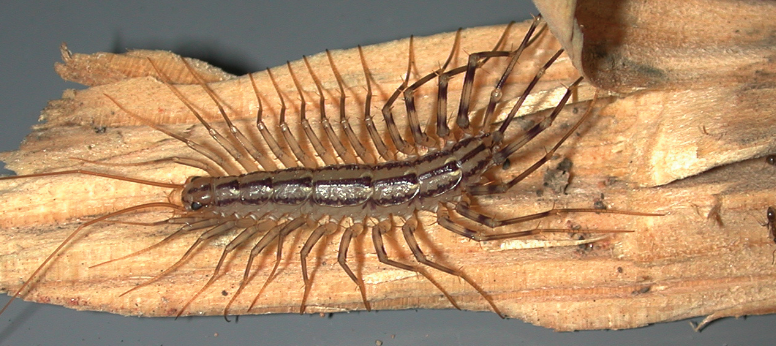
Centipedes are non-insect arthropods with one pair of legs per segment. House centipedes are long-legged, with alternating light and dark gray bands on the legs and long, slender antennae. Eastern bark centipedes are up to 5 in., obviously segmented, with short legs, and with segments that are glossy and greenish colored. It is not invasive.
Habits: Centipedes are predatory, and thus fast crawling to be able to pursue their invertebrate prey. They are most active (hunting) at night, when they feed on small insects and other invertebrate prey. House centipedes are found in sheds, garages, log piles, basements, and other undisturbed, humid areas indoors. Eastern bark centipedes are found in the natural outdoor environment, typically under rotten, fallen logs, under the rotten bark of fallen trees, and under similar items lying on the forest floor. Centipedes may bite if handled.
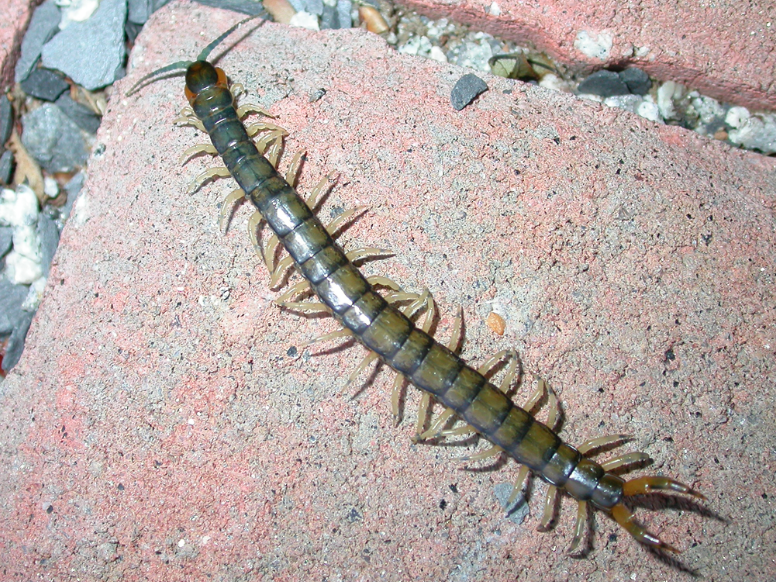
Interventions: These predators are found where their food source or prey insects are found. Therefore, reduce prey numbers by following suggestions under section titled Proactive Pest Management. It is especially important to eliminate harborage and install doorsweeps. If desired, apply a localized treatment with an appropriately labeled residual spray where centipedes are found. For more information see University of Georgia Extension Circular 1088, Millipedes and Centipedes, at https://extension.uga.edu/publications.html.
Might be confused with: garden millipedes.
Millipedes (Class Diplopoda):
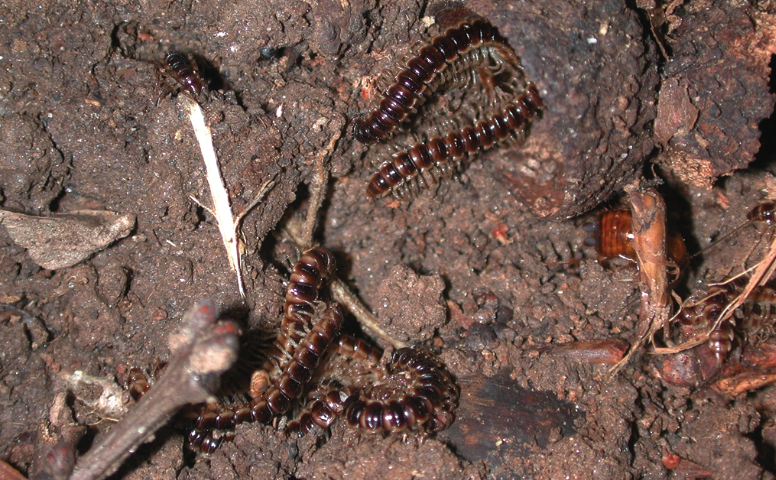
Slow-moving, non-insect arthropod, 1 in., with two pairs of legs per segment after the first three segments. The top of each segment is glossy brown, but white underneath.
Habits: General feeder on detritus, mold, fungi, etc. Releases noxious smell when threatened or handled. Often coils when threatened. Because millipedes are desiccation-susceptible, they are found primarily and associated with wet to overly moist conditions. Found outdoors especially under items lying flat on the ground where microhabitats high in humidity are created. Also found in heavily mulched areas. Quickly desiccates and dies in low moisture conditions, such as indoors.
Interventions: It is especially important to eliminate harborage (even those far away from the building), dry out the environment, and install doorsweeps. If desired, apply a localized treatment with an appropriately labeled residual spray to millipede harborage sites (spray only outdoors). For more information see University of Georgia Extension Circular 1088, Millipedes and Centipedes, at https://extension.uga.edu/publications.html.
Might be confused with: earthworms, centipedes.
Daddy longlegs (Class Arachnida: Order Opiliones):
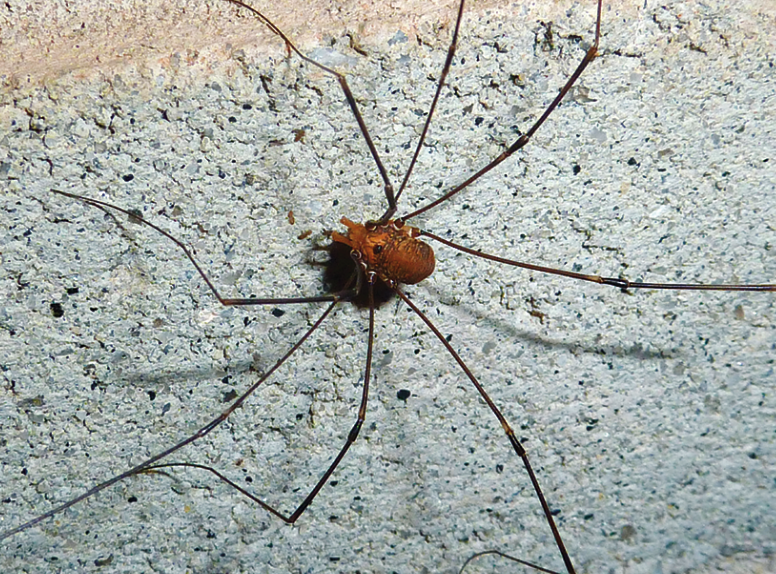
Also referred to as harvestmen. Daddy longlegs are not spiders. They appear spider-like with eight long, thin legs and three body parts fused into one body, unlike spiders. Each body part is segmented, also unlike spiders.
Habits: Predatory and omnivorous/scavengers. Daddy longlegs cannot bite and are harmless. Internet myths suggesting otherwise are not correct. For discussion on this topic, see the website spiders.ucr.edu.
Interventions: Because they are harmless, no control is necessary. Keep vegetation away from house, keep window screens in good repair, and install doorsweeps to limit access to the interior.
Might be confused with: multiple spider species.
Velvet mites (Class Arachnida: Order Trombidiformes, especially genus Balaustium, the concrete mites or sidewalk mites):
A large mite, up to 1/16 in., with eight legs and a bright red-colored body covered with fine hairs, giving it a velvety appearance. Constantly crawling; rarely, if ever, at rest. Commonly found on brick or concrete surfaces, often in large numbers, during the hottest part of the summer in Georgia. Adult mites, with eight legs like other arachnids, are very small, oval-shaped with a pair of long legs pointing forward that are often mistaken for antennae. Acarine larvae normally have six legs rather than eight.
Habits: Some species are beneficial, feeding on other mites and tiny insects and their eggs. Most species found around structures are simply benign, feeding mainly or exclusively on pollen. The mites are seasonal and do not bite.
Interventions: Keeping doors and windows tightly sealed can be effective in preventing mite entry into the house. Weatherproof all windows and doors where mites may be entering. Live mites are easily crushed but will stain walls, carpet, and drapes. If desired, apply a localized treatment of an appropriately labeled residual spray to walls and other outdoor surfaces where mites are most commonly found. Indoor insecticide applications are not recommended because they will not provide relief beyond what vacuuming can accomplish.
Might be confused with: larval ticks (referred to as seed ticks).
Chiggers or Redbugs (Trombiculidae: Eutrombicula alfreddugesi):
Chiggers are the parasitic, larval stage of mite species in the family Trombiculidae. They are too small to be seen with the naked eye.
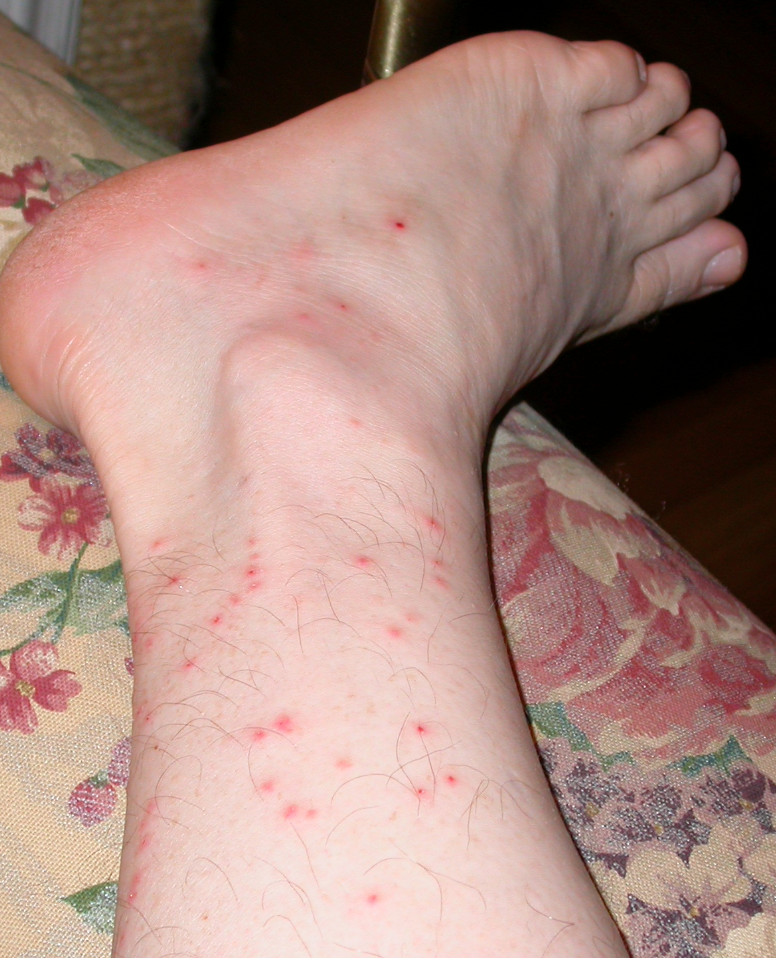
Habits: Chiggers feed (3 to 5 days) on the skin cells of a wide variety of vertebrate hosts, including amphibians, reptiles, birds, and mammals (rabbits and mice) before dropping off the host to complete development. Humans are accidental, non-preferred hosts. Chiggers are prevalent during hot, dry conditions and are most common in areas characterized by thick underbrush – e.g., saplings, shrubs, briars, weeds, berry bushes, and high grass. When biting humans, chiggers feed on the thin outer layer of skin, the epidermis, leading to skin irritation and extreme itching referred to as chigger dermatitis. When they bite, they puncture the skin with their mouthparts, inject saliva, and feed externally on skin cells, lymph, and the liquid material that exudes from the wound. This physical and chemical assault on the skin results in inflammation (dermatitis) typical of a chigger bite and the resultant, almost uncontrollable, urge to scratch the bite. Chiggers do not burrow into the skin, as do ticks, and they do not feed on blood. Because humans are not preferred hosts, chiggers only stay attached to human skin for a few hours. As a result, by the time evidence of a bite presents, usually a day or two after outdoor activity, the chigger is no longer present. When biting humans, they attach to areas where clothing fits snugly against the skin – e.g., under socks, underwear, etc. When encountered, chiggers are typically numerous.
Interventions: Avoiding chigger bites is the best advice. After bites become evident, little can be done to alleviate itching and the potential for secondary infections that come from scratching open wounds. Because chiggers cannot be seen with the naked eye, backpackers, campers, hikers, hunters, and other summertime outdoor enthusiasts should assume that chiggers are present during outdoor activities, especially in chigger-friendly habitats, and take precautions to protect themselves prior to going afield. Prior to entering areas where chiggers are likely present, clothing, especially socks, shoes, and lower extremities, should be sprayed with products containing the active ingredient permethrin. Permethrin is approved for use on clothing only. DO NOT apply permethrin to the skin. Products containing DEET can also be used effectively. Showering and scrubbing with a soapy sponge those areas where chiggers attach to skin (ankles under socks, midsection under elastic underwear strap, back of the leg behind knee) is recommended within a couple hours of spending time in areas where chiggers were likely present.
Might be confused with: poison ivy, ticks.
Scorpions (Class Arachnida: Order Scorpiones):
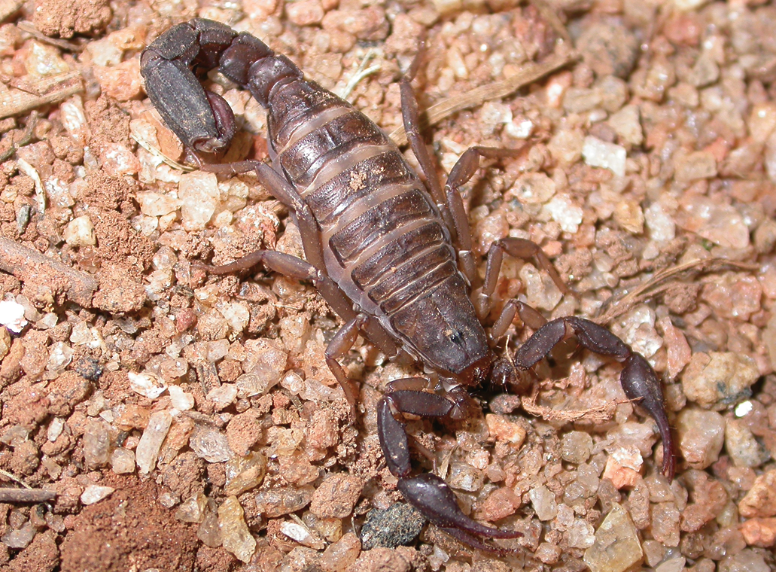
Large (1.25 to 1.5 in.), non-insect arthropod with forward pincers and a long, strongly-segmented tail tipped with a stinger.
Habits: Scorpions sting, so should be handled with care. Scorpions feed on insects and other arthropods and are found outdoors in wood piles and under flat items (such as boards, rock piles, etc.) lying on the ground. Sometimes found under tree bark. May be found in homes, often with numerous cracks and crevices to hide, that have gone uninhabited for long periods—i.e., buildings that are only intermittently heated or occupied (hunting cabins, second homes, etc.). Scorpions are secretive.
Interventions: The best remedy is to crush individual scorpions. Also, follow suggestions under the section Proactive Pest Management. Install doorsweeps on all exterior doors. It is especially important to eliminate harborage for scorpions and their insect prey. On the rare occasion when scorpions are so numerous that their presence requires a chemical intervention, spray them directly or apply a spot treatment with an appropriately labeled residual spray to areas where scorpions are found. For more information see University of Georgia Extension Circular 782, Stinging and Biting Pests, at https://extension.uga.edu/publications.html.
Might be confused with: cockroaches.
Ticks (Class Arachnida: Order Ixodida: Family Ixodidae):
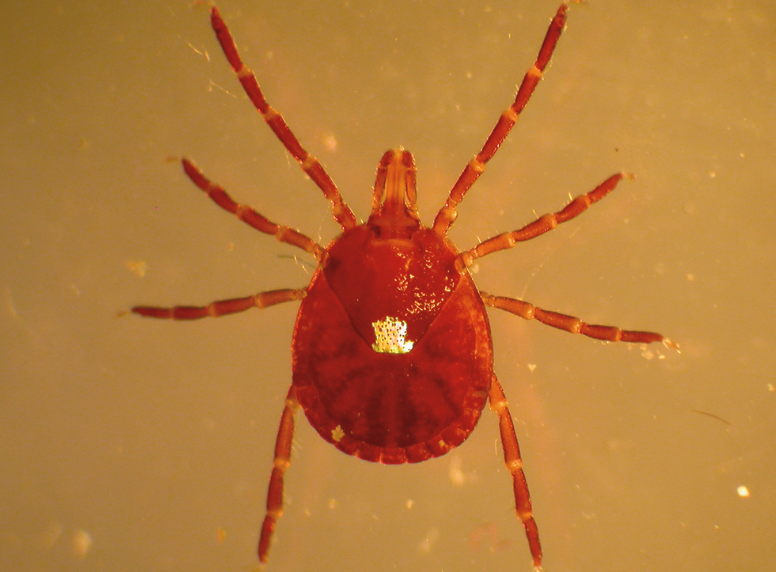
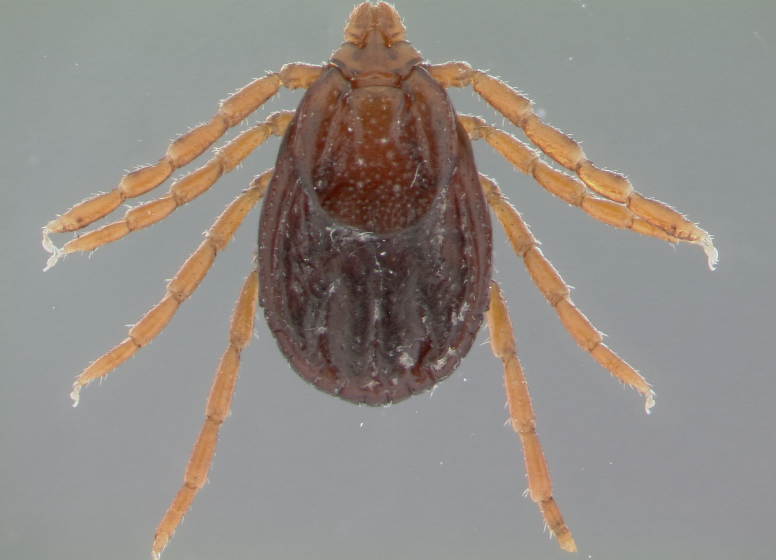
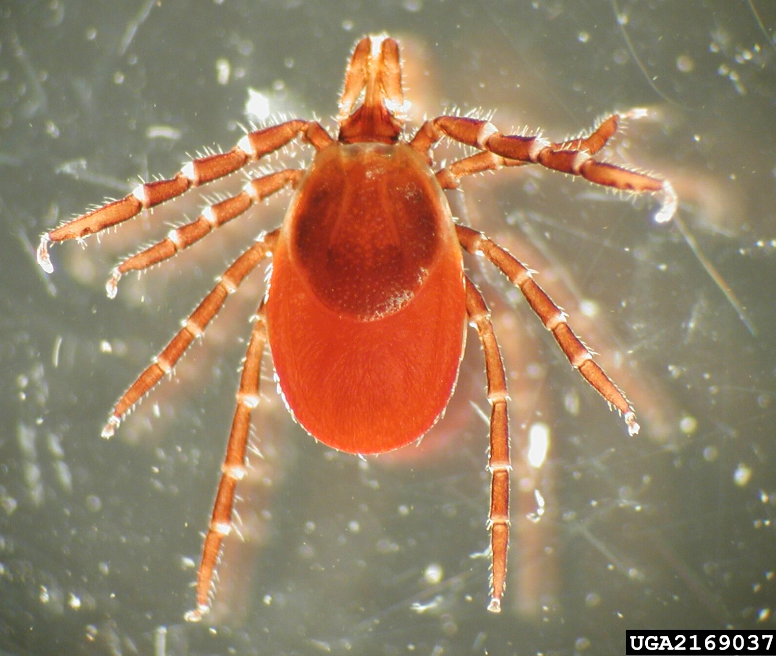
Oblong to oval, ⅛ to 3/16 in., six-legged (larvae) or eight-legged (nymphs and adults), black- to brown- to cherry-colored, slow-moving, non-insect arthropod. Some species have distinct markings on their back. The term seed tick refers to a first instar larval tick just hatched from the egg in spring; seed ticks are barely visible to the naked eye and often encountered in large numbers.
Habits: There are 17 tick species in Georgia. Several
species are disease vectors in humans and other non-human mammals. All ticks are obligate parasites that suck blood needed for egg production. The most common tick species in Georgia, the lone star tick (Amblyomma americanum; female pictured), is a vector of at least four diseases: Southern Tick Associated Rash Infection (STARI; a Lyme-like disease in humans), human monocytic ehrlichiosis (HME), meat allergy/alpha-gal syndrome (results in the inability to eat meat), and bobcat fever (a commonly fatal disease in domestic cats, but not found in humans). The American dog tick (Dermacentor variabilis), also native to Georgia, is a vector of Rocky Mountain Spotted Fever, which is much more common in Georgia than Lyme disease. In fact, Lyme disease is not common in Georgia.
The brown dog tick (BDT), Rhipicephalus sanguineus, is the only tick capable of sustaining an infestation inside homes, kennels, groomers, dog daycare, dog parks, veterinarian clinics, and other places dogs spend time. Dogs are the preferred host of BDTs, and infestations start when just a few ticks attach to a dog. Based on their life cycle (described below) obvious signs of infestation (e.g., numerous ticks crawling up walls) may not show up for months following the initial attachment of just a few ticks. After consuming dog blood for about a week, a raisin-sized adult female will detach from the dog, crawl to a secluded location, and 1–2 weeks later begin laying 4,000–7,000 eggs over a 1–2‒week period. The female then dies. Eggs hatch in 2–4 weeks, and 1–2 weeks later the small larvae (sometimes called seed ticks) begin searching for a new host; it is at this time that homeowners may see thousands of larvae crawling about, sometimes up walls, as they search for a host (typically the same dog). Larvae feed for 2–4 days, detach from the dog, crawl to a secluded place, and 2–4 weeks later molt to the nymphal stage. Nymphs then seek out and attach to the dog again and feed for 5‒10 days, detach, find a secluded location, and then molt to the adult stage 2 weeks later. The adults may wait another month, or longer, before seeking out and attaching to the same dog a third time, where adults mate and then females feed for 7 days, detach, and the process starts anew. A life cycle typically requires 3‒6 months (2‒4 generations per year) for completion, sometimes longer (up to a year) if a host is not readily available or temperatures are cooler than normal. BDTs are long-lived; larvae and nymphs can survive in the off-animal environment for 6 months, while adult females can survive a year without a host.
Ticks use their Haller’s organ, located on their front legs, to detect carbon dioxide, lactic acid, temperature changes, air currents, vibrations, and sounds associated with potential hosts. Like other blood-feeding arthropods (bed bugs, fleas, and mosquitoes), ticks are attracted to carbon dioxide, as it is indicative of a warm-blooded host. When feeding, ticks inject analgesics (to deaden bite-associated pain) and anticoagulants (to keep blood from clotting).
Interventions: Generally, keep grass cut low. To avoid tick bites: (a) use an EPA registered repellent (see cfpub.epa.gov/oppref/insect; Find the Repellent that is Right for You), (b) wear protective clothing (e.g., tuck pant legs into socks when in tick-infested habitat), (c) prior to outdoor activity, spray clothing (never skin), especially socks and pants of the lower extremities, with any one of a number of commercial products containing the active ingredient permethrin, (d) perform tick checks following outdoor activities in tick infested habitat, and (e) if possible, shower soon after returning from tick-infested habitat. Showering and scrubbing with a soapy sponge is recommended within a couple hours of spending time in areas where ticks are present. For more information see University of Georgia Extension circulars #937, Protect Yourself from Ticks, and #782, Stinging and Biting Pests, at https://extension.uga.edu/publications.html.
Control of the BDT is unique and deserves to be singled out because BDT infestations routinely take 6 months to a year to eliminate and require participation from three parties: the property owner, the property owner’s veterinarian, and a pest management professional (PMP) hired by the property owner. Chemical insecticide use in the on- and off-animal environment are required. The veterinarian will recommend, and instruct on how to use, on-animal products to protect the animal’s health. Homeowners should follow closely the veterinarian’s instructions and heed all instructions on the recommended product’s label. The homeowner should inspect the dog (between toes and in the ears) regularly, remove and discard ticks, and wash and dry, at high temperature, pet bedding. IMPORTANT NOTE: The dog should NOT be removed from the infested environment, should not be taken to other premises, and other dogs should not be allowed to visit the infested dog. When provided effective veterinarian-recommended products, the dog serves as bait and will help eliminate ticks before they can become reproductive females. If the dog is removed, ticks will move to an alternative host, including humans. PMPs should engage in routine, intensive inspections in the off-animal environment where ticks might reside (cracks and crevices) when they detach from the dog. Inspect especially those areas where dogs bed. When ticks are found, treatments (residual sprays, aerosols, and dusts) should be made to these areas. Numerous treatments, with a diversity of products, preferably with different modes of action (see irac-online.org for resistance management recommendations), over a lengthy period will likely be required. Vacuums and steamers designed for pest control (cockroaches and bed bugs) can be used to physically remove or eliminate ticks from the off-animal environment. Pyrethroid resistance has been detected in some populations of the BDT. If pyrethroids are used, the formulation should contain the synergist piperonyl butoxide (PBO). Insect growth regulators (IGRs) and imidacloprid are ineffective against the BDT.
Might be confused with: mites, chiggers, other ticks.
Sowbugs & Pillbugs (Class Malacostraca: Order Isopoda):
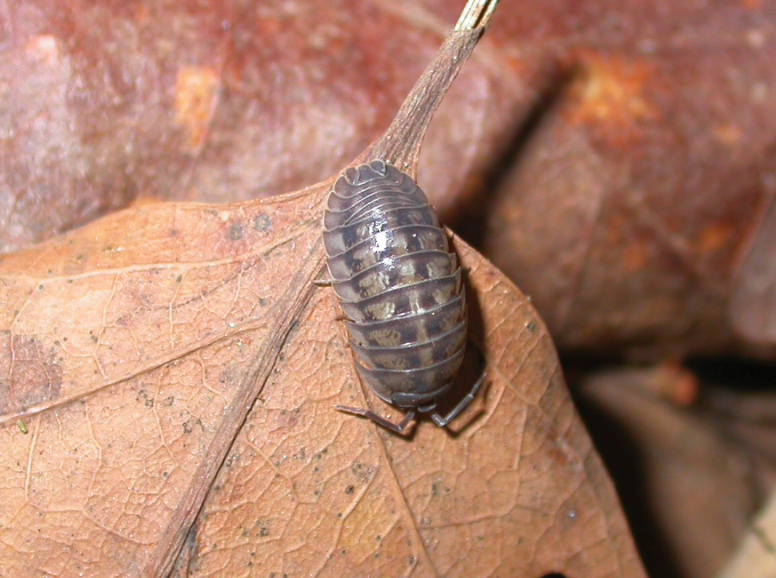
Clearly segmented, 1/4 in., oblong, flat gray, non-insect, slow-moving arthropod.
Habits: Found in log piles, leaf litter, and under flat items such as boards lying on the ground. Because these creatures are desiccation-susceptible, they are found primarily in and are associated with wet to overly moist conditions. Common occurrence is suggestive of a persistently moist to wet environment. General feeder on detritus, mold, fungi, etc.
Interventions: Follow suggestions under section titled Proactive Pest Management. It is especially important to eliminate excessive harborage, install doorsweeps, and eliminate excessive moisture problems. In the rare case that a pesticide treatment is needed, apply a localized treatment with an appropriately labeled residual spray (spray only outdoors).
Might be confused with: ground beetles.
Spiders
Southern house spider (Filistatidae: Kukulcania hibernalis):
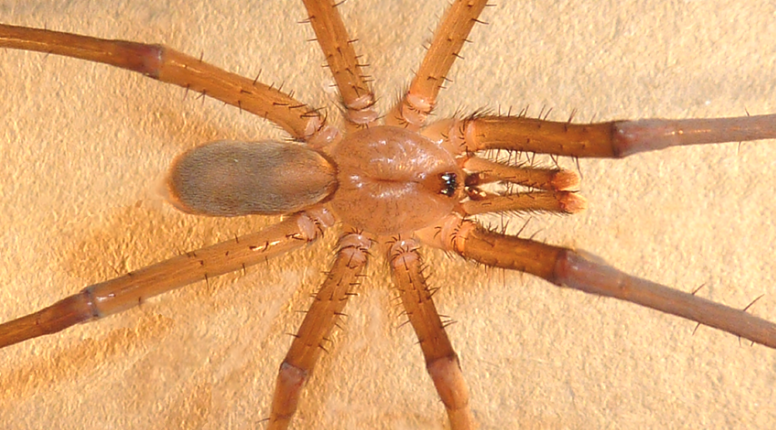
Southern house spider males and females look nothing alike. The dusky, charcoal-colored females appear almost tarantula-like and are larger than the amber-colored males. Male Southern house spiders commonly are misidentified as the brown recluse spider, Loxosceles reclusa, because of their color, general shape and appearance. Male Southern house spiders tend to be a little larger than the brown recluse spider. The brown recluse spider is rare in Georgia, and although it’s known to be in the northwest part of the state, even there it is uncommon. The male Southern house spider has a single aggregation of eight distinct eyes, while the brown recluse spider has three distinct pairs of eyes (six eyes total). The characteristic violin on the brown recluse is much less distinct on the male Southern house spider. For more information on the distribution, occurrence, and biology of the brown recluse spider see spiders.ucr.edu.

Habits: Southern house spiders live indoors in cracks and crevices, and make unkept, messy webs at the entry of their retreat to catch their prey as it wanders by. Female Southern house spiders are long-lived.
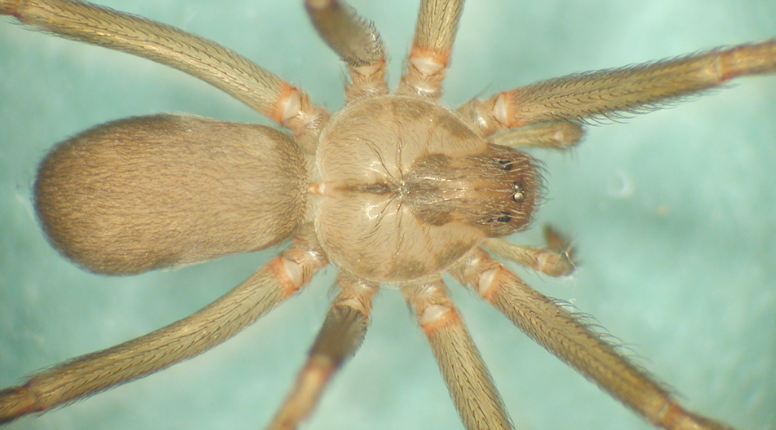
Interventions: Southern house spiders are harmless and, like many spiders, are beneficial in that they consume many species deemed pests—e.g., cockroaches, moths, flies, etc. If needed, appropriately labeled insecticidal dusts can be applied into cracks and crevices where spiders live. Alternatively, vacuuming the areas will remove webs and spiders and discourage their return. The use of essential oils (as repellents) or continued use of web-removal devices (websters and long-handled brooms) also are recommended.

Might be confused with: brown recluse spider.
Joro Spider (Nephilidae: Trichonephila clavata):
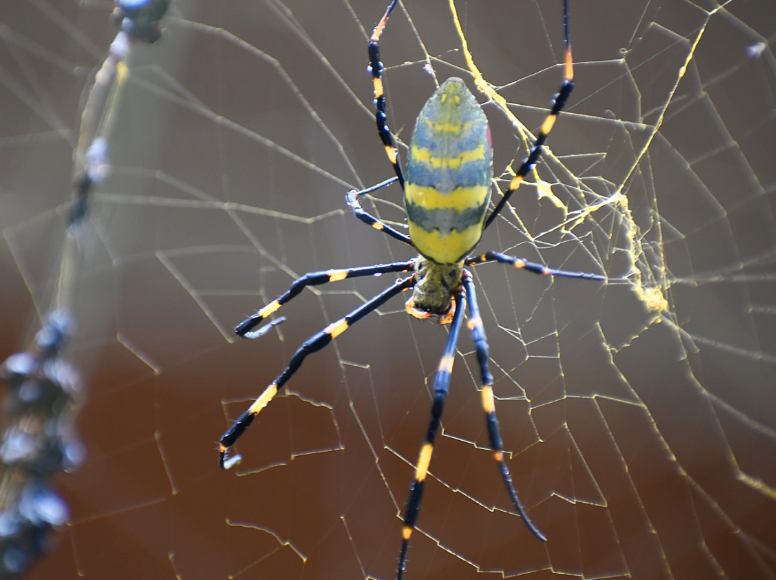
The Joro spider is a large (female body size up to 11/4 in., with long legs) orb weaver with large, spiral, wheel-shaped webs. Webs are sometimes gold-colored. It is native to east Asia ( Japan, China, Korea, and Taiwan), and was first found in the Western Hemisphere in northeast Georgia in September 2014. Adult females are most visible (due to size and coloration), are much larger than adult males, and are quite colorful and attractive. The dorsum of adult females is bright yellow with broad, horizontal bluish-green bands while the underside has large, red markings. The adult female’s long legs are black with yellow/orange bands. Adult males are small (1/4 in.), greenish-brown, and easily go unseen when in the web.
Habits: There is likely one generation per year. In the fall (September through November), adult Joro spiders build large, strong webs outdoors in areas where flying insects (prey) are common. Spiders mate and an egg sac (inside a silken cocoon), containing hundreds of eggs, is deposited on leaves, walls, tree bark, and nearby human structures. Adult spiders die; the egg sac overwinters and eggs hatch the following spring. Joro spiders are common in populated, suburban environments.
Interventions: Joro spiders are harmless. However, should they become so numerous that they become a nuisance, their webs can be removed with a webster or long-handled broom. Surfaces where web attachments have been made can be sprayed with products containing plant essential oils in the chance that essential oil volatility, and the resultant aroma, might serve as a deterrent to web construction.
Might be confused with: golden silk orbweaver (or banana spider; Trichonephila clavipes), yellow and black garden spider (or writing spider; Argiope aurantia).
Acknowledgements
We thank Terry W. Bowen, B.S., B.C.E. (Bowen Consulting Enterprises, LLC, Norcross, Ga); Frank Meek (Orkin Pest Control, Atlanta, Ga); Richard Spencer (Arrow Exterminators, Atlanta, Ga); Tim Daly, Wade Hutcheson, and Laura Ney (University of Georgia Cooperative Extension); and Elmer Gray (UGA Entomology, Athens, Ga) for their thoughtful review of this bulletin. Sam Pittard (University Printing) and Tim Welsh (Bulldog Print + Design) for design and layout. Printed by Bulldog Print + Design, Athens, Ga, www.printing.uga.edu


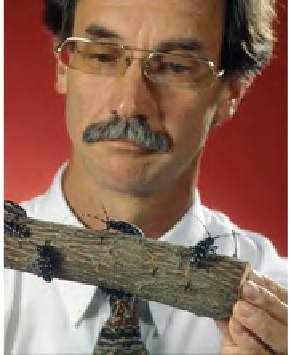

About the Authors
Daniel Suiter (dsuiter@uga.edu) and Brian Forschler (bfor@uga.edu) are Professors of Entomology, specializing in urban entomology, in the Department of Entomology at the University of Georgia; Suiter is located on the university’s campus in Griffin and is the Orkin Professor of Urban Entomology, while Forschler is on the main campus in Athens, Ga.
Lisa Ames (lames@uga.edu) directs the Homeowner Insect and Weed Diagnostics Laboratory on the UGA Griffin Campus.
E. Richard Hoebeke, a systematic entomologist, is the associate curator of the UGA Collection of Arthropods of the Georgia Museum of Natural History on the UGA’s main campus in Athens, Ga (rhoebeke@uga.edu).
Photo Credits
Unless noted, all photos by Lisa Ames or Daniel Suiter, UGA Entomology.