

Carrots (Daucus carota L.) are among the most economically important vegetable crops grown in Georgia, with a 2019 farm gate value of $47 million. A significant obstacle to carrot production all over the United States, including in the state of Georgia, is plant-parasitic nematodes.
Nematodes often are referred to as “hidden enemies”; they are microscopic (about 0.02–0.1 in. in length), unsegmented roundworms that have a mouth-spear, or stylet, they use to feed on host crops. Nematodes only move a few inches on their own but can be spread widely through infected plant materials or from soil clinging to farm equipment.
Nematodes that penetrate and feed internally on plant tissue (specifically root tissue) are called endoparasites. Those that remain outside the roots and feed externally on plant cells using their stylets are called ectoparasites. Endoparasitic nematodes usually cause greater damage than ectoparasites.
Like in other root-vegetable crops (e.g., sweet potatoes or beets), nematode infections in carrots can result in significant reduction in marketable yield and quality because the harvested edible product (the taproot) is directly affected. Several counties in south Georgia are involved in the production of carrots for both the fresh market and the processing industry. In these regions, root-knot nematodes (Meloidogyne spp.) are widespread and are known to cause serious damage to carrots. Stubby-root (Paratrichodorus or Nanidorus spp.) and root-lesion (Pratylenchus spp.) nematodes also are common in south Georgia, although their potential ability to damage carrots has not yet been established.
Root-Knot Nematodes
Most of the plant-parasitic nematodes that significantly impact vegetable crops feed on plant roots, but the root-knot nematode is considered a devastating pathogen for carrot crops specifically.
In Georgia, the heavy infestation of root-knot nematodes leads to severe problems in sandy-textured soils in all carrot-growing areas. Three major species of nematodes are important in south Georgia: M. incognita, M. arenaria, and M. javanica. Of these three species, M. incognita and M. arenaria are widespread. M. javanica has limited dispersal.
Life Cycle of Root-Knot Nematodes
There are multiple stages in the life cycle of nematodes: egg stage, four juvenile stages, and the adult stage. The second-stage juveniles (J2s; Figure 1A) hatch from eggs, search and move through the soil looking for host plants, and then enter into the root.
Once inside, J2s migrate through the root cells and become sedentary. They then cause the root tissue to enlarge and produce giant cells, which provide the developing nematode with nutrients. The J2 then becomes increasingly swollen as it undergoes its third and fourth juvenile stages inside the roots. The females become lemon-shaped or completely swollen at maturity (Figure 1B) and lay hundreds of eggs in egg masses (Figure 1C), which protrude on the surface of the roots.
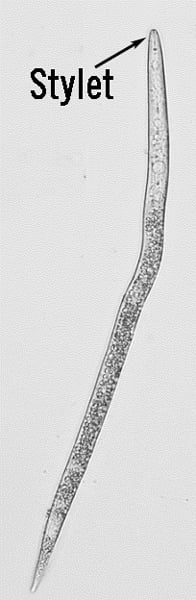

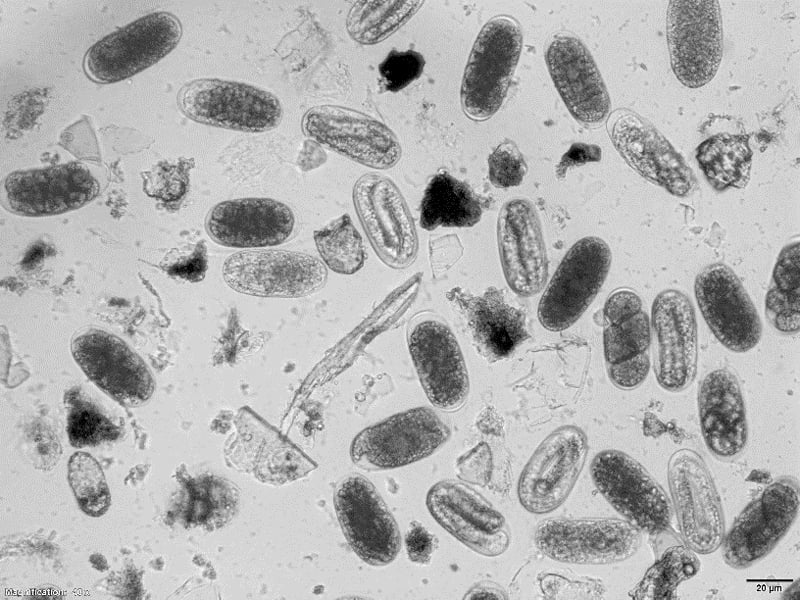
Figure 1. Second-stage juvenile (left) showing the stylet (mouth-spear); females (top right); and eggs (bottom right) of root-knot nematodes that contain the first-stage juvenile that hatches to the second-stage juvenile.
Roots infected by nematodes form galls on both fibrous (hairy) roots and taproots. The length of the life cycle depends on the specific nematode species as well as the soil temperature, varying from 3–5 weeks in the spring and summer to greater than 8 weeks in the winter. As a result, nematode development and reproduction are greatest on carrot crops grown from May to September.
Sandy or sandy-loam soils in south Georgia have sufficient aeration, which allows the nematodes to have increased mobility and to penetrate roots more easily. This results in increased nematode reproduction. Nematodes spread within and among fields via animals, humans, vegetative plant parts, irrigation water, or soil infested with eggs or juveniles that adhere to farm equipment and tools.
Damage Symptoms
Nematode-infested areas in a field usually are patchy and localized. Where there are high nematode densities, plant foliage becomes stunted with yellowing leaves—symptoms that are similar to those associated with nutrient deficiency.
The most notable symptom caused by the nematode is swelling or galling on both fibrous roots and taproots. Carrots infected by the nematodes typically are malformed, stubby, and forked, with excessive root production and/or pimple-like swellings on the skin of the carrot (Figure 2). These symptoms reduce the marketable yield and quality of carrot production.
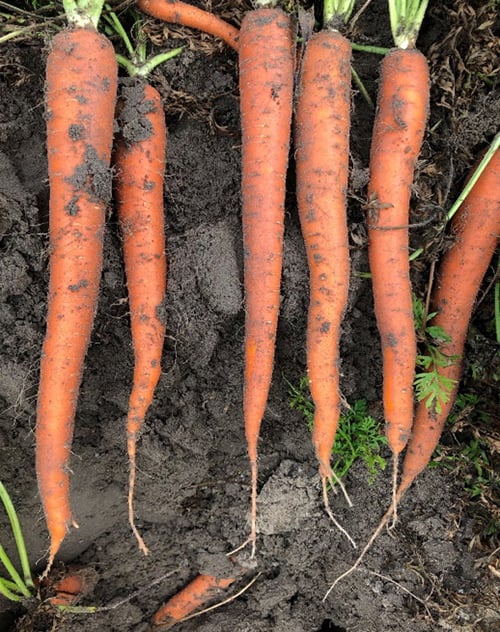


Figure 2. Healthy carrots showing no nematode damage (left) compared with carrots infected with the root-knot nematode (middle and right), showing galls (circled) on both fibrous (hair) and tap (feeder) roots, as well as stunted, forked, or deformed taproots.
Control Options
Root-knot nematodes can be managed through various approaches, including field monitoring, rotation to nonhost or cover crops, resistant cultivars, biocontrol agents, and nematicides.
Monitor Nematode Populations
Prevention is always more effective and cheaper than control treatment when it comes to root-knot nematode management. Preplant soil sampling is a crucial step in assessing the risk that nematodes can pose to directly seeded carrots and is useful for accurate nematode identification and counts. Root-knot nematode population densities usually are lowest at the time of planting and highest around the time of crop maturity.
The damage threshold of nematodes on carrot crops is one nematode per 100 cu cm of soil. If a field with a history of root-knot nematode infestation contains nematode numbers below the damage threshold at the time of sampling, it may still be wise to monitor the nematode population during the season and to use postplant nematicides if needed.
Crop Rotation and Cover Cropping
Producers should avoid growing carrots in root-knot nematode-infested fields. If there is no alternative but to grow carrots, nematode-management options should be considered.
One method to suppress root-knot nematode populations in the soil is to rotate carrots with nonhost or poor-host crops, such as wheat and barley. In the summer, crops can be covered with nematode-resistant cultivars of sunn hemp, sesame, or sorghum-sudangrass. During the winter months, oilseed radish, rye, or oats can help control nematodes.
However, take care when planting a cover crop, as certain cultivars also are susceptible to root-knot nematodes. Planting these would lead to an increase, rather than a decrease, in nematode population density in the soil. Detecting which nematode species is present in the soil is important to ensure that a proper nonhost or poor-host crop is selected.
If you are unsure of which cover crop cultivars have nematode-suppressive traits, contact your local consultant, Extension agent, or specialist. Leaving land to fallow for a short period of time, such as a single year, is not effective at reducing root-knot nematode numbers in the soil.
Resistant Cultivars
The most effective long-term control strategy for nematode-infested carrot production systems is the use of genetically resistant and/or tolerant cultivars. Sources of nematode resistance have been detected in wild lines of carrots. However, there currently are no commercial carrot cultivars available with resistance to root-knot nematodes.
Chemical Control
Chemical nematicides are important elements in the suppression and eradication of root-knot nematodes in carrot production. Chemical control actions should take place either prior to planting or at the time of planting because there are not many postplant methods to completely control nematode damage.
Fumigants
Preplant soil fumigation with Telone II (1,3-dichloropropene), chloropicrin, or their combined products (1,3-dichloropropene + chloropicrin) has been effective in controlling root-knot nematodes in field trials in Georgia. The efficacy of these products varies, with Telone II better controlling root-knot nematodes compared to mixed formulations of Telone + chloropicrin (such as Pic-60 and Pic-80). However, little or no difference in the crop yield was observed between the nematicide treatments examined (Figure 3).


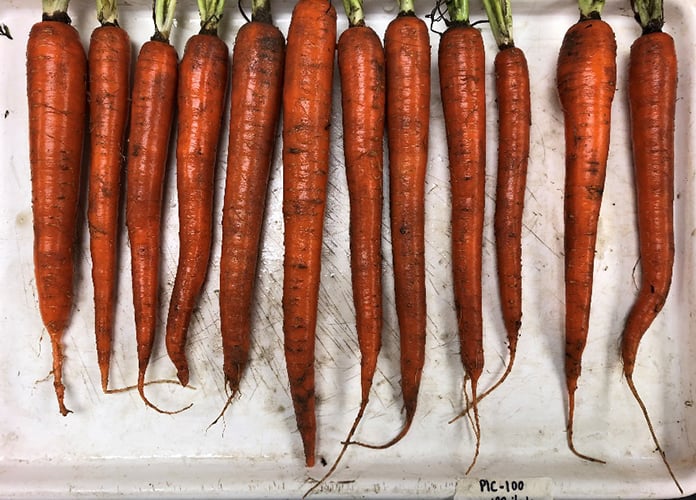
Figure 3. Carrots collected from a root-knot nematode-infested field in south Georgia showing the efficacy of preplant soil fumigation with Telone II (left), Pic-80 (middle), and Pic-100 (right) on the quality of taproots.
These fumigants require injection into the soil using proper rigs or shanks. Telone II helps control nematodes only, whereas Telone + chloropicrin mixtures have broader activities and control several soilborne diseases. The usage rates of fumigants can vary based on the nematode population densities in the soil prior to planting. Carrot seeding should take place 2 to 3 weeks after fumigation so the fumigant can dissipate and prevent damage to emerging plants. Vapam (metam-sodium) also has been introduced as a fumigant in carrot production, but reports show that it is less effective than other products for root-knot nematode control.
Fumigation efficacy is affected by soil texture, soil moisture, compound rates, and application methods. Even with preplant fumigation, crop damage still is likely to occur. As an example, in a field in south Georgia, Telone II (12.5 gallons/acre) was applied before seeding carrots in September 2019.
However, the carrot plants showed poor growth and stunted foliage across the field because of severe root-knot nematode infestation (specifically M. incognita), with galls present on the roots approximately 3 months after planting (Figure 4). In this study, it’s not known why the nematicidal efficacy was low or nonexistent, but high pressure from the nematode infestation and/or unsuitable soil conditions may have played a role.


Figure 4. Stunted foliage growth of carrots caused by root-knot nematode damage 3 months after seeding. This field was fumigated with Telone II before planting, suggesting a lack of efficacy because of inappropriate soil conditions (A). Small galls (arrows) caused by the nematode are visible on the fibrous roots (B).
Nonfumigant Nematicides
Until recently, Vydate (oxamyl) was the only nonfumigant nematicide registered for use in carrot production. Vydate can be applied either in-furrow at planting or through chemigation at planting and/or postplanting. Applications of Vydate during the growing season are recommended if producers observe nematode damage in the field. The second and third applications of Vydate at intervals of 2–3 weeks may help reduce nematode damage and yield loss.
However, it is important to note that nematicide applications during the growing season may not be as effective as preplant application programs because root-knot nematode infection and damage may have already occurred. In recent years, two other nonfumigant nematicides (fluorinated products) have been registered for use in carrot production. Nimitz (fluensulfone) should be applied at least 7 days before planting to prevent potential phytotoxicity damage. Velum Prime (fluopyram) can be used both at planting and postplanting.
Nonfumigant nematicides should not be used when carrot crops are nearing harvest. Producers should limit the amount of irrigation water used when treating carrot crops through an overhead sprinkler system so that the nematicides are concentrated in the root zone.
Biological Control
Application of fungi and bacteria for biological control of root-knot nematodes is not a new concept. Fungal genera such as Purpureocillium, Pochonia, Trichoderma, and Aspergillus have been established as potential biological control agents of nematodes.
One of the most recent U.S. studies reported that fungi in the genera Alternaria, Chaetomium, Cladosporium, Diaporthe, Epicoccum, Gibellulopsis, and Purpureocillium had an effect against the southern root-knot nematode (M. incognita). Successful application of certain strains of Pochonia chlamydosporia and Purpureocillium lilacinum against M. incognita also has been reported.
Combining biological control agents with other nematode-control strategies may prove to be useful in nonchemical management strategies.
Other Nematode Species of Importance in Carrot Production
Some other plant-parasitic nematodes, including stubby-root (Paratrichodorus spp.), root-lesion (Pratylenchus spp.), and spiral (Helicotylenchus spp.), are present in Georgia soils and are considered carrot-crop pests. These nematodes are of minor significance to carrot production because of their low numbers in the soil, but they may have an impact on crop yields in particular situations. Soil fumigation and use of nonfumigant nematicides can help reduce the presence of these nematode species.
Conclusion
The carrot crop is very susceptible to infection by root-knot nematodes, and severe yield reductions occur as a result of the high reproductive ability of this nematode. Management of nematodes in carrots in Georgia is heavily dependent upon the use of nematicides.
Preplant soil fumigation is an essential option used in carrot production to manage root-knot and other pathogenic nematodes. However, these compounds are being restricted because they have adverse impacts on nontarget beneficial organisms in the soil, human health, and the environment, and contribute to poor air quality.
Newly introduced nonfumigant nematicides have provided reliable nematode control and are recommended for use in carrot production. In the longer term, a more integrated approach using cultural, biological, and chemical controls should be considered for both effective management of plant-parasitic nematodes and sustainable carrot production.
References
Becker, J. O., Ploeg, A., & Nuñez, J. J. (2019). Multi-year field valuations of fluorinated nematicides against Meloidogyne incognita in carrots. Plant Disease, 103(9), 2392–2396. https://doi.org/10.1094/PDIS-03-19-0489-RE
Forghani, F., & Hajihassani, A. (2020). Recent advances in the development of environmentally benign treatments to control root-knot nematodes. Frontiers in Plant Science, 11, 1125. https://doi.org/10.3389/fpls.2020.01125
Hajihassani A. (2018). Chemical nematicides for control of plant-parasitic nematodes in Georgia vegetable crops (Publication No. B 1502). University of Georgia Cooperative Extension. https://fieldreport.caes.uga.edu/publications/B1502/
Hajihassani A., Wade, B., & Fuller, P. (2019). Impact of fumigation with Telone II and Pic-Chlor on southern root-knot nematode in carrot, 2018. Plant Disease Management Reports, 13, N012. https://doi.org/10.1094/PDMR13
Mallard, J., & Hajihassani, A. (2020). Effect of post-plant application of Vydate on carrot infected with southern root-knot nematode, 2020. Plant Disease Management Reports, 14, N031. https://doi.org/10.1094/PDMR14
Marquez, J., Severns, P. M., & Hajihassani, A. (2021). Influence of the environment and vegetable cropping systems on plant-parasitic nematode communities in southern Georgia. Plant Disease, 105(10), 3181–3191. https://doi.org/10.1094/PDIS-09-20-2019-RE