

Water spinach (Ipomoea aquatica) is an herbaceous aquatic or semiaquatic freshwater plant that belongs to the sweet potato and morning glory family (Convolvulaceae; Rubatzky & Yamaguchi, 1995). In addition to water spinach, there are many common names used when referring to Ipomoea aquatica, such as kang kong, water convolvulus, and swamp morning glory (Austin, 2007).
Food and Medicinal Value
Widely consumed throughout tropical Asia, water spinach is usually incorporated into meals as a cooked vegetable. Many greens such as cabbage, kale, or lettuce grow poorly during hot summers in much of Southeast Asia, leaving water spinach as an important commodity because it can be grown and distributed locally during hot periods (Edie & Ho, 1969).
Typical culinary practices include frying, boiling, or steaming the tips of the plant, or incorporating them into soups, stews, stir fries, and curries (Westphal, 1993; Austin, 2007). Older, undesirable portions of water spinach can also be utilized as supplemental fodder for animals such as fish, ruminants, or chickens (Ali & Kaviraj, 2018; Kusumah & Pertiwi, 2021; Maung et al., 2020; Sambo et al, 2023).
Habitat and Botany
Water spinach grows best in warm, wet climates where temperatures regularly exceed 77 °F and prefers full sun (Edie & Ho, 1969; Gangopadhyay et al., 2021). Water spinach grows best in soils with a pH range of 5.3–6.0 and high levels of organic material, especially when grown in nonaquatic environments (Westphal, 1993). The wide adaptability of water spinach and its rapid growth rate have also led to its classification as a weed species (Austin, 2007).
Water spinach has long, hollow stems that can trail or float along the surface of waterways. The ability to float can aid in its dispersal in waterways and enable the plant to reach sunlight, outcompeting other aquatic species that may be anchored in the soil. The plant’s primary roots grow in moist soil along the banks of waterways, such as rivers or ponds. Stems can grow adventitious roots at the plant’s nodes, and this growth is enhanced in environments with high humidity and physical contact with water.
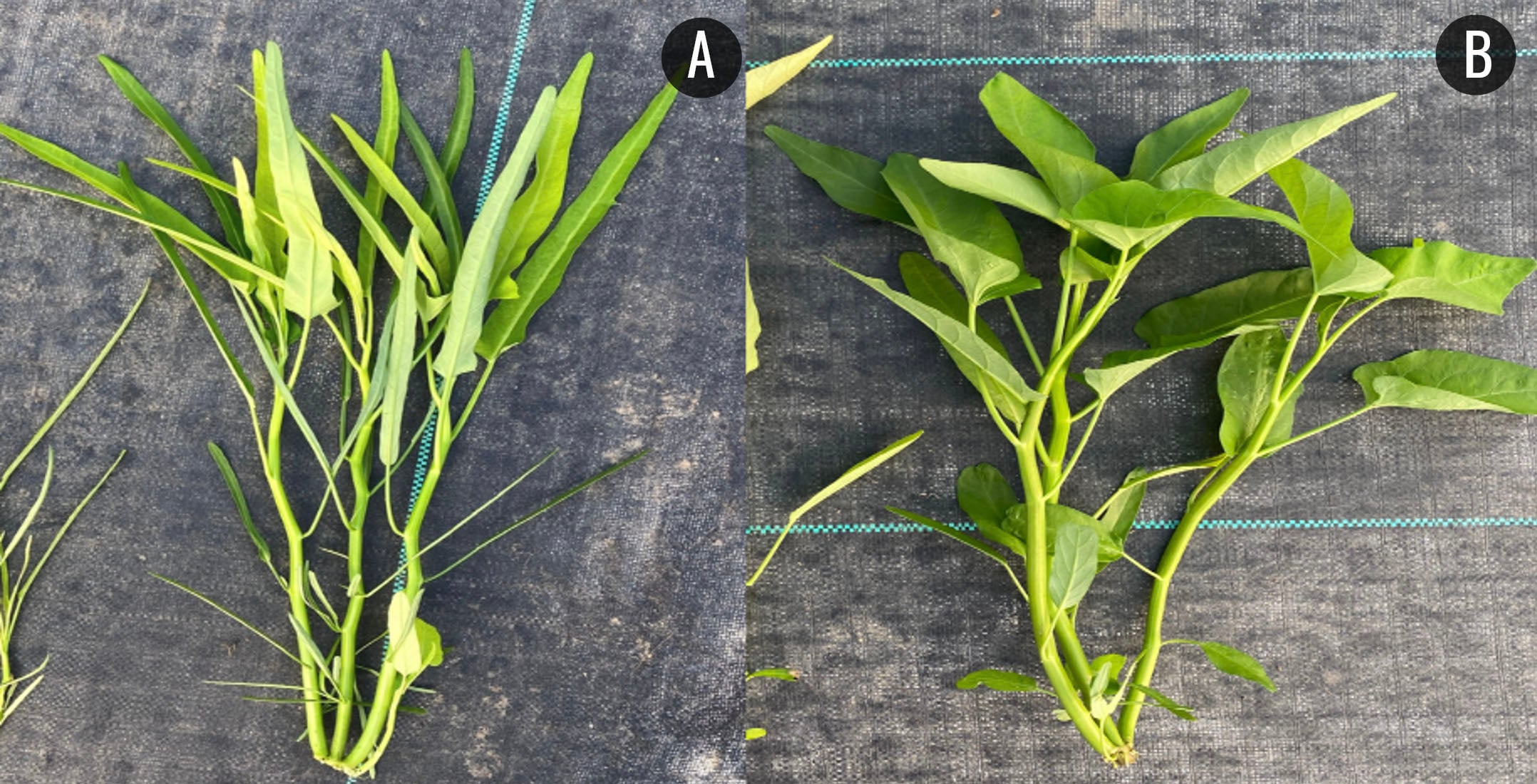
It can be both an annual and a perennial plant depending on the growing location and climate (Prasad et al., 2008). In tropical regions, where freezing temperatures do not occur, it may exist as a perennial. Leaves have long petioles (leaf stalks), can be lanceolate (elongated spear) or hastate (triangular like an arrowhead) in shape, and alternate along the stem (Figure 1).
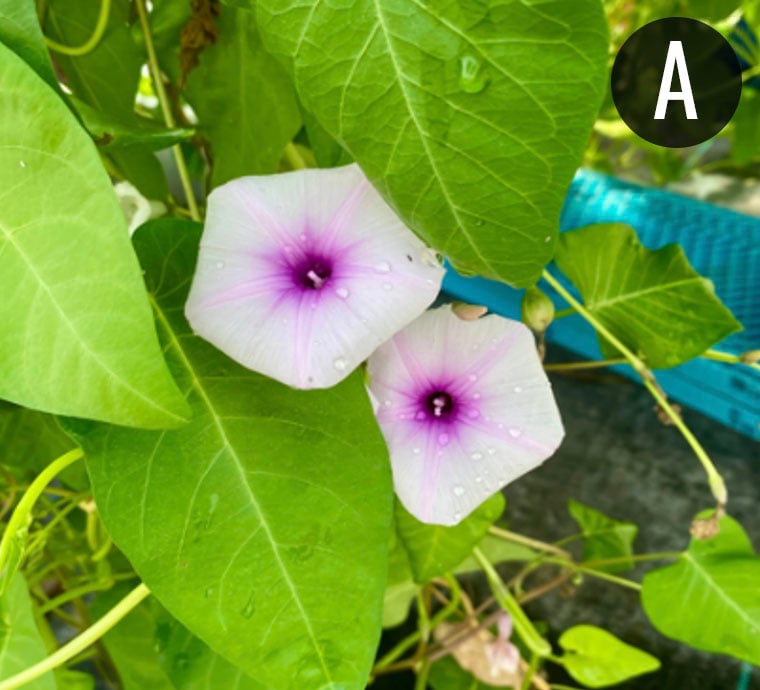
Two wild biotypes of water spinach are often recognized. The red type has green or purple stems, dark green leaves, and white or light purple flowers. The white type is characterized by its green or white stems, green leaves, and white flowers (Westphal, 1993; see Figure 2).


Reproduction and Potential as an Invasive Species
Water spinach can reproduce both sexually and asexually. Limiting seed production is a crucial aspect of responsible water spinach management in the cultivated environment. Although less is known about the breeding of water spinach, empirical observations suggest that it is likely an outcrossing species with self-incompatibility (plants cannot pollinate themselves) like that of sweet potato (Martin, 1965).
As an outcrossing species, seed production in a greenhouse environment without pollinators is limited. Caution is required with field cultivation, which may lead to seed production and subsequent invasiveness in environments where it may be naturalized as a weed (Austin, 2007).
Asexual reproduction can occur when fragments of stems are removed and carried by water or animals. The hollow stems can float through waterways, allowing vegetative fragmentation—ultimately, this is the primary means of reproduction in these environments. Roots growing at each node enable the formation of new independent plants from one single parent plant (Patnaik, 1976; Edie & Ho, 1969). This is the most likely method for this potentially invasive species to spread in the environment.
Within the United States, I. aquatica has been naturalized in Florida, Guam, Hawaii, and Puerto Rico (Institute for Regional Conservation, n.d.; Stone, 1970; Animal and Plant Health Inspection Service, 2020). Water spinach has been repeatedly reintroduced into Florida since 1979 despite several unsuccessful attempts at eradication (Langeland & Burks 1998). In 1998, three phenotypes were officially recorded existing in the wild in Florida. These types have descriptions similar to those found in Southeast Asia, with two types (red and white) floating in waterways and one type (white) growing upland (Van & Maderia, 1998).
Water spinach is currently permitted for cultivation in Texas, Hawaii, Florida, and California. Aquatic herbicides have been used to control water spinach, but the control was only temporary. Other broad-spectrum herbicides, such as Diuron (3-(3,4-dichlorophenyl)-1,1-dimethylurea), have been shown to control water spinach but also negatively impact native vegetation (Schardt & Schmitz, 1990). According to the U.S. Department of Agriculture (USDA), 9% of the United States was estimated to be suitable for the establishment of water spinach, and it is classified as a noxious weed (Federal Noxious Weed Disseminules of the U.S., n.d.; Invasive Species Specialist Group, 2006).
Since 2022, Georgia has approved permits for the import and sale of water spinach within the state (Georgia Department of Agriculture [GDA], 2022). Community leaders in Georgia have advocated for the availability of water spinach in markets throughout the state for over a decade (Pearson, 2022).
Currently, only the tops (shoots) of the plants can be sold to reduce the risk of propagation, and legal cultivation of water spinach in Georgia remains under review (GDA, 2022; Lee, 2023). This guide provides a brief description of production tactics that the authors have used for water spinach. At the time of publication, however, the state of Georgia does not permit the cultivation of water spinach.
Water spinach was grown by the authors of this resource with permission from the GDA to carry out the objectives of the Specialty Crop Block Grant titled: A sustainable protected culture system for water spinach in Georgia. At the completion of these studies, all remaining plant material was destroyed to prevent it from entering the natural environment.
Cultivation
For this project, the authors cultivated water spinach using deep-water culture (raft and pond system) hydroponics in a greenhouse and in the soil within a high tunnel structure. Because of water spinach’s invasive potential, we grew the crop only within enclosed (greenhouse) or semi-enclosed (high tunnel) environments.
Greenhouse Hydroponic Production
For greenhouse production, we used a deep-water or pond culture system. Plants were produced in late spring to early summer to promote growth as high temperatures were expected. Given that water spinach thrives in heat, it may be expensive to produce in a greenhouse during cooler months because of its high heat requirements.
Seedlings were grown in 1-in. rockwool cubes for approximately 2 to 3 weeks until roots began to grow from the undersides of the cubes. We then transferred them into plastic tubs containing both one-quarter and half-strength Hoagland’s nutrient solution (Hoagland & Arnon, 1938; see Table 1).
| Water/solution | Nutrients in ppm | |||||
| N | P | K | Ca | Mg | pH | |
| Well water | 2.1 | < 0.02 | 1.9 | 7.3 | 1.5 | 6.7 |
| 0.50 strengthz | 118.4 | 16.3 | 131.8 | 107.3 | 28.4 | 6.8 |
| 0.25 strength | 61.5 | 10.2 | 67.9 | 61.2 | 10.2 | 6.9 |
| z Nutrient solution: Ca(NO₃)₂∙4H₂O, KNO₃, KH₂PO₄, MgSO₄∙7H₂O, H₃BO₃, MnCl₂∙4H₂O, ZnSO₄∙7H₂O, CuSO₄∙5H₂O, H₂MoO₄∙H₂O, and Sequestrene 330. | ||||||
The purpose of our research was to determine the performance of water spinach under various fertility regimes and to gather general production information for hydroponic production in Georgia. While most growers would purchase a commercial hydroponic fertilizer and not use a Hoagland’s solution, we chose this because it is commonly used in research settings. Our results clearly showed that the one-quarter-strength solution was not suitable and that a half-strength solution (118 ppm nitrogen) was most suitable for production. Figure 3 shows an overview of the system used. Further research to identify optimal nutrient levels should be performed if water spinach is grown on a commercial scale.


Plants could have been harvested about 3 weeks after transplanting in the deep-water system. Sixty days after transplanting, they began flowering and growth slowed considerably. While plants in the greenhouse flowered, no seeds formed because there were no pollinators.
High Tunnel Production
Watkinsville
Approximately 3-week-old seedlings were planted in a certified organic high tunnel at the Durham Horticulture Research Farm in Watkinsville (near Athens), GA, in May, June, and July to determine optimum planting times and harvests. Plants were grown using drip irrigation and were planted approximately 1 ft apart within rows, with rows 2 ft on center (Figure 4).

Although water spinach thrives in aquatic environments, it performed well in the high tunnel as long as plants were irrigated nearly every day. By midsummer, crop water demand in the high tunnel was significant, requiring 2 to 3 in. of water per week. Rapid plant development began 2 weeks after transplanting, and harvest was 4 weeks after transplanting, a similar time frame to that noted by Westphal (1993). Plant shoots were harvested when approximately 2 ft tall, leaving a few leaves at the base of the plant for subsequent growth (Figure 5).

Plants were successfully grown for multiple harvests using 100 lb/acre of nitrogen using a 10-2-8 organic fertilizer. Fertilizer was applied preplant immediately prior to planting, and no additional side-dress operations were performed. However, plants were grown in a rich organic soil with high levels of base fertility. Tifton results suggest that, depending on soil type, you may need to apply more fertilizer during growth.
Our studies showed that May planting was optimal for Athens, as it allowed for multiple in-season harvests and our highest overall yields. Yields declined as our planting date moved into the summer. Overall cumulative yields from three harvests were more than 130,000 lb/acre (fresh weight) for the hastate-leaf-shaped variety (Figure 1) and nearly 100,000 lb/acre for the lanceolate-leaf type. Plantings that occurred late in the summer performed poorly and are not recommended. In Athens, plant growth slowed significantly by mid-September.
Tifton
The study was conducted in 2024 in a certified organic high tunnel at the Horticulture Farm on the University of Georgia Tifton Campus. Water spinach seedlings were raised in a greenhouse and transplanted to soil in the high tunnel 3 to 4 weeks after sowing, with a germination rate of approximately 90%. A lanceolate-leaf variety was used. The objective was to evaluate the effects of planting date and organic fertilization rate on water spinach yield.
Prior to planting, organic fertilizer was incorporated into the soil. Within the high tunnel, plants were established on drip-irrigated raised beds covered with white-on-black plastic mulch. Each bed supported two rows of plants, spaced 18 in. apart between rows and 12 in. apart within each row. Because of the wider spacing of the plastic-mulched rows in Tifton, there were lower plant populations per acre compared to the bare-ground production system used in Watkinsville.
We evaluated three planting dates—May 16, July 9, and October 3—in combination with four fertilization rates: 0, 50, 100, and 200 lb/acre nitrogen (N), applied as organic fertilizer. Each combination of planting date and fertilizer regime was studied.
Shoots were harvested by cutting 2 in. above the soil surface. Harvesting occurred four times for the May planting, three times for the July planting, and once for the October planting, with the final harvest on November 22. Shoot fresh weight (FW) was recorded at each harvest.
Total cumulative yield was highest for the earliest planting date (24,700 lb/acre), intermediate for the July planting date (21,000 lb/acre), and lowest for the last planting (550 lb/acre). The sharp decline in yield for the October planting indicates that cooler autumn conditions strongly limited plant growth, as was the case for the late July planting in Watkinsville.
Across fertilizer treatments, cumulative yield was highest at 200 lb/acre N (18,100 lb/acre yield) and lowest at 0 lb/acre N (12,600 lb/acre yield). The unexpectedly high yields for plants grown with 0 lb/acre N suggest that root growth and roots growing from adventitious shoots were extending beyond plot boundaries. Plants appeared visually more vigorous under conditions of adequate soil moisture and higher fertilization.
In conclusion, the optimal planting window for water spinach in South Georgia appears to be from April to July.
Issues
Although little is known about the commercial production of water spinach in the United States, we encountered some pests during our trials in Watkinsville (North Georgia). The first was a leaf spot that was identified as Cercospora sp. (Figure 6B). This was most prevalent in the greenhouse trials and on the hastate-leaf variety, although it was also observed in the high tunnel.
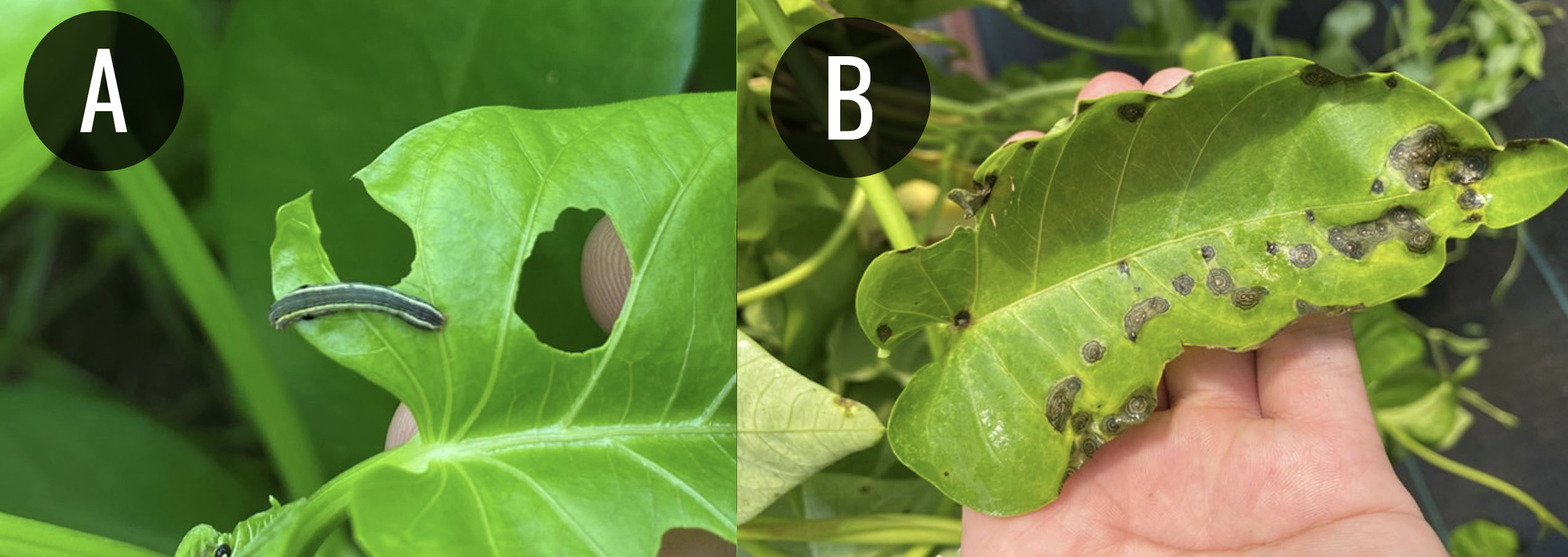
Because water spinach is sold for foliage, a pathogen that causes spotting would be an issue. Given the status of water spinach in the United States, options for disease control would be limited. Proper sanitization of hydroponic systems would be an important first step in limiting pest and disease issues. Armyworms were also encountered in some plots of water spinach grown in the high-tunnel production system, causing damage (Figure 6A) to both varieties.
Pest issues that were not observed in our studies, but have been noted by others, include non-host-specific factors such as Pythium root rot, root knot nematodes (M. incognita and M. javanica), and aphids (Aphis sp.). Two polyphagous lepidopterans, Acronicta strigulate (dagger moth) and Spodoptera litura (cotton leafworm),have been reported to feed on water spinach. The pathogen Albugo candida can also be a pest of water spinach (Westphal, 1993; Dueñas-López, 2023; Austin, 2007).
Water spinach in the high tunnel produced some viable seed. Although regular harvests limited the number of flowers produced, late in the season, dozens of flowers were present throughout the high tunnel, and several of them produced viable seed. After two to three hard freezes, the high tunnel was left open, and the remaining water spinach was killed by the cold weather. No water spinach resprouted after that point. However, water spinach grown in the high tunnels in Tifton, GA, did survive the winter because of the warmer temperatures there.
Conclusions
At the time of publication, water spinach production is not permitted in Georgia. However, if cultivation is allowed with regulation in the future, we have shown that water spinach can be successfully grown in both high tunnels and greenhouses.
Cultivation in soil in a high tunnel required significantly fewer inputs than hydroponic greenhouse production, though a greenhouse may be considered more secure. Yields were highest for late-spring plantings in both locations, and our results indicate that mid- to late-summer plantings should be avoided. Because of this crop’s heat-loving nature, it may be a suitable alternative for growers in Georgia during the summer when high tunnels are often considered too hot for many vegetable crops.
Plants were grown from seed and planted in a bare-ground setting in Watkinsville with rows spaced 2 ft apart with 1 ft in-row spacing, or on plastic mulch in Tifton, spaced on 6-ft centers in a double-row configuration, with plants in a row spaced 1 ft apart. The lower plant population used in Tifton resulted in lower yields per acre compared to Watkinsville.
Cultivation in high tunnels in both Tifton and Watkinsville locations was done according to USDA organic standards; there were only minor pest issues, and the plant’s fast-growing and spreading nature helped reduce competition from weeds. Because the water spinach plants grown in Tifton were able to survive winter temperatures, we would not likely recommend it for in-ground production in South Georgia, because of the risk of it being established in the native landscape. However, the colder temperatures in Watkinsville resulted in a winter kill of water spinach in North Georgia, significantly reducing risk to the environment.
References
Ali, S., & Kaviraj, A. (2018). Aquatic weed Ipomoea aquatica as feed ingredient for rearing rohu, Labeo rohita (Hamilton). Egyptian J. of Aquatic Research, 44(4), 321–325. https://doi.org/10.1016/j.ejar.2018.09.004
Animal and Plant Health Inspection Service. (2020, February 24). Weed risk assessment for Ipomoea aquatica Forssk. (Convolvulaceae) – Water spinach (Version 1). U.S. Department of Agriculture. https://www.aphis.usda.gov/media/document/85783/file
Austin, D. F. (2007). Water spinach (Ipomoea aquatica, Convolvulaceae): A food gone wild. Ethnobotany Research and Applications, 5, 123–146. https://doi.org/10.17348/era.5.0.123-146
Dueñas-López, M. A. (2023, August 28). Ipomoea aquatica (swamp morning-glory). CABI Compendium. Retrieved October 17, 2024, from https://www.cabidigitallibrary.org/doi/epdf/10.1079/cabicompendium.28781
Edie, H. H., & Ho, B. W. C. (1969). Ipomoea aquatica as a vegetable crop in Hong Kong. Economic Botany, 23, 32–36. https://doi.org/10.1007/bf02862969
Federal Noxious Weed Disseminules of the U.S. (n.d.). Ipomoea aquatica. Identification Technology Program. Retrieved August 15, 2024, from https://idtools.org/fnwd/index.cfm?packageID=1097&entityID=2600
Gangopadhyay, M., Das, A. K., Bandyopadhyay, S., & Das, S. (2021). Water spinach (Ipomoea aquatica Forsk.) breeding. In J. M. Al-Khayri, S. M. Jain, & D. V. Johnson (Eds.), Advances in plant breeding strategies: Vegetable crops. (pp. 183-215). Springer, Cham. https://doi.org/10.1007/978-3-030-66969-0_5
Georgia Department of Agriculture. (2022, March 15). Grocery stores and restaurants may now sell water spinach [Press release]. Retrieved October 10, 2024, from https://www.agr.state.ga.us/pr/grocery-stores-and-restaurants-may-now-sell-water-spinach
Invasive Species Specialist Group. (2006, August 29). Global Invasive Species Database, species profile: Ipomoea aquatica. https://www.iucngisd.org/gisd/species.php?sc=477
Hoagland, D. R., & Arnon, D. I. (1938, December). The water-culture method for growing plants without soil (Circular 347). California Agricultural Experiment Station. https://dn720705.ca.archive.org/0/items/waterculturemeth347hoag/waterculturemeth347hoag.pdf
Institute for Regional Conservation. (n.d.). Plants of the island of Puerto Rico: Ipomoea aquatica. Retrieved September 15, 2024, from https://www.regionalconservation.org/ircs/database/plants/PlantPagePR.asp?TXCODE=Ipomaqua
Kusumah, V., & Pertiwi, H. (2021). Potential of Ipomoea aquatica hay and its phytochemical to improve performance health status in ruminants. Ecology, Environment & Conservation Paper, 28, 33–41. https://doi.org/10.53550/EEC.2022.v28i01s.004
Langeland, K. A., & Burks, K. C. (1998). Identification & biology of non-native plants in Florida’s natural areas. University of Florida.
Lee, C. (2023, April 17). Water spinach, a staple of Asian cuisine, is finally legal in Georgia. Atlanta Magazine. Retrieved October 28, 2024, from https://www.atlantamagazine.com/dining-news/water-spinach-a-staple-of-asian-cuisine-is-finally-legal-in-georgia/
Martin, F. W. (1965). Incompatibility in the sweet potato. A review. Economic Botany, 19(4), 406–415. https://www.jstor.org/stable/4252651
Maung, A. T., Swe, K. H., Maw, A. A., & Aung, Y. L. (2020). Effects of supplementing water spinach (Ipomoea aquatica) to basal diet on growth performance and nutrients digestibility of broiler chickens. J. of Livestock Sci., 11, 77–84. https://doi.org/10.33259/jlivestsci.2020.77-84
Patnaik, S. (1976). Autecology of Ipomoea aquatica Forsk. Journal of the Inland Fisheries Society of India, 8, 77–82.
Pearson, E. W. (2022, March 27). The Asian food staple water spinach is mostly illegal, but Ga. is changing its mind. NPR. Retrieved October 28, 2024, from https://www.npr.org/2022/03/27/1089047801/the-asian-food-staple-water-spinach-is-mostly-illegal-but-ga-is-changing-its-min
Prasad, K. N., Shivamurthy, G. R., & Aradhya, S. M. (2008). Ipomoea aquatica, an underutilized green leafy vegetable: A review. International J. of Botany, 4(1), 123–129. https://doi.org/10.3923/ijb.2008.123.129
Rubatzky, V. E., & Yamaguchi, M. (1995). World vegetables: Principles, production, and nutritive values (2nd ed.). Springer New York. https://doi.org/10.1007/978-1-4615-6015-9
Sambo, C., Heng, S., Te, K., Ven, S., Vong, P., Keo, S., & Seng, M. (2023). Supplementation of water spinach (Ipomoea aquatica) on the utilization of Mimosa pigra and Leucaena leucocephala leaf for in vitro fermentation. Veterinary World, 16(1),215–221. https://doi.org/10.14202/vetworld.2023.215-221
Schardt, J. D., & Schmitz, D. C. (1990). 1990 Florida aquatic plant survey report. Florida Department of Natural Resources.
Stone, B. C. (1970). The flora of Guam: A manual for the identification of the vascular plants of the island. University of Guam.
Van, T. K., & Madeira, P. T. (1998). Random amplified polymorphic DNA analysis of water spinach (Ipomoea aquatica) in Florida. J. Aquatic Plant Management, 36(2), 107–111. https://apms.org/wp-content/uploads/japm-36-02-107.pdf
Westphal, E. (1993). Ipomoea aquatica Forsskal. In J. S. Siemonsma & K. Piluek (Eds.), Plant resources of South-East Asia: No. 8: Vegetables (pp. 181–184). Pudoc Scientific Publishers. https://edepot.wur.nl/326103
Funding Note
The information presented in this publication was supported by the
Georgia Department of Agriculture from Specialty Crop Block Grant titled:
A sustainable protected culture system for water spinach in Georgia.