
The red-headed flea beetle (RHFB), Systena frontalis (F.) (Coleoptera: Chrysomelidae) (Figure 1) is a serious insect pest in ornamental nurseries. It is also referred to as the “cranberry flea beetle” in cranberry and blueberry systems in the Northern U.S.
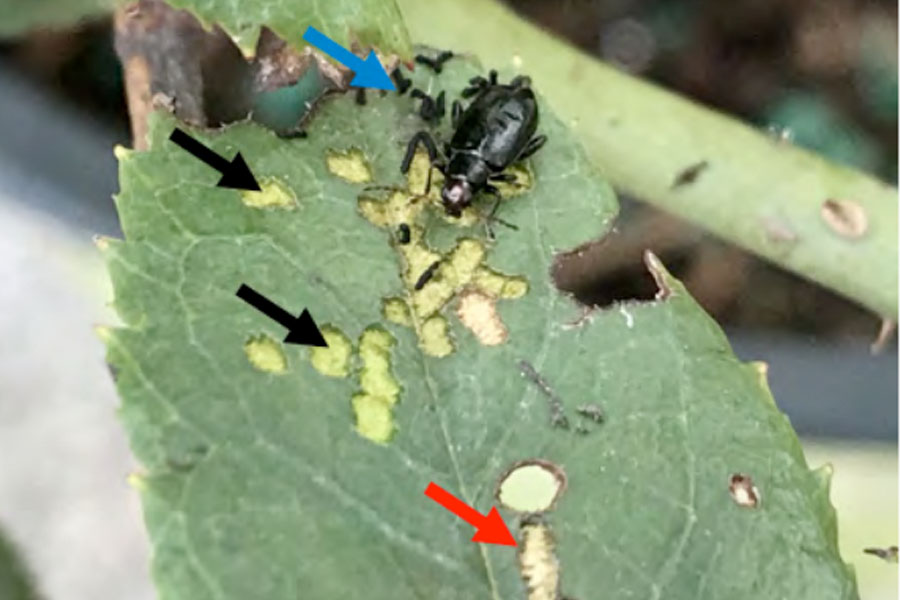
Photo: Shimat V. Joseph
The adult RHFB causes serious feeding damage to the foliage of a variety of woody and herbaceous container plants in nurseries (Figures 3 and 4). As the name suggests, the RHFB jumps when disturbed, similar to a dog flea. A native pest, the RHFB is present in the central and eastern regions of the U.S.
Identification and biology
RHFB adults are small, shiny, oval-shaped beetles, about 0.2 inches in length, with metallic-black bodies and red heads— a unique identifying characteristic that distinguishes these beetles from similar species. Females are slightly larger than males. A pair of light-brown, serrate (notched) antennae with dark-brown distal segments originates below the eyes. On the last pair of legs, the femur is wider and swollen, enabling RHFBs to jump.
Mature females lay pale yellow eggs singly in the potting medium. Larvae are about 0.5 to 1 centimeter in length and creamy white in color (Figure 2), with a pale brown head capsule and three pairs of legs. The last segment on the rear end of the larva is oriented upward with prominent setae (hairs) (Figure 2). RHFBs undergo three larval stages, which all feed on roots.

Photo: D.K.B. Cheung via https://www.dkbdigitaldesigns.com/clm/content/systena-frontalis-12
RHFBs overwinter as eggs. In nurseries, adult beetles are typically first observed feeding on foliage during the last week of May in most of Georgia, although timing may depend on local weather conditions. After a distinct first generation emergence in the spring, multiple overlapping generations occur in Georgia until late October. During summer, multiple stages (eggs, larvae, and adults) may be found on an individual containerized plant.
Host plants
RHFBs feed and cause damage to numerous plants grown in the nursery industry. In Georgia, high numbers of RHFB have been found on roses (Rosa spp.) and panicle hydrangeas (Hydrangea paniculata). RHFB damage has also been reported on Virginia sweetspires (Itea virginica), forsythias (Forsythia x intermedia), anise trees (Illicium spp.), azaleas (Rhododendron spp.), crapemyrtles (Lagerstroemia spp.), dogwoods (Cornus spp.), Japanese hollies (Ilex crenata), weigelas (Weigela florida), loropetalum (Loropetalum sinense), fragrant osmanthus (Osmanthus fragrans), viburnums (Viburnum spp.), and wax myrtles (Morelia cerifera). They also attack Vacinium spp. (cranberry and blueberry), including lowbush blueberry (Vaccinium angustifolium), cranberry (Vaccinium macrocarpon), and highbush blueberry (Vaccinium corymbosum), as well as alfalfa (Medicago sativa) in Northern states. In addition to woody plants, RHFBs attack herbaceous hosts such as asters (Aster spp.), chrysanthemums (Dendranthema spp.), tickseeds (Coreopsis spp.), goldenrods (Solidago spp.), joe-pye weeds (Eupatorium spp.), salvias (Salvia spp.), sedum (Sedum spp.), veronicas (Veronica spp.), and zinnias (Zinnia spp.).
RHFBs also attack weeds including jewelweed (Impatiens capensis), lambsquarter (Chenopodium album), pigweed (Amaranthus spp.), smartweed (Polygonum spp.), Canadian thistle (Cirsium arvense), clover (Trifolium spp.), and common burdock (Arctium minus). The range of plants reported as damaged by RHFB suggests that the beetle can feed on virtually any broad-leaved woody or herbaceous plant growing in or around the nursery.
Damage symptoms
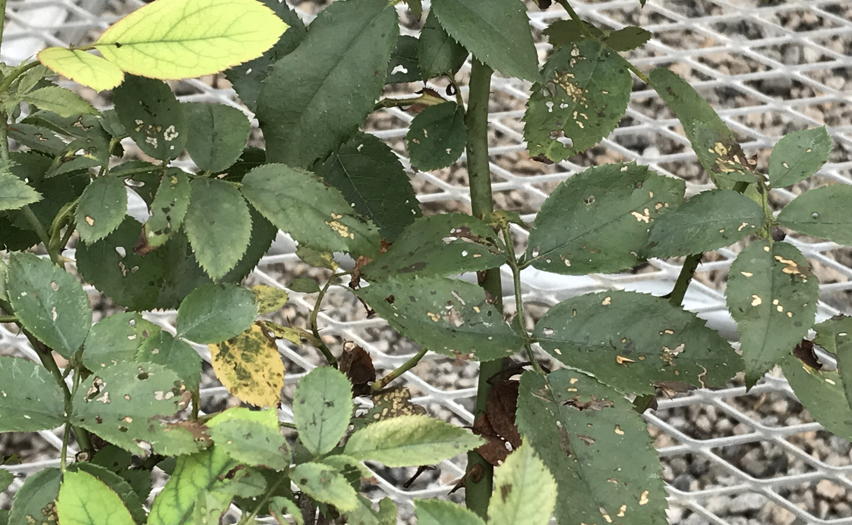
Photo: Shimat V. Joseph
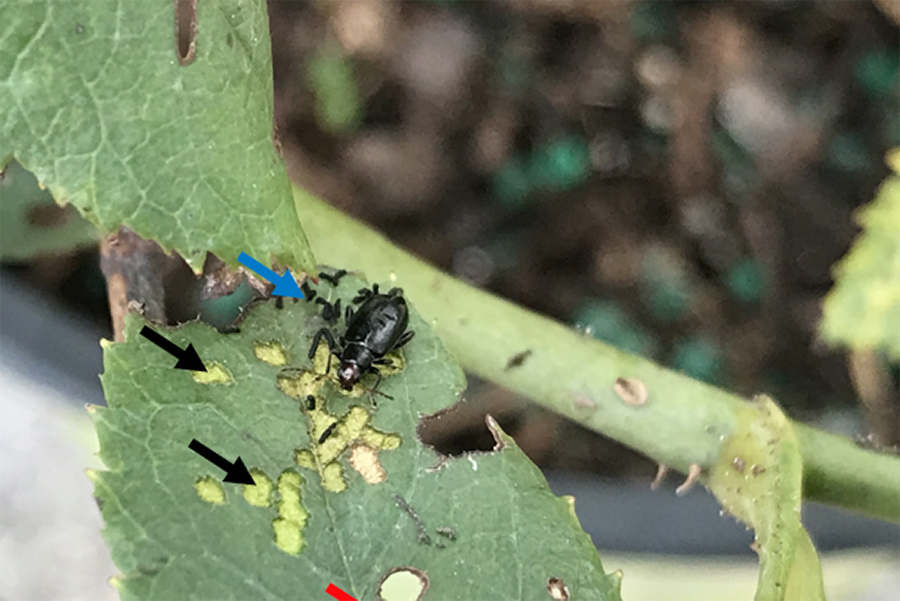
RHFB adults feed on leaves, causing numerous holes, and sometimes skeletonizing them by removing the surface layer of both upper and lower sides of mature leaves (Figures 3 and 4).
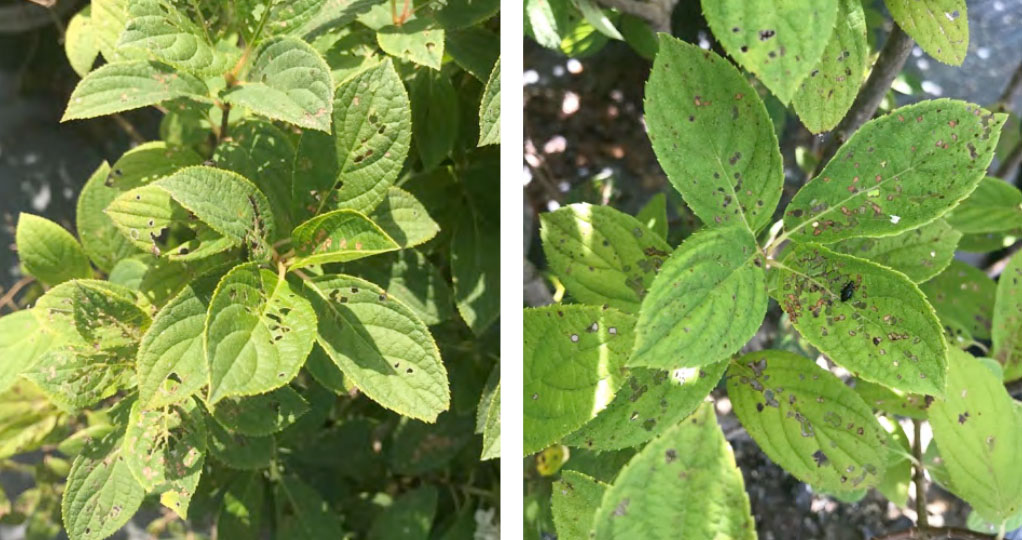
Photo: Shimat V. Joseph
They often deposit fecal matter near the feeding site (Figure 1). Damage to plants can be severe and rapid depending on the number of invading RHFB adults. Affected plants are typically not marketable. Although RHFB larvae feed on the roots, they rarely cause noticeable damage.
Monitoring and management
Nursery plants, especially preferred host plants, should be aggressively scouted weekly for adult RHFBactivity starting in mid-May, preferably during the middle of theday. Because RHFBs attack volunteer species, weeds should also be scouted. As part of cultural control, removing weeds in and around the nursery could reduce food resources for adult RHFBs and prevent population buildup in the general area. If the container stock is already infested with RHFB, it is advised not to place newly propagated plant containers near infested stock plants.
Biorational (non-toxic to humans with minimal environmental side effects) options include using microbial biological control agents such as the entomopathogenic nematode (Steinernema carpocapsae) as well as entomopathogenic fungi (Beauveria bassiana and Metarhizium anisophliae),which are effective on larval stages of the RHFB in containers.
To manage adult populations, applying foliar insecticides is essential. Depending on the number of invading RHFB adults on plants, multiple applications may be necessary to bring the population under control. There is no threshold determined for this pest, as the market is driven by zero damaged plants. Adult RHFBs are highly mobile, so coverage is important, especially when using contact insecticides. For current insecticide recommendations, contact your local UGA Cooperative Extension office.
Applying soil drench insecticides in the container can yield acceptable control of larvae if it’s possible to ensure uniform distribution of the insecticide throughout the root ball. A soil drench may be applied as a preventative treatment in spring if the plants were exposed to adults in the previous season. RHFB larvae can develop within a small volume of non-treated soil medium in the container. Although high larval densities may be present in the soil, it is not certain that all of the adults feeding on the foliage originate from the same container. For that reason, regularly scouting and removing weeds could help reduce the insect load on the desirable nursery stock.
References
Ahola, K. L., Weber, D. C., & Roskelley, S. R. (2000). Control Of Flea Beetle In Cranberry With Thiamethoxam, 1999. Arthropod Management Tests, 25(1). https://doi.org/10.1093/amt/25.1.C8
Averill A. L., & Sylvia, M. M. (2011). Red-headed flea beetle, Systena frontalis (F.) (Coleoptera: Chrysomelidae). University of Massachusetts Cranberry Experiment Station. https://ag.umass.edu/sites/ag.umass.edu/files/fact-sheets/pdf/red-headed_flea_beetle.pdf
Cloyd, R. A., & Herrick, N. J. (2018). Red headed flea beetle. Kansas State University Agricultural Experiment Station and Cooperative Extension Service. MF3225. https://www.bookstore.ksre.ksu.edu/pubs/MF3225.pdf
Dittl, T. (1988). A survey of insects found on cranberry in Wisconsin [Master’s Thesis]. University of Wisconsin, Madison.
Maltais, P. M., & Ouellette, M. C. (2000). A note on Systena frontalis [Coleoptera: Chrysomelidae] adults on lowbush blueberry, Vaccinium angustifolium. Phytoprotec., 81, 129–131. https://doi.org/10.7202/706207ar
Peters, D. C, & Barton, H. E. (1969). Systena frontalis larvae in corn roots. J. Econ. Entomol., 62, 1232–1233. https://doi.org/10.1093/jee/62.5.1232
Jacques, R. L., & Peters, D. C. (1971). Biology of Systena frontalis with special reference to Corn12. Journal of Economic Entomology, 64(1), 135–138. https://doi.org/10.1093/jee/64.1.135
Storch, R. H., Manzer, F. E., Sewell, G. H., & Smith, O. P. (1979). Scientific note. American Potato Journal, 56(7), 363–364. https://doi.org/10.1007/BF02853851