

Introduction
Fresh-market pepper production continues to grow as consumer demand increases for specialty peppers. However, selecting the best variety can be challenging because yield potential and fruit dimensions vary widely among jalapeño, serrano, poblano, and banana types.
Fruit length and width influence grading, packing efficiency, and market preference, while differences in marketable yield directly affect growers’ profitability. Limited side-by-side comparisons of these market classes make it difficult to identify varieties that combine strong yield with desirable fruit characteristics.
To address this need, this study evaluated 18 pepper varieties representing four market types (jalapeño, serrano, poblano, and banana) under spring-production conditions. The objective was to compare marketable yield and fruit size to identify varieties with both high marketable yield and favorable fruit dimensions for fresh-market use.
Material and Methods
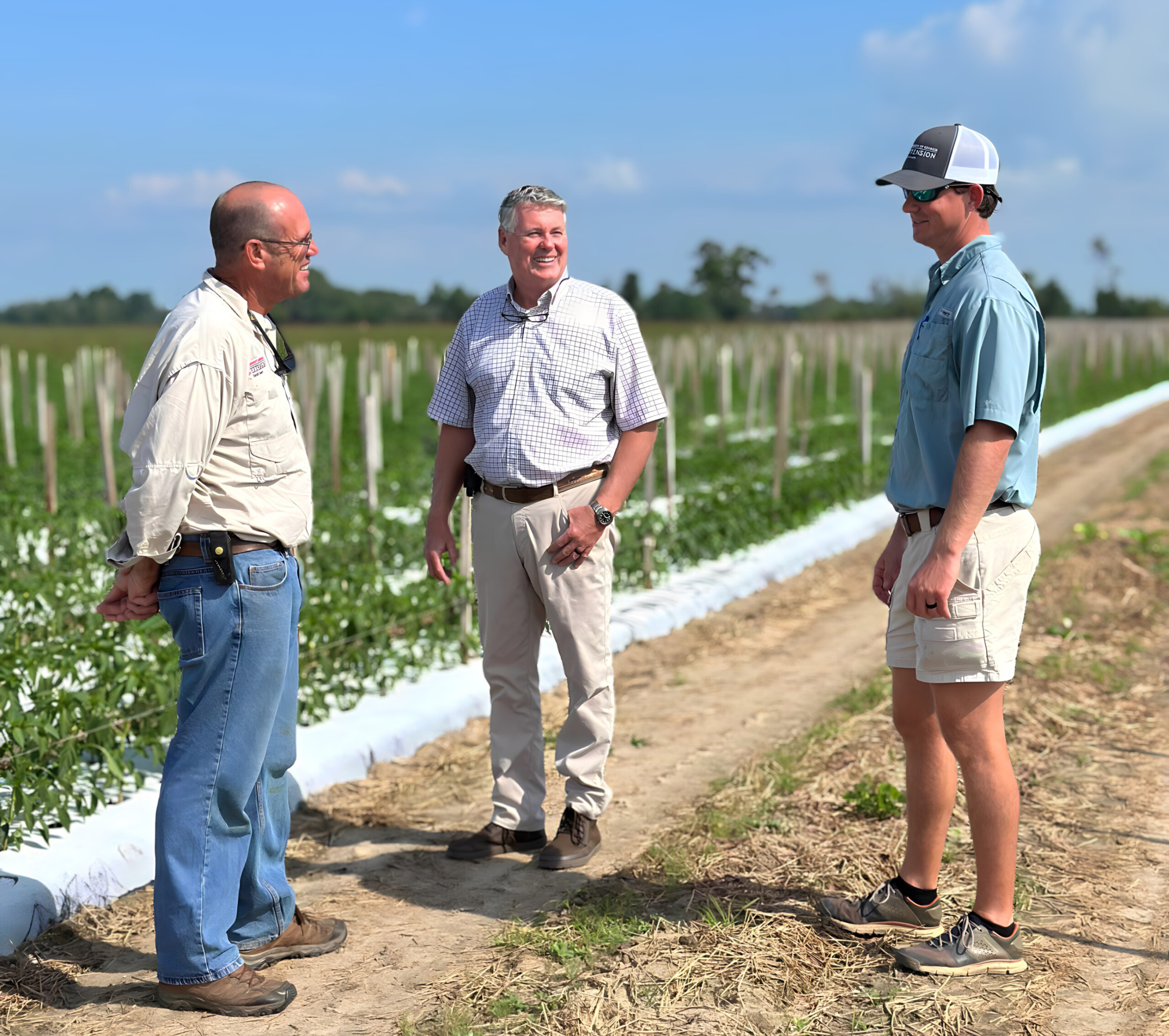
The trial was conducted in a commercial pepper grower’s field in Grady County, GA, during spring 2024. Eighteen pepper varieties representing four market classes, jalapeño (J), serrano (S), poblano (P), and banana (B), were evaluated. Plots were arranged in a randomized complete block design with three replications.
Results
Marketable yield differed significantly among the 18 pepper varieties. ‘Pathfinder’ and ‘Real Serrano’ (serrano types) produced the highest marketable yield, followed closely by ‘Soundwave’ and ‘Orizaba’ (jalapeño types). In contrast, ‘Sequoia’ (poblano type) and ‘Teniente’ (jalapeño type) produced the lowest marketable weights. Most varieties had very little cull weight, but ‘Seminis 5816’, ‘Teca F1’, and ‘Blazing Banana’ showed a significantly higher proportion of unmarketable fruit than the other varieties.
Fruit size also differed across market types. ‘Blazing Banana’ produced the longest fruit, while the poblano varieties (‘Carranza’, ‘Hitman’, ‘Sequoia’, and ‘Teca F1’) were both long and wide. Serrano varieties (‘Pathfinder’, ‘Real Serrano’, ‘Seminis 5633’) were narrower than poblano and jalapeño types. Jalapeño varieties showed a wide range of sizes, with ‘Unicorn’ producing some of the longest fruit and ‘Soundwave’ producing some of the widest. These results indicate significant differences in both yield potential and fruit dimensions across pepper varieties and types.
| Variety | Type | Marketable weight (lb) | Unmarketable weight (lb) | Length (in.) | Width (in.) |
|---|---|---|---|---|---|
| Blazing Banana | Bi | 15.9 abcdv | 1.5 ab | 7.6 a | 1.7 bc |
| Carranza | Pii | 15.9 abcd | 1.1 b | 5.8 b | 3.0 a |
| Catarino | Jiii | 16.1 abcd | 1.0 b | 4.7 bcd | 1.8 bc |
| Chametla | J | 17.5 abc | 1.0 b | 3.8 d | 1.8 bc |
| Cuatrero | J | 18.8 abc | 1.3 b | 3.9 d | 1.8 bc |
| Gabino | J | 16.8 abc | 0.9 b | 4.0 d | 1.6 bcd |
| Hitman | P | 13.3 bcd | 0.9 b | 5.8 b | 3.0 a |
| Megatron | J | 18.6 abc | .9 b | 4.2 cd | 1.83 b |
| Orizaba | J | 19.8 ab | 0.5 b | 4.1 d | 1.7 bc |
| Pathfinder | Siv | 21.6 a | 0.7 b | 4.6 bcd | 1.2 cde |
| Real Serrano | S | 20.4 a | 1.1 b | 4.4 bcd | 0.9 e |
| Seminis 5633 | S | 15.3 abcd | 0.5 b | 3.7 d | 1.0 de |
| Seminis 5816 | J | 15.4 abcd | 3.6 a | 4.0 d | 1.8 bc |
| Sequoia | P | 9.1 d | 1.1 b | 5.1 bcd | 3.0 a |
| Soundwave | J | 20.7 a | 0.6 b | 4.2 cd | 1.9 b |
| Teca F1 | P | 15.0 abcd | 2.1 ab | 5.2 bcd | 3.0 a |
| Teniente | J | 12.7 cd | 0.7 b | 3.8 d | 1.5 bcd |
| Unicorn | J | 13.1 bcd | 0.9 b | 5.6 bc | 2.0 b |
| p value | < 0.0001 | 0.0017 | < 0.0001 | < 0.0001 | |
| iB = Banana Pepper iiP = Poblano iiiJ = Jalapeno ivS = Serrano vMeans followed by the same letter are not significantly different based on Tukey’s honest significant difference test at 95%. | |||||
Conclusion
The spring 2024 pepper variety trial in Grady County showed significant differences among cultivars. ‘Pathfinder’, ‘Real Serrano’, and ‘Soundwave’ produced the highest marketable yields, while ‘Sequoia’ yielded the lowest. ‘Blazing Banana’ had the longest fruit, and poblano cultivars produced the widest fruits. ‘Seminis 5816’ recorded the highest unmarketable weight, mainly because of cracking, indicating quality concerns. Overall, ‘Pathfinder’, ‘Real Serrano’, and ‘Soundwave’ appear most promising for spring pepper production in southern Georgia.