General Agriculture Resources
-

L’arachide est cultivée en Haïti depuis au moins 500 ans et remonte très probablement à la préhistoire. Selon Bartolomé de las Casas, un prêtre qui a accompagné Christophe Colomb lors de son expédition dans le Nouveau Monde et qui est accrédité avec la première description écrite de l’arachide, les Amérindiens indigènes ont cultivé l’arachide comme culture vivrière sur l’île d’Hispaniola avant l’arrivée des Européens. La production d’arachides en Haïti a continué jusqu’à nos jours. C’est une culture populaire parce qu’elle a un prix élevé sur le marché et qu’elle constitue une source de nourriture importante et agréable pour de nombreux Haïtiens. Les arachides séchées se trouvent toute l’année dans la plupart des marchés en plein air, et des produits à base d’arachides fabriqués localement, tels que le beurre d’arachide (y compris les formes sucrée, épicée et non aromatisée) sont couramment vendus dans les magasins et les supermarchés.
|
-

Fertilization is an important practice of maintaining plant health. The blueberry plant is no exception, but there are important considerations when fertilizing blueberries. The rates, timing, and type of fertilizer should be common knowledge for the grower. In this circular, how to fertilize blueberry plants is described with text, diagrams, and calculations to provide growers, Extension agents, and anyone interested with the knowledge to successfully grow blueberries, from newly established to mature plantings. This publication was written to address commercial growers’ need for a reference to avoid costly mistakes such as over-fertilization, discussing both granular and liquid fertilization.
|
-
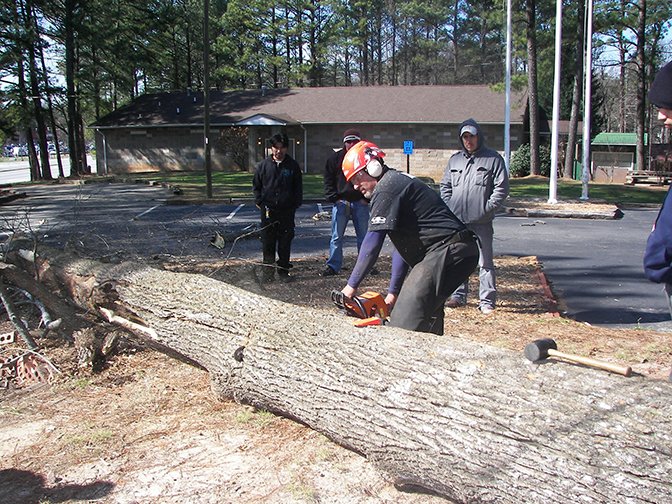
Operating a chainsaw is inherently dangerous. Chainsaw cuts are always serious, but this is not the only hazard a saw operator faces. Saw operators are often struck by falling limbs and trunks as the tree moves during felling. Saw operators may fall off ladders or out of trees, or they may trip while moving through brush and uneven ground. Even when the tree is on the ground, danger lurks in wood under tension. Spring poles snap and logs roll unexpectedly. Personal protective equipment (PPE) saves lives every day. The Occupational Safety and Health Administration (OSHA) requires that saw operators wear the PPE described in this publication, including head protection, eye protection, ear protection, chainsaw chaps or pants, and suitable footwear.
|
-

B 1499
Haiti Peanut Research Report
This report summarizes the findings of field trials and basic data collected in Haiti under the Feed the Future Peanut & Mycotoxin Innovation Lab project from 2014-2017. The focus of the research was to improve peanut productivity through management options for foliar diseases, low soil fertility, and other yield-limiting agronomic factors.
French translation:
https://extension.uga.edu/publications/detail.html?number=B1499-FR”>https://extension.uga.edu/publications/detail.html?number=B1499-FR|
-

Drip, trickle, microemitters, and subsurface irrigation systems are considered low-volume irrigation. Low-volume irrigation systems are designed to improve irrigation efficiency, delivering water to the crop accurately with minimal water loss. Irrigation efficiency can be categorized into two main concepts: water loss and uniform application. If water loss is significant, or application uniformity is poor, efficiency will be low. Generally, the most significant loss of irrigation water is from overwatering, where the water percolates below the root zone, or from runoff. With good management, losses due to leaks, system drainage, and flushing of filters and lateral lines should not exceed 1%. Low-volume systems have the opportunity to achieve efficiency, and under careful management, will minimize losses from overirrigation. However, using low-volume systems requires increased irrigation frequency and soil moisture monitoring should be used to improve water-use efficiency. This publication covers system design, system efficiencies, components, chemical applications, diseases related to irrigation, and soil moisture monitoring.
|
-

Cover crops are in essential part of an organic production system. Cereal rye and crimson clover are cover crops that are commonly used. If organic cover crop production is a viable enterprise for growers, it could improve the availability of varieties adapted to the Southeast; provide a source for locally grown seeds; and be another profit center for growers, seed cleaners, and local seed companies.
This bulletin discusses what farmers need to know about producing cover crops organically and gives example enterprise budgets for cereal rye and crimson clover. A two-year on-farm trial indicated that producing organic cover crop seed may be profitable.
|
-

Experimental power determinations are very important to agriculture and other applied sciences. It is necessary to be able to detect small differences when human and animal health or production profitability are in question. These documents help researchers estimate the power of their experiments.
|
-

David R. Coyle, A. Brady Self, James D. Floyd, and John J. Riggins
Four species of Ips bark beetles (also commonly known as Ips engraver beetles or Ips beetles) occur throughout pure and mixed pine forests in the southeastern U.S.: the six-spined ips (Ips calligraphus), the pine engraver (Ips pini), the eastern five-spined ips (Ips grandicollis), and the small southern pine engraver (Ips avulsus). Ips beetles appear similar to other bark beetles in this region, including the southern pine beetle (SPB), black turpentine beetle, and red turpentine beetle. These beetles occur throughout the entire southeastern U.S., with the exception of the pine engraver and red turpentine beetle, which are found only in the Appalachian region.
|
-

Private forest owners control most of the southern forest resource and are critical to maintaining forest health in the South. Record droughts, rising temperatures, increased frequency and intensity of wildfires, insect and plant invasions, and more intense storm events all pose threats to the health of Southern forests. Scientists project that increases in temperature and changes in rainfall patterns will cause these disturbances to become more common, occurring with greater intensity or duration. This pamphlet reviews healthy forest strategies and approaches to decrease the risks associated with these disturbances on your forestland.
|