

Introduction
Plant viruses, such as tomato yellow leaf curl virus (TYLCV; a DNA virus) and tomato chlorosis virus (ToCV; an RNA virus) cause tomato yellow leaf curl disease (TYLCD), resulting in substantial yield loss, mostly in summer and fall-grown crops. Tomato spotted wilt virus (TSWV; an RNA virus) is more prevalent in spring-grown crops.
Seven slicer-tomato cultivars were selected based on the presence or absence of single or multiple resistance genes (ty-1, ty3/6). After 4 to 5 weeks posttransplantation in Colquitt, Grady, and Tift counties, high disease pressure was observed. Symptomatic samples were tested using molecular assays, and this confirmed the presence of TYLCV and ToCV. Additionally, a full-length sequence of TYLCV revealed an abundance of TYLCV-GA (Georgia) populations in the region.
Although cultivars like ‘Camaro’, ‘Grand Marshall’, ‘Jolene’, and ‘STM 2255’ performed best in natural conditions, overall marketable fruit production was significantly reduced.
Material and Methods
Plant Materials
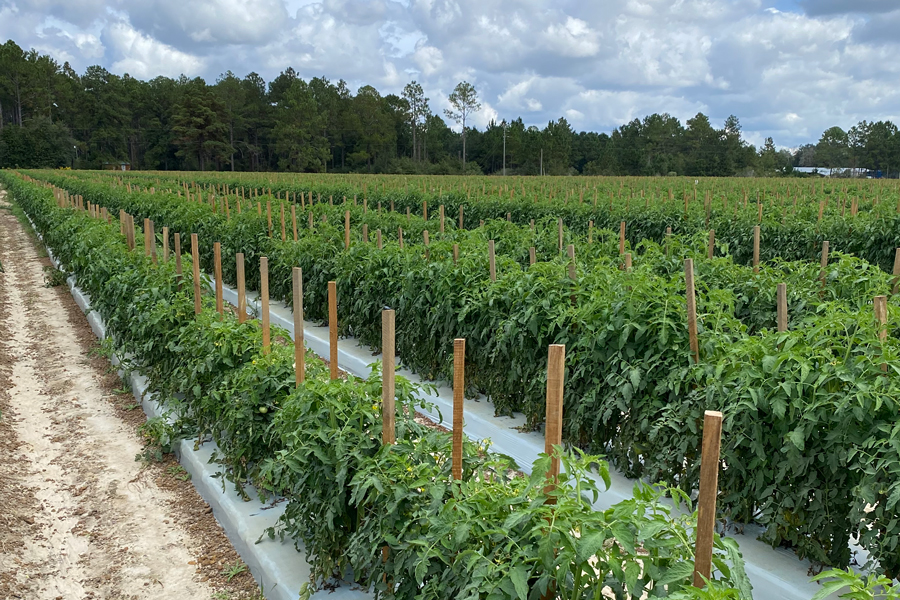
Seven commercially grown cultivars (‘Grand Marshall’, ‘STM 2255’, ‘Red Snapper’, ‘Camaro’, ‘Varsity’, ‘Jolene’, and ‘Myrtle’) of slicer tomatoes were evaluated under field conditions in the fall of 2022 and 2023 in Colquitt, Grady, and Tift counties. Tomato plants showed severe symptoms, including upward leaf curling, yellowing, reduced leaf sizes, and stunted growth. Moreover, leaves among the lower foliage showed marginal yellowing, interveinal chlorosis, and leaf blistering.
Approximately 1,680 plants (10 plants/treatment x seven cultivars x four replications x three counties x 2 years) were assessed for symptom progression every 2 weeks posttransplantation under natural disease pressure. Samples were collected and tested in the UGA Plant Virology Laboratory in Tifton for the presence and absence of TYLCV and ToCV. Additionally, TSWV symptoms were visually analyzed in those plants.
All research plots were maintained properly according to the standard Georgia tomato production guidelines (UGA Extension expert resource B 1312, Commercial Tomato Production Handbook).
Virus Detection Using Molecular Assay
Collected samples were processed for total nucleic acid (TNA) extraction by following the magnetic bead-based mechanical disruption of leaf samples. Further, TNA was used for the detection of TYLCV and ToCV using virus-specific primers in a polymerase chain reaction (PCR) assay (Kumar et al., 2023). For TSWV, immunostrips (Agdia Inc., Elkhart, IN) were used for the detection of the virus.
Infectivity Analysis
In this study, we used a soil bacterium (Agrobacterium) as a delivery vehicle to deliver TYLCV-GA into the tomato plants in controlled conditions at the UGA Department of Plant Pathology greenhouse. This virus was prevalent in all three locations in Georgia, infecting tomato cultivars (Kumar et al., 2022).
After infection, tomato plants were assessed for symptom development for up to 30 days, and samples were collected from the uppermost leaves at 2-week intervals.
Insect-Mediated Transmission Assay
Healthy silverleaf whiteflies (Bemisia tabaci) were raised on cotton plants (Dyna-Gro 3615 B3XF, Loveland Products Inc.), a nonhost for TYLCV. Cotton plants with whitefly populations were kept inside the insect-free greenhouse at 26 °C ± 2 °C with a 16/8-hr (light/dark) photoperiod.
Approximately 10–15 healthy adult whiteflies were collected using an aspirator and confined in clip-cages for 24 hr with TYLCV-GA-infected tomato plants. After the acquisition, these insects were transferred to 4- to 6-week-old healthy tomato cultivars (‘Myrtle’ and ‘Varsity’) for the next 48 hr.
After that, clip-cages were removed, and plants were sprayed with ASSAIL 30SG (UPL NA Inc.) with an active ingredient of acetamiprid to eliminate all insects from the test plants. All experimental plants were maintained inside insect-proof cages (BugDorm, 160 μm aperture, MegaView Science Co., Ltd).
Marketable Fruit Production
A total of two harvests were conducted approximately 1 week apart during each year (Table 1). Five plants from the center of each plot were harvested. Marketable fruits were graded into four size categories based on width: extra-large (> 6.98 cm), large (5.71–6.32 cm), medium (6.35–6.96 cm), and small (5.38–5.79 cm).
Yield per plant was calculated by dividing the total fruit weight by 5, corresponding to the number of sampled plants per plot used for fruit harvest (Acharya et al., 2025).
Results
Tomato production is significantly impacted by tomato yellow leaf curl disease in several countries, including the United States. A prime cause for the disease is TYLCV. However, mixed infection with other viruses, including ToCV, plays a major role in symptom development and severity.
Commercial tomato cultivars were improved by integrating intermediate-resistance genes (ty1 and ty3/6) against TYLCV-Isreal isolate. However, viral epidemics linked to TYLCD pose a major threat to marketable tomato production in Georgia.
This study suggests that tomato cultivars are susceptible to TYLCD in natural conditions (Figure 1). Symptom severity and disease incidence were significantly higher in three major tomato-growing counties (Tift, Colquitt, and Grady) in Georgia.

Further studies on the genomic structure suggest that the isolate in Georgia may have shifted or modified from the Isreal isolate that was prevalent earlier. The data suggests that TYLCV-GA isolates are more prevalent in the region, and they can successfully be transmitted via whiteflies. ToCV is also present in mixed-infection conditions in all selected cultivars.
Although we did not observe many incidences of TSWV in the fall season, this might be because of the lower availability of the thrips population in tomatoes. The presence of RNA viruses associated with TYLCD further complicates the management of insect-transmitted viruses in natural conditions.
This study suggests a significantly higher marketable fruit weight (ranging from 33,316.7–26,619.7 kg/ha) in TYLCV-intermediate resistance cultivars compared to the TYLCV-susceptible ‘Myrtle’ (13,814.2 kg/hectare). However, ‘Camaro’, ‘Grand Marshall’, ‘Jolene’, and ‘STM 2255’ were calculated to be 30%–38% lower in fruit production and value compared to the expected level (Table 1).
| Cultivars | Marketableu | XL (> 6.98 cm) | L (5.71–6.32 cm) | M (6.35–6.96 cm) | S (5.38–5.79 cm) |
|---|---|---|---|---|---|
| ‘Camaro’ | 33316.7 az | 16083.9 a | 13814.2 a | 3026.2 b | 308.2 a |
| ‘Grand Marshall’ | 32896.4 a | 16168.0 a | 14374.6 a | 2325.7 bc | 168.1 a |
| ‘Jolene’ | 29477.8 ab | 11432.5 b | 14682.9 a | 2970.2 bc | 420.3 a |
| ‘STM 2255’ | 29393.8 ab | 13337.9 ab | 12917.6 ab | 2914.2 bc | 224.2 a |
| ‘Varsity’ | 26619.7 b | 10591.8 b | 11124.2 b | 4511.3 a | 392.3 a |
| ‘Red Snapper’ | 26787.8 b | 12917.6 ab | 11152.3 b | 2577.9 bc | 168.1 a |
| ‘Myrtle’ | 13814.2 c | 6276.6 c | 5295.9 c | 1877.4 c | 364.3 a |
| Values are kilograms/hectare (kg/ha). uMarketable fruit consists of four different tomato-fruit sizes: extra-large, large, medium, and small, for fresh market consumption. | |||||
Additional factors, such as the presence of variants/isolates, insect pressure, host resistance, environmental factors, and management practices, determine overall tomato production. The emergence and spread of TYLCV-GA (a prevalent variant of TYLCV) in tomatoes significantly increases TYLCD pressure.
Conclusion
Identification of major tomato-infecting viruses in southwest Georgia suggests mixed-infection conditions in tomatoes. Plants were shown to be co-infected with TYLCV and ToCV, and both are transmitted via silverleaf whiteflies. Furthermore, TYLCV-GA, another variant of TYLCV, was infective and developed severe symptoms of TYLCD after transferring to healthy tomato plants.
Samples tested from all three locations highlight the predominance of the TYLCV-GA variant in commercial tomatoes. Our study suggests a differential symptom in tomato cultivars (intermediate resistance and susceptible cultivars) under natural disease pressure.
‘Grand Marshall’, ‘Camaro’, ‘Jolene’, and ‘STM 2255’ may be the best performers for commercial production based on moderate to low TYLCD incidence and severity, as well as based on top performance for marketable extra-large and large-sized fruit production in Georgia.
Overall, the presence of TYLCV-GA and other associated viruses with high insect populations further complicates the management of TYLCD. Further investigation is needed to understand the potential role of ToCV and TYLCV-GA in host resistance breakdown in tomatoes.
References
Acharya, N., Kumar, M., Bag, S., Torrance, T., Cloud, C., Simmons, A. M., Kumari, M., Suarez, E., & McAvoy, T. (2026). Performance of tomato cultivars under natural tomato yellow leaf curl disease pressure in Georgia, U.S.A. Plant Disease, 110(5), 1662–1670. https://doi.org/10.1094/PDIS-03-25-0469-RE
Kumar, M., Bag, S., McAvoy, T., Torrance, T., Cloud, C., & Simmons, A. M. (2025). A shift in Begomovirus coheni populations associated with tomato yellow leaf curl disease infecting tomato cultivars in the southeastern United States. Plant Pathology, 74(5), 1277–1289. https://doi.org/10.1111/ppa.14091
Kumar, M., Kavalappari, S. R., McAvoy, T., Hutton, S., Simmons, A. M., & Bag, S. (2023). Association of tomato chlorosis virus complicates the management of tomato yellow leaf curl virus in cultivated tomato (Solanum lycopersicum) in the southern United States. Horticulturae, 9(8), 948. https://doi.org/10.3390/horticulturae9080948