

Introduction
Summer squash (Cucurbita pepo), including yellow squash and zucchini, is a major vegetable crop produced in the southeastern United States. One of the main constraints for squash production, especially in the fall, is whiteflies and their transmitted viruses.
Whiteflies and viruses transmitted by whiteflies in Georgia reduced yield by 35% and 15% in 2017 and 2018, respectively (Little et al., 2018, 2019). The most economically important whitefly-transmitted viruses include cucurbit leaf crumple virus (CuLCrV), cucurbit yellow stunting disorder virus (CYSDV), and cucurbit chlorotic yellows virus (CCYV).
High resistance was found in butternut squash (Cucurbita moschata); however, butternut is a different species from summer squash, and it will take many years to breed resistant summer squash using this resistant source. It has been observed that yellow squash cultivars are particularly susceptible to whitefly-transmitted viruses, while zucchini squash is less sensitive (Candian et al., 2021). This research aimed to introduce the tolerance found in zucchini into yellow squash.
Material and Methods
A segregating population from a cross between the yellow squash ‘Early Prolific Straightneck’ and zucchini ‘Black Beauty’ cultivars was created in the greenhouse in Athens, GA. This field trial was conducted in the fall of 2024 in Tifton, GA (Hort Hill Farm, University of Georgia [UGA] Tifton campus).
Plants were fertilized following instructions in the Southeastern U.S. Vegetable Crop Handbook. F2 progeny and parents were direct-seeded in August 2024 with 4 ft in-row spacing and 6 ft between bed centers.
Since the whitefly pressure was very high, 700 g per hectare Flupyradifurone (Sivanto 200 SL; Bayer CropScience, Research Triangle Park, NC, USA) and 1050 g per hectare Cyantraniliprole (Knack; Valent, Walnut Creek, CA, USA) were sprayed to avoid plant death caused by to high whitefly pressure. Other diseases were controlled following the UGA vegetable fungicide spray program (Dutta, 2023).
Plants were evaluated once a week, and after visual virus symptoms appeared, data was collected for 4 weeks, after which most plants died because of high disease pressure. Data was collected visually on CuLCrV-like symptoms and yellowing symptoms (chlorosis is the primary symptom for CCYV and CYSDV) based on a 0 to 5 scale, and for silverleaf disorder from 0 to 100% in increments of 5%. Leaf samples were collected 6 weeks after planting from the third and fourth leaves of all plants for molecular quantification of CuLCrV, CYSDV, and CCYV loads in the laboratory in Athens, GA.
Results
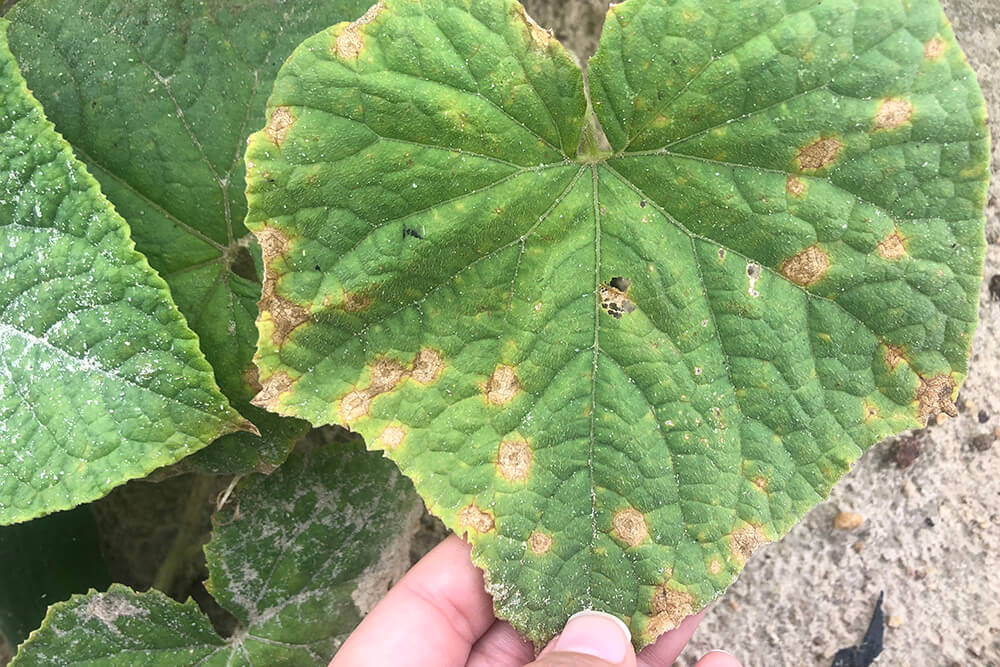
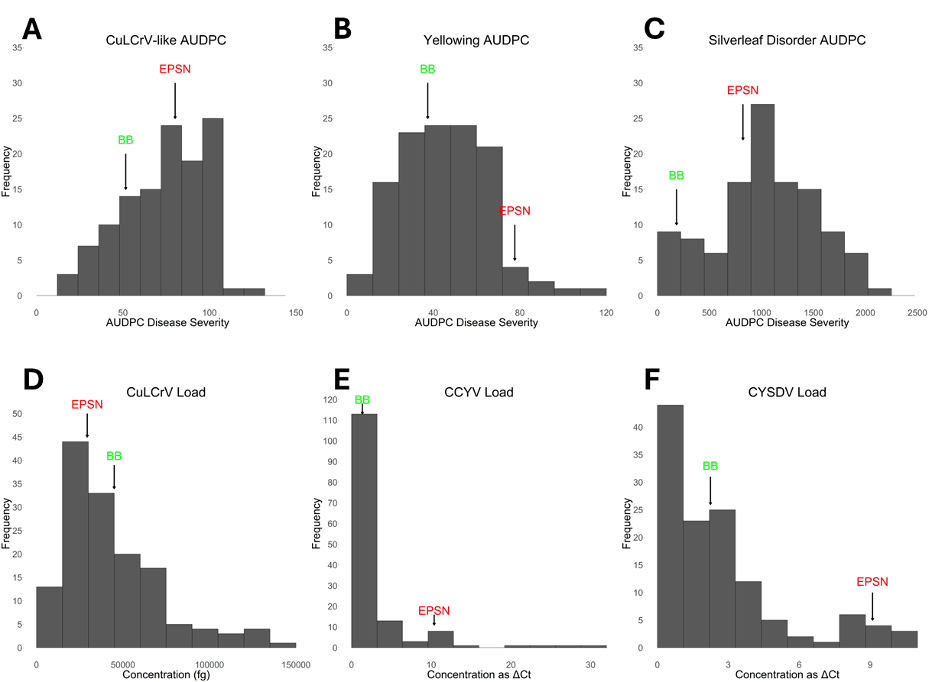
CuLCrV-like symptoms were observed in both ‘Early Prolific Straightneck’ and ‘Black Beauty’, but the latter had lower symptom severity (Figures 1 and 2A). Interestingly, ‘Black Beauty’ had slightly higher CuLCrV loads than ‘Early Prolific Straightneck’ (Figures 1 and 2D), confirming the higher tolerance of zucchini for this virus.
The yellowing of the leaves and stunting were more pronounced in ‘Early Prolific Straightneck’ than ‘Black Beauty’ (Figures 1 and 2B). The increased yellowing can be due to many factors beyond the Criniviruses being evaluated in this trial. However, CCYV and CYSDV were at much higher concentrations in ‘Early Prolific Straightneck’ compared to ‘Black Beauty’ (Figures 2E and 2F), suggesting that the observed yellowing is at least partly associated with virus symptoms.
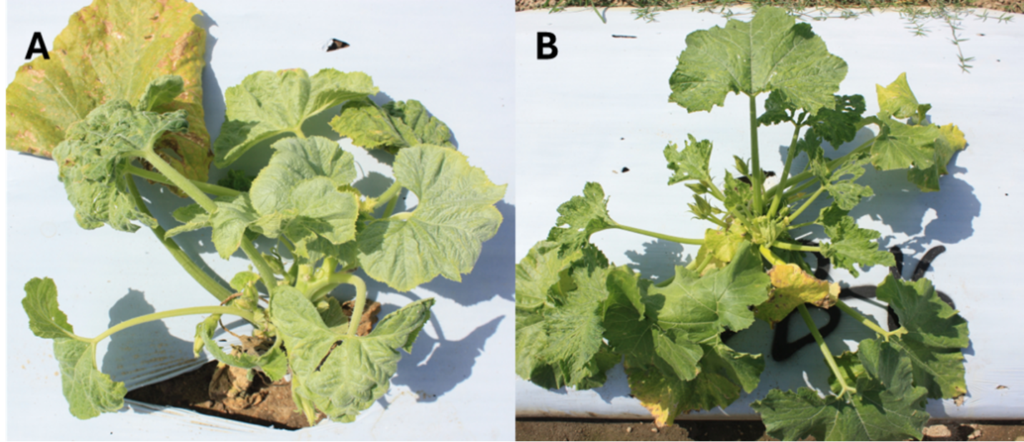
The F2 progeny were segregated for all visual symptoms collected and all viruses quantified (Figure 2). These segregation distributions suggest that some of these traits may have a single major gene controlling the tolerance. Single-gene tolerance would allow for much quicker introgression into yellow squash.
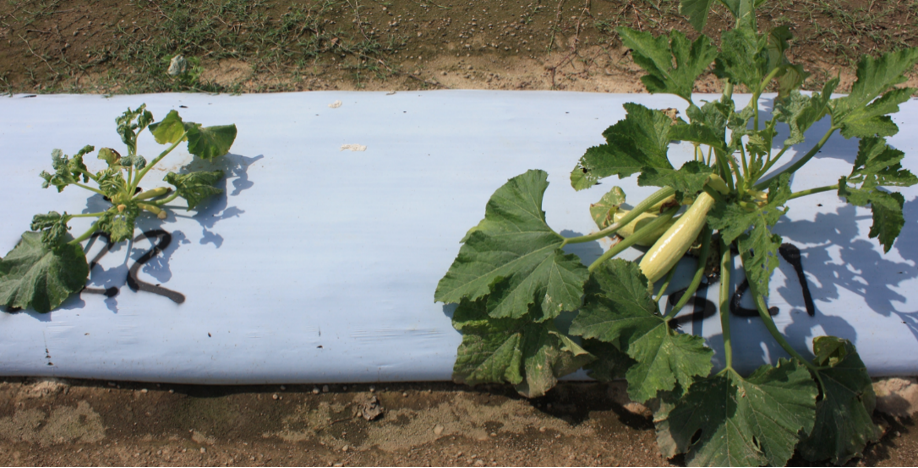
For every disease trait evaluated, progeny were identified as performing similarly or better than ‘Black Beauty’ (Figures 2 and 3). These results are very promising and suggest that breeding efforts to improve virus tolerance in yellow squash in this population are feasible.
Because of high disease pressure in this experiment, many plants did not bear fruit, and we were unable to collect fruit-trait characteristics for the population. The contrast in fruit bearing of susceptible and tolerant plants from this population is shown in Figure 3.
Conclusion
These results confirmed previous reports that zucchini squash displays fewer whitefly-transmitted virus symptoms than yellow squash. Our results show the potential of hybridizing a yellow squash with a zucchini to breed plants that outperform both parents. The next steps in this research will be utilizing this data to identify the genetic basis of the observed tolerance in zucchini in order to improve selection efficiency for accelerated breeding.
References
Brock, J. H., Little, E. L., Brannen, P. M., Jagdale, G., & Dutta, B. (2019). 2017 Georgia plant disease loss estimates (Publication No. AP 102-10). University of Georgia Cooperative Extension. https://fieldreport.caes.uga.edu/publications/AP102-10/2017-georgia-plant-disease-loss-estimates/
Brock, J., Little, E. L., Brannen, P. M., Jagdale, G., & Dutta, B. (2020). 2018 Georgia plant disease loss estimates (Publication No. AP 102-11). University of Georgia Cooperative Extension. https://fieldreport.caes.uga.edu/publications/AP102-11/2018-georgia-plant-disease-loss-estimates/
Candian, J. S., Coolong, T., Dutta, B., Srinivasan, R., Sparks, A. L., Barman, A., & da Silva, A. L. B. (2021). Yellow squash and zucchini cultivar selection for resistance to cucurbit leaf crumple virus in the southeastern United States. HortTechnology, 31(4), 504–513. https://doi.org/10.21273/HORTTECH04877-21
Dutta, B. (2023). UGA vegetable fungicide spray guide. University of Georgia Cooperative Extension. https://site.extension.uga.edu/turnerab/2023/01/uga-vegetable-fungicide-spray-guide-2023/